
The primary purpose of the 600°C annealing treatment is to transform a applied silver coating into a functional, high-performance electrode. This thermal process, specifically designed for silver-coated ceramics, drives the physical and chemical changes necessary to establish a solid ohmic contact and ensure strong adhesion between the ceramic body and the metal layer.
Core Takeaway The 600°C treatment is not merely for drying; it is a critical sintering process that fuses silver particles into a continuous conductive network. By creating a micro-diffusion layer at the interface, it guarantees the uniform charge distribution required for accurate polarization and electrical testing.
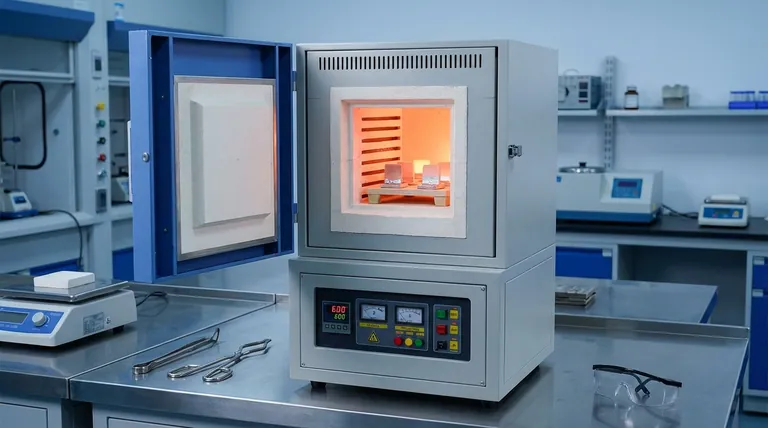
The Mechanics of Electrode Formation
The 600°C treatment—often referred to as silver firing—performs three specific functions that are vital for the electrical integrity of the component.
Sintering for Conductivity
The initial silver coating often consists of distinct particles suspended in a paste. The high-temperature environment causes these silver particles to sinter.
This fusion process converts the loose particles into a continuous conductive thin layer. Without this step, the electrode would lack the continuity required for efficient electron flow.
Creating the Micro-Diffusion Layer
Adhesion is not just about the silver sitting on top of the ceramic. The heat treatment induces a phenomenon known as micro-diffusion.
Silver atoms migrate slightly into the ceramic surface, creating an interlocking interface. This diffusion layer is responsible for the strong physical adhesion that prevents the electrode from peeling or delaminating during use.
Establishing Ohmic Contact
For a piezoelectric ceramic to function correctly, the electrical connection must be seamless. The 600°C firing establishes a solid ohmic contact.
This type of contact ensures a linear relationship between voltage and current, preventing parasitic resistance at the junction that could skew electrical testing or hinder polarization.
Distinguishing Process Goals
It is important to distinguish the specific goal of the 600°C silver firing from other high-temperature annealing processes used in ceramic manufacturing.
Electrode Firing vs. Bulk Stress Relief
While the 600°C treatment focuses on the surface interface, other annealing processes focus on the "bulk" material.
For example, prolonged heat treatments (such as 16 hours) are often used on hot-pressed samples to release residual internal stresses generated during sintering.
Optical vs. Electrical Objectives
Long-duration bulk annealing aims to repair lattice defects (like oxygen vacancies) to enhance optical transmittance and mechanical stability.
In contrast, the 600°C silver treatment is strictly focused on ensuring uniform charge distribution and efficient electrical transmission.
Critical Process Considerations
While the 600°C point is the target, understanding the risks associated with this step is essential for quality control.
The Risk of Incomplete Sintering
If the furnace fails to maintain the 600°C temperature uniformly, the silver particles may not fully sinter.
This results in a discontinuous layer with high resistance, compromising the component's ability to undergo effective polarization.
Thermal Interface Management
The success of the treatment relies on the formation of the micro-diffusion layer.
However, the process must be controlled to prevent excessive diffusion or thermal shock, ensuring the efficient transmission of electrical signals without damaging the underlying ceramic structure.
Making the Right Choice for Your Goal
To maximize the performance of your piezoelectric components, ensure your thermal profile matches your specific manufacturing stage.
- If your primary focus is establishing electrical connectivity: Prioritize the 600°C firing profile to ensure full silver sintering and the formation of a robust ohmic contact.
- If your primary focus is improving optical or bulk mechanical properties: Utilize a prolonged annealing cycle (e.g., 16 hours) to relieve internal stresses and repair lattice defects before electrode application.
The 600°C annealing step is the definitive moment where a passive ceramic material is activated into a connectable electronic component.
Summary Table:
| Process Function | Mechanism | Benefit |
|---|---|---|
| Sintering | Fusion of silver particles | Creates a continuous conductive network |
| Micro-diffusion | Atomic migration into ceramic | Ensures strong physical adhesion and durability |
| Contact Formation | Ohmic contact establishment | Linear voltage-current relationship for testing |
| Charge Distribution | Uniform surface coverage | Enables efficient polarization and signal transmission |
Elevate Your Material Research with KINTEK
Precise temperature control is the difference between a failed coating and a high-performance electrode. KINTEK provides industry-leading Muffle, Tube, and Vacuum furnaces designed to deliver the thermal uniformity required for critical 600°C silver firing and long-duration stress relief.
Why partner with KINTEK?
- Expert R&D & Manufacturing: Our systems are engineered for the rigorous demands of ceramic and metal sintering.
- Fully Customizable: We tailor high-temp furnace solutions to meet your unique lab or production specifications.
- Proven Reliability: Achieve consistent micro-diffusion and ohmic contact results every time.
Ready to optimize your annealing process? Contact KINTEK today for a custom consultation!
References
- Michaela Roudnická, Dalibor Vojtěch. Hydrogen Embrittlement of Ti-Al6-V4 Alloy Manufactured by Laser Powder Bed Fusion Induced by Electrochemical Charging. DOI: 10.3390/met14020251
This article is also based on technical information from Kintek Furnace Knowledge Base .
Related Products
- High Temperature Muffle Oven Furnace for Laboratory Debinding and Pre Sintering
- Laboratory Muffle Oven Furnace with Bottom Lifting
- Chairside Dental Porcelain Zirconia Sintering Furnace with Transformer for Ceramic Restorations
- Dental Porcelain Zirconia Sintering Ceramic Vacuum Press Furnace
- Vacuum Heat Treat Furnace with Ceramic Fiber Liner
People Also Ask
- What thermal phenomena occur during polymer binder burnout in ceramic green bodies? Lab Furnace Guide
- What role does a high-temperature muffle furnace play in STFO synthesis? Achieve Pure Perovskite Results
- Why is controlled heat treatment in a muffle furnace necessary for calcined clay? Achieve Optimal Pozzolanic Activity
- How does a high-temperature muffle furnace facilitate the formation of LaNbxAl1−xO3+δ perovskite structures? Key Roles
- What role does a high-temperature muffle furnace play in the multi-stage synthesis of Li0.5MnFe1.5O4? Key to Pure Spinel



















