
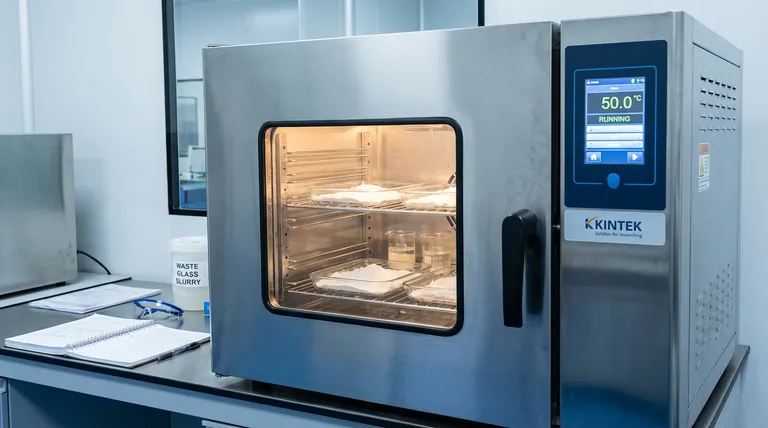
The specific purpose of using an industrial oven in this process is to remove liquid grinding media, such as alcohol, from the wet-milled glass slurry at a controlled temperature of 50 °C. This precise thermal treatment returns the material to a dry powder state without inducing chemical or physical changes.
Low-temperature drying is a preservation technique as much as a separation process; it ensures the complete evaporation of organic solvents while protecting the glass's critical amorphous structure from thermal degradation.
The Mechanics of Solvent Removal
Controlled Evaporation
The wet milling process introduces liquids, such as alcohol, to facilitate grinding. The industrial oven maintains a constant temperature of 50 °C to drive off these solvents.
Restoring the Powder State
By removing the liquid medium, the oven converts the wet slurry back into a free-flowing solid. This restoration is essential for handling the material in subsequent processing steps.
Preserving Material Integrity
Protecting the Amorphous Structure
The most critical aspect of this process is the temperature cap. Keeping the drying heat low ensures that the amorphous structure of the waste glass remains unaltered.
Preventing Thermal Stress
Exposing the glass to higher temperatures could potentially change its physical properties. The 50 °C limit is a deliberate boundary set to evaporate the solvent while leaving the glass microstructure untouched.
Understanding the Operational Constraints
The Risk of High-Temperature Drying
While higher temperatures might dry the material faster, they pose a significant risk to the experiment's validity. If the temperature exceeds the safe threshold, the glass may lose its amorphous character, rendering the data from subsequent tests inaccurate.
Requirement for Complete Dryness
The drying process must be absolute, not partial. Any residual solvent can interfere with the mass and behavior of the powder during later stages.
Enabling Downstream Processing
Preparation for Mechanical Sieving
Wet glass particles agglomerate and cannot be sized accurately. Drying the glass allows for effective mechanical sieving to separate particles by size.
Readiness for Mortar Mixing
For the glass to be used in mortar mixing experiments, it must be chemically inert regarding the solvent. The oven ensures the powder is pure and ready for homogeneous mixing.
Making the Right Choice for Your Goal
To ensure your processed waste glass is suitable for research or application, consider the following priorities:
- If your primary focus is Material Purity: Maintain the temperature strictly at 50 °C to ensure the amorphous structure is perfectly preserved during solvent evaporation.
- If your primary focus is Process Readiness: Ensure the drying cycle is long enough to achieve complete evaporation, as residual moisture will inhibit successful mechanical sieving.
Low-temperature drying is the bridge that transforms raw slurry into a reliable, scientifically valid test material.
Summary Table:
| Parameter | Specification | Purpose |
|---|---|---|
| Drying Temperature | 50 °C (Controlled) | Prevents thermal degradation of amorphous structure |
| Primary Media | Alcohol/Solvent | Removed via controlled evaporation |
| Material Output | Free-flowing powder | Restores state for sieving and mortar mixing |
| Critical Constraint | Low-temp limit | Avoids physical/chemical alterations to glass |
Optimize Your Material Recovery with KINTEK
Ensure the integrity of your research with precision thermal solutions. Backed by expert R&D and manufacturing, KINTEK offers a wide range of specialized equipment including Muffle, Tube, Rotary, Vacuum, and CVD systems. Whether you are performing low-temperature solvent removal or high-temp sintering, our lab furnaces are fully customizable to meet your unique processing needs.
Ready to elevate your lab's efficiency? Contact us today to find your perfect thermal solution!
References
- Ana Mafalda Matos, Joana Sousa Coutinho. Feasibility of Non-Remanufactured Waste Bottle Glass as Supplementary Cementitious Material. DOI: 10.3390/app14052004
This article is also based on technical information from Kintek Furnace Knowledge Base .
Related Products
- High Temperature Muffle Oven Furnace for Laboratory Debinding and Pre Sintering
- 1200℃ Muffle Oven Furnace for Laboratory
- Laboratory Muffle Oven Furnace with Bottom Lifting
- 1800℃ High Temperature Muffle Oven Furnace for Laboratory
- 1700℃ High Temperature Muffle Oven Furnace for Laboratory
People Also Ask
- What thermal phenomena occur during polymer binder burnout in ceramic green bodies? Lab Furnace Guide
- What role does a high-temperature muffle furnace play in STFO synthesis? Achieve Pure Perovskite Results
- Why is controlled heat treatment in a muffle furnace necessary for calcined clay? Achieve Optimal Pozzolanic Activity
- How does a high-temperature muffle furnace facilitate the formation of LaNbxAl1−xO3+δ perovskite structures? Key Roles
- What role does a high-temperature muffle furnace play in the multi-stage synthesis of Li0.5MnFe1.5O4? Key to Pure Spinel





