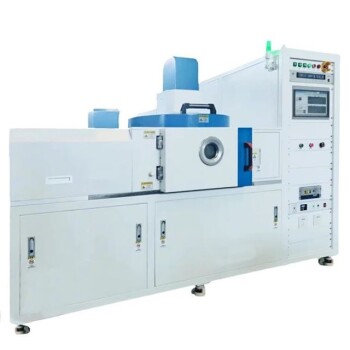
In Plasma Flash Sintering (PFS), a reactive nitrogen atmosphere acts as an active chemical agent rather than a passive medium. During the process, the nitrogen gas is ionized into highly active species that directly interact with the titanium dioxide ($TiO_2$). These ions are adsorbed and integrated into the crystal lattice, effectively converting the surface composition into titanium nitride (TiN) or chemically adsorbed nitrogen.
By utilizing a reactive atmosphere, PFS acts simultaneously as a sintering tool and a surface engineering method. This enables the precise, one-step modification of material properties by embedding ionized gas species directly into the crystal structure.
The Mechanism of Surface Modification
Ionization of the Atmosphere
In standard sintering, an atmosphere might simply protect the material from oxidation. In PFS, the nitrogen atmosphere plays a more dynamic role.
The high-energy environment of the plasma ionizes the nitrogen gas, breaking it down into highly active ionic species. These species are chemically aggressive and ready to interact with the substrate.
Integration into the Lattice
Once ionized, the nitrogen does not merely coat the surface; it penetrates it.
The active nitrogen ions are adsorbed onto the titanium dioxide surface. From there, they are integrated into the crystal lattice structure itself.
Chemical Transformation
This integration results in a fundamental chemical change at the surface level.
The interaction leads to the formation of titanium nitride (TiN) or chemically adsorbed nitrogen. This alters the material's surface composition without necessarily changing the bulk properties of the core material.
The Dual Role of PFS
Sintering Meets Surface Engineering
Typically, sintering (densification) and surface doping (modification) are separate manufacturing steps.
PFS combines these distinct processes into a single operation. While the material is being sintered, the reactive atmosphere allows for simultaneous surface engineering.
Precision Control
The process relies on "controlled chemical environments."
By adjusting the atmosphere, engineers can dictate exactly how the surface composition is modified. This turns the sintering environment into a tool for precise material design.
Understanding the Trade-offs
Dependency on Environmental Control
The primary challenge in using a reactive atmosphere is the requirement for strict control.
Because the process relies on the ionization of specific gases to form compounds like TiN, any fluctuation in the gas composition or pressure can alter the outcome. The "precise modification" promised by PFS is only as good as the stability of the chemical environment provided.
Surface vs. Bulk Properties
It is important to distinguish between surface and bulk effects.
The reactive nitrogen atmosphere targets the surface composition ($TiO_2$ to TiN). While this engineering is beneficial for surface-dependent properties, it implies that the core material properties may remain distinct from the surface, creating a functional gradient that must be accounted for in the application design.
Making the Right Choice for Your Goal
To leverage the full potential of reactive atmospheres in Plasma Flash Sintering, consider your specific manufacturing objectives:
- If your primary focus is Surface Chemistry Modification: Utilize a nitrogen-rich atmosphere to actively convert the surface layer of titanium dioxide into titanium nitride (TiN).
- If your primary focus is Process Efficiency: Leverage the dual nature of PFS to combine densification and chemical doping into a single processing step, eliminating the need for post-sintering surface treatments.
By controlling the reactive atmosphere, you transform the sintering process from a passive heating step into an active tool for material innovation.
Summary Table:
| Feature | Role of Nitrogen in PFS |
|---|---|
| Atmosphere State | Ionized into highly active chemical species |
| Surface Interaction | Adsorption and lattice integration |
| Chemical Outcome | Formation of Titanium Nitride (TiN) |
| Process Benefit | Simultaneous sintering and surface engineering |
| Control Variable | Gas composition and pressure stability |
Revolutionize Your Material Engineering with KINTEK
Unlock the full potential of Plasma Flash Sintering and advanced surface modification. Backed by expert R&D and world-class manufacturing, KINTEK offers high-performance Muffle, Tube, Rotary, Vacuum, and CVD systems. Whether you are converting $TiO_2$ surfaces or developing complex ceramic composites, our lab high-temperature furnaces are fully customizable to meet your unique research and production needs.
Ready to achieve precise material design? Contact us today to discuss how our specialized thermal solutions can streamline your manufacturing process.
References
- Eva Gil‐González, Luis A. Pérez‐Maqueda. Plasma‐flash sintering: Metastable phase stabilization and evidence of ionized species. DOI: 10.1111/jace.20105
This article is also based on technical information from Kintek Furnace Knowledge Base .
Related Products
- Spark Plasma Sintering SPS Furnace
- High Temperature Muffle Oven Furnace for Laboratory Debinding and Pre Sintering
- Vacuum Dental Porcelain Sintering Furnace for Dental Laboratories
- 915MHz MPCVD Diamond Machine Microwave Plasma Chemical Vapor Deposition System Reactor
- Vacuum Heat Treat Sintering and Brazing Furnace
People Also Ask
- How does the heating mechanism of Spark Plasma Sintering (SPS) function? Enhance TiC/SiC Composite Fabrication
- Why is it necessary to maintain a high vacuum environment during the SPS of SiC? Key to High-Density Ceramics
- What are the technical advantages of using an SPS sintering furnace? Elevate Al2O3-TiC Material Performance
- What are the steps in the discharge plasma sintering process? Master Fast, High-Density Material Consolidation
- What are the advantages of spark plasma sintering (SPS) over traditional forging? Precision Microstructural Control