
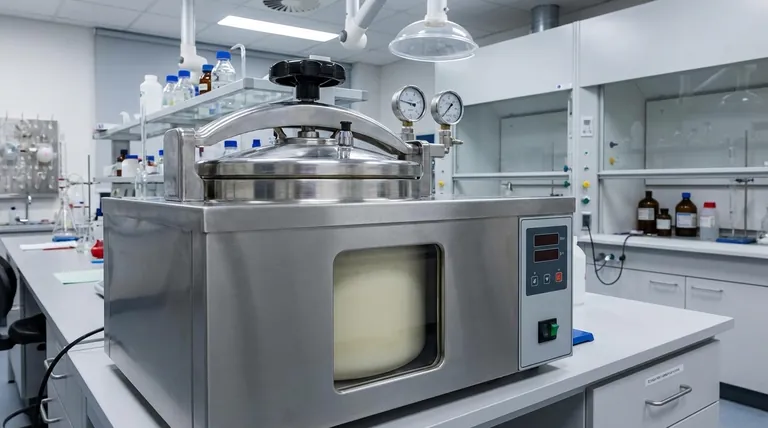
A Teflon-lined autoclave functions as a specialized, sealed reaction vessel designed to withstand the rigors of hydrothermal acid treatment during catalyst preparation. By maintaining high temperatures and pressures within a corrosion-resistant chamber, it drives the chemical modification of precursor materials to enhance their reactivity.
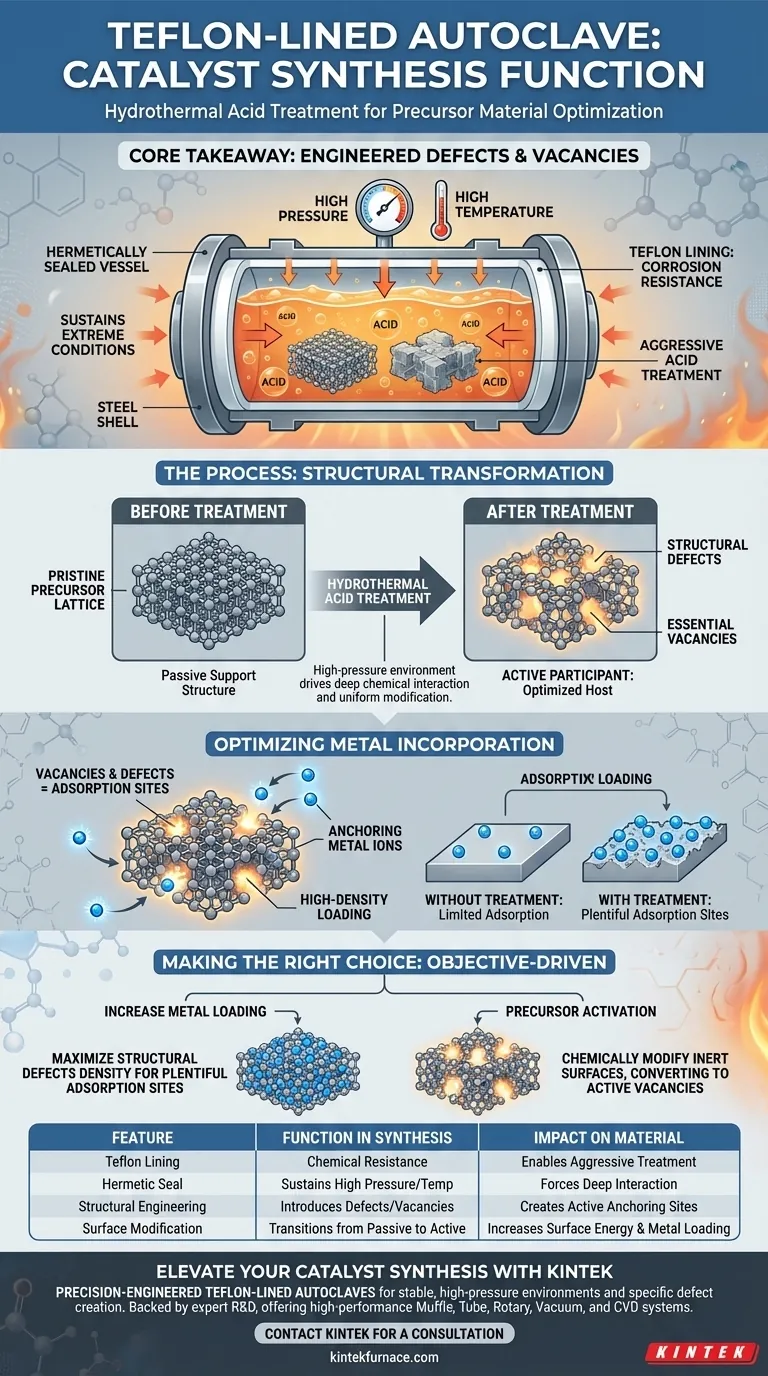
Core Takeaway The primary role of the autoclave is to create a high-pressure environment that facilitates aggressive acid treatment. This process engineers specific structural defects and vacancies into the precursor, transforming it into an optimized host for capturing metal ions.
The Mechanics of Hydrothermal Treatment
Sustaining Extreme Conditions
The autoclave provides a hermetically sealed environment. This isolation allows the internal system to reach and sustain temperatures and pressures far exceeding those possible in open vessels.
Facilitating Acid Interaction
The Teflon lining is critical for this specific application. It allows for the use of corrosive acidic solutions without damaging the steel reactor shell.
Under these intensified conditions, the acid treatment can penetrate the precursor material more effectively. This ensures a uniform and deep chemical interaction throughout the substance.
Engineering the Precursor Structure
Introducing Structural Defects
The high-pressure acid treatment is not merely for cleaning; it is a structural engineering tool. The process intentionally introduces structural defects into the precursor's crystal lattice.
Creating Essential Vacancies
Alongside general defects, the treatment generates specific vacancies. These are intentional voids or missing atoms within the material's framework.
These vacancies fundamentally alter the surface chemistry of the precursor. They transition the material from a passive support structure into an active participant in synthesis.
Optimizing for Metal Incorporation
Forming Adsorption Sites
The defects and vacancies created by the autoclave treatment serve a vital function. They act as ideal physical and chemical adsorption sites.
Anchoring Metal Ions
For a catalyst to be effective, metal ions must adhere securely to the precursor. The engineered defects provide the necessary anchoring points for this subsequent metal ion incorporation.
Without this hydrothermal treatment, the precursor surface would likely lack the specific "docking" sites required for high-density metal loading.
Understanding the Trade-offs
Balancing Structural Integrity
While creating defects is necessary for adsorption, it requires precise control. The goal is to induce enough imperfections to host metal ions without compromising the overall mechanical stability of the precursor.
Process Intensity
The use of high temperature and pressure increases the energy demand and complexity of synthesis. It is a more resource-intensive method compared to ambient treatments, justified only by the superior quality of the resulting adsorption sites.
Making the Right Choice for Your Goal
To maximize the effectiveness of your catalyst synthesis, consider your specific objectives when employing this equipment:
- If your primary focus is Increasing Metal Loading: Utilize the autoclave to maximize the density of structural defects, ensuring plentiful adsorption sites for the metal ions.
- If your primary focus is Precursor Activation: Use the high-pressure acid treatment to chemically modify inert surfaces, converting them into active vacancies ready for functionalization.
The Teflon-lined autoclave is the essential tool for transforming raw precursors into highly receptive, defect-rich scaffolds for advanced catalyst production.
Summary Table:
| Feature | Function in Catalyst Synthesis | Impact on Material |
|---|---|---|
| Teflon Lining | Provides chemical resistance to corrosive acids | Enables aggressive treatment without contamination |
| Hermetic Seal | Sustains high pressure and temperature | Forces deep chemical interaction into the lattice |
| Structural Engineering | Introduces intentional defects and vacancies | Creates active anchoring sites for metal ions |
| Surface Modification | Transitions material from passive to active | Increases surface energy and metal loading density |
Elevate Your Catalyst Synthesis with KINTEK
Precision matters in hydrothermal treatment. KINTEK’s Teflon-lined autoclaves are engineered to provide the stable, high-pressure environments required to create the specific structural defects your catalyst precursors need.
Backed by expert R&D and manufacturing, we offer high-performance Muffle, Tube, Rotary, Vacuum, and CVD systems, along with customizable lab high-temp furnaces tailored to your unique research requirements. Whether you are aiming to maximize metal loading or activate inert precursors, our equipment ensures uniform and repeatable results.
Ready to optimize your lab's high-temperature processes?
Contact KINTEK today for a consultation and let our experts help you choose the perfect system for your materials research.
Visual Guide
References
- Yihan Zhang, Hyesung Park. Lanthanum‐Induced Gradient Fields in Asymmetric Heterointerface Catalysts for Enhanced Oxygen Electrocatalysis. DOI: 10.1002/adma.202511117
This article is also based on technical information from Kintek Furnace Knowledge Base .
Related Products
People Also Ask
- What is the purpose of dental sintering furnaces? Transform Zirconia into Durable, High-Quality Dental Restorations
- How does a dental vacuum porcelain furnace maintain restoration quality? Precision Sintering for Superior Esthetics
- What economic benefits does using a dental sintering furnace offer? Boost Profits with Faster, Automated Dental Lab Workflows
- What is a dental sintering furnace and what is its purpose? Achieve High-Strength Dental Restorations
- What are the cooling requirements for ceramics in the Fast Slow Dental Sintering Furnace? Ensure Crack-Free Restorations
