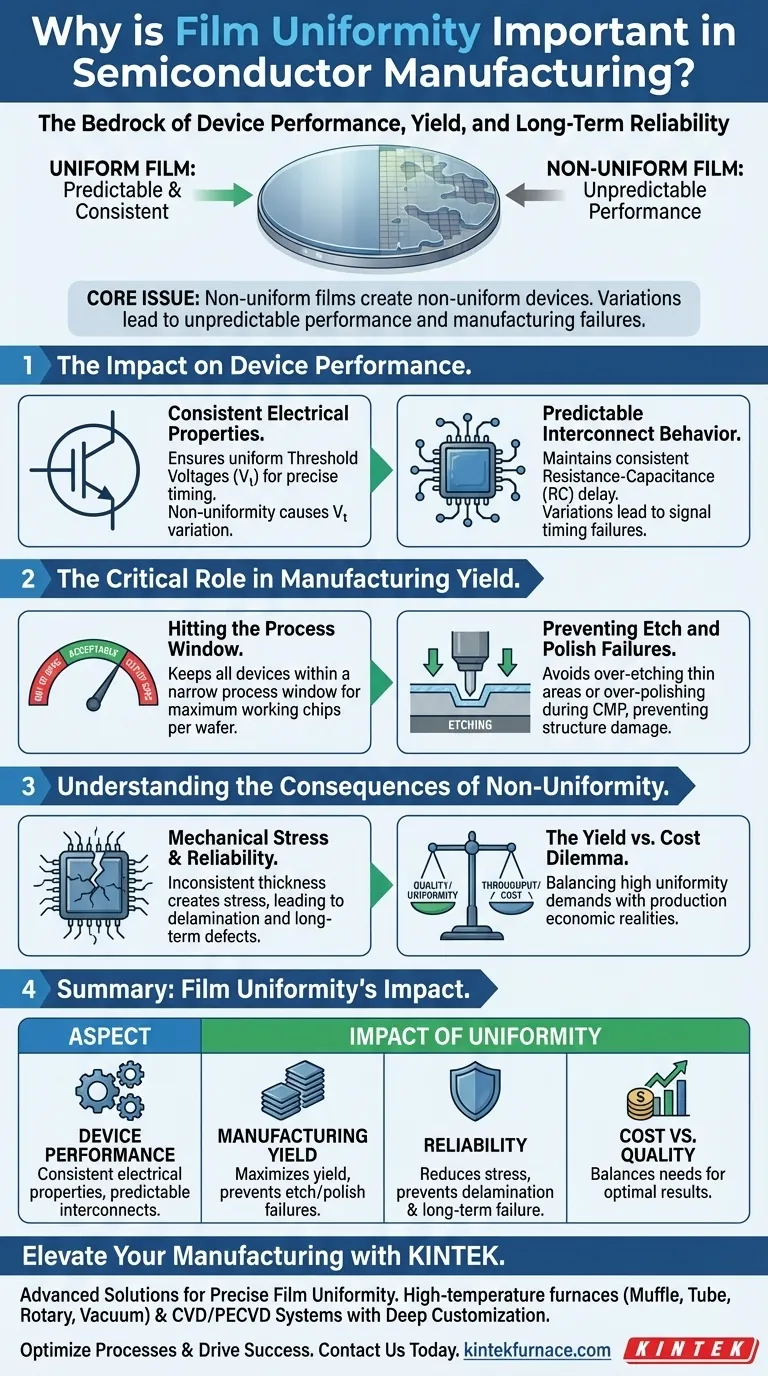
In semiconductor manufacturing, film uniformity is the bedrock of device performance, manufacturing yield, and long-term reliability. It is the critical factor that ensures every one of the billions of transistors on a silicon wafer behaves predictably and consistently. Without it, mass-producing functional integrated circuits would be impossible.
The core issue is simple: non-uniform films create non-uniform devices. When film thickness varies across a wafer, the electrical and physical properties of the transistors and interconnects also vary, leading to unpredictable performance and widespread manufacturing failures.
The Impact on Device Performance
At the nanometer scales of modern chips, even slight variations in film thickness have a dramatic effect on how the final device functions.
Consistent Electrical Properties
The thickness of a deposited film directly governs fundamental electrical characteristics. For example, the gate oxide layer in a transistor controls its switching behavior.
A non-uniform gate oxide means transistors in different locations will have different threshold voltages (Vt), causing them to turn on at different times. This variability destroys the precise timing required for a complex circuit to operate.
Predictable Interconnect Behavior
Similarly, the thickness of metal and dielectric layers determines the Resistance-Capacitance (RC) delay of the wires connecting transistors.
Variations in these films lead to inconsistent signal travel times across the chip. Some paths become too slow, causing timing failures that render the entire chip useless.
The Critical Role in Manufacturing Yield
Uniformity is not just about performance; it is a prerequisite for successfully manufacturing a device in the first place. Every step in the fabrication process is calibrated with the assumption of a uniform starting surface.
Hitting the Process Window
Semiconductor fabrication operates within an extremely narrow process window, which defines the acceptable range of parameters for a given step.
Excellent film uniformity ensures that all devices across the entire wafer fall within this critical window. Non-uniformity pushes devices "out of spec," directly causing a reduction in yield—the percentage of working chips per wafer.
Preventing Etch and Polish Failures
Subsequent manufacturing steps, like etching and Chemical-Mechanical Planarization (CMP), are highly dependent on film thickness.
If a film is not uniform, an etch process might completely remove the film in thinner areas before it has finished patterning the thicker areas. Likewise, CMP can over-polish thin regions, damaging underlying structures.
Understanding the Consequences of Non-Uniformity
Striving for uniformity is a constant battle against physical and chemical limitations. Failing to manage it has severe consequences.
Mechanical Stress and Reliability
When a film's thickness is inconsistent, it creates gradients in mechanical stress across the wafer.
These stress points can cause a number of long-term reliability failures, including film delamination (peeling), cracking, and other physical defects that emerge over the lifetime of the device.
The Yield vs. Cost Dilemma
Achieving near-perfect uniformity is technologically demanding and expensive. Deposition tools capable of higher uniformity often have lower throughput or higher costs.
Engineers must constantly balance the need for tighter uniformity against the economic realities of production. This trade-off between perfect quality and manufacturing cost is a central challenge in the industry.
Evaluating Uniformity for Your Goal
How you approach film uniformity depends on your specific role and objective.
- If your primary focus is device design: You must incorporate expected film variations into your simulation models to ensure your chip is robust enough to function despite minor process imperfections.
- If your primary focus is process integration: Your goal is to select and optimize deposition and etch processes to minimize within-wafer variation and maximize the process window for all manufacturing steps.
- If your primary focus is reliability engineering: You must analyze how film non-uniformity creates stress points and use this data to predict and mitigate long-term failure modes.
Ultimately, controlling film uniformity is synonymous with controlling the performance, yield, and reliability of the final product.
Summary Table:
| Aspect | Impact of Film Uniformity |
|---|---|
| Device Performance | Ensures consistent electrical properties and predictable interconnect behavior |
| Manufacturing Yield | Keeps devices within process windows and prevents etch/polish failures |
| Reliability | Reduces mechanical stress, preventing delamination and long-term failures |
| Cost vs. Quality | Balances uniformity needs with production economics for optimal results |
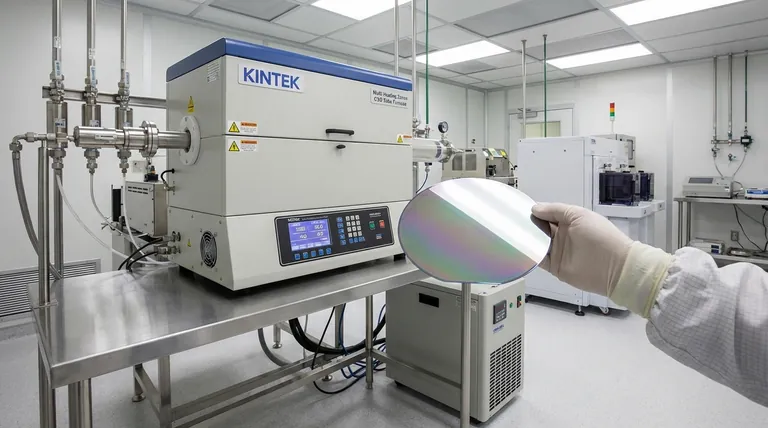
Elevate your semiconductor manufacturing with KINTEK's advanced solutions! Leveraging exceptional R&D and in-house manufacturing, we provide diverse laboratories with high-temperature furnace systems like Muffle, Tube, Rotary, Vacuum & Atmosphere Furnaces, and CVD/PECVD Systems. Our strong deep customization capability ensures precise film uniformity to meet your unique experimental requirements, boosting device performance, yield, and reliability. Contact us today to discuss how we can optimize your processes and drive success!
Visual Guide
Related Products
- High Performance Vacuum Bellows for Efficient Connection and Stable Vacuum in Systems
- Multi Heating Zones CVD Tube Furnace Machine for Chemical Vapor Deposition Equipment
- Ultra High Vacuum CF Observation Window Flange with High Borosilicate Glass Sight Glass
- Stainless Steel Quick Release Vacuum Chain Three Section Clamp
- Inclined Rotary Plasma Enhanced Chemical Deposition PECVD Tube Furnace Machine
People Also Ask
- Why is an Ultra-High Vacuum (UHV) System Required for In2Se3? Achieving Atomic-Level Ferroelectric Clarity
- Why is an environmental laboratory chamber equipped with an optical window required for synthesizing Hafnium Carbide?
- What role does a closed pressure vessel play during the carbonation of gamma-C2S? Unlock Rapid Mineralization
- Why are desiccators containing saturated salt solutions used when evaluating the hygroscopicity of modified wood?
- How does the pressure environment affect the metallic thermal reduction for titanium? Master Precision Control