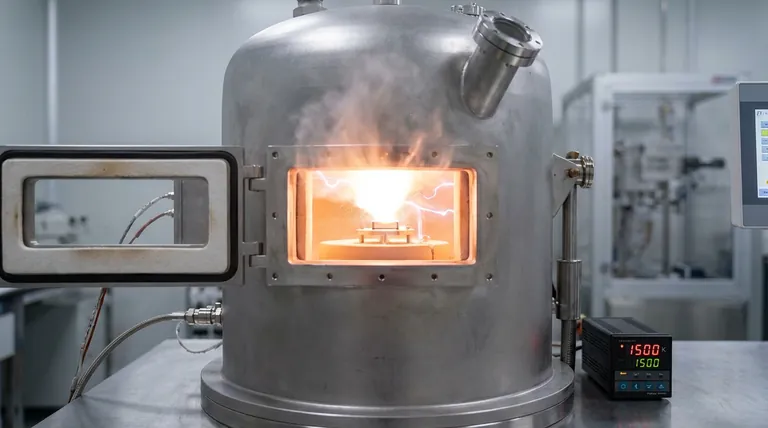
An ultrafast Joule heating device functions as a high-intensity thermal trigger, fundamentally altering the synthesis process of nanocatalysts. It operates by delivering a substantial current of approximately 20 A directly to a radiation source, elevating the ambient temperature to roughly 1500 K in less than one second. This specific mechanism allows for the instantaneous decomposition and conversion of precursor materials into structural nanoparticles.
Core Takeaway The device’s primary value is its ability to decouple temperature magnitude from heating duration. By achieving extreme temperatures (1500 K) almost instantly, it bypasses the slow thermal ramp-up that typically causes particles to clump, ensuring the creation of distinct, ultrafine heterostructures.
The Mechanics of Rapid Synthesis
The Energy Input
The process is driven by a high-amperage electrical input. The device delivers approximately 20 A of current to the core heating element.
This is not a gradual warming process; it is an immediate surge of energy designed to shock the system into reaction.
The Thermal Spike
The defining characteristic of this method is the heating rate. The system raises the ambient temperature to about 1500 K within a single second.
This timeframe is critical because it forces the reaction to occur faster than the physical movement of the particles can occur, locking them in place.
Solving Material Science Challenges
Preventing Grain Growth
In conventional synthesis, slow heating allows particles to migrate and merge, leading to large, ineffective "grains."
The ultrafast Joule heating device prevents this by minimizing the reaction duration. The short timeframe denies the particles the time needed to agglomerate, resulting in ultrafine structures.
Achieving In-Situ Conversion
The rapid thermal shock prompts the immediate decomposition of precursors.
This process facilitates the in-situ conversion of materials into specific configurations, such as WOx/W2C heterostructure nanoparticles.
Ensuring Uniform Dispersion
Because the heating is applied so quickly and intensely, the resulting nanoparticles do not have the opportunity to clump together unevenly.
The result is a uniformly dispersed set of particles, which is essential for consistent catalytic performance.
Critical Operational Dynamics
The Requirement for High Current
This method is not passive; it requires a robust power source capable of delivering 20 A consistently.
Standard low-current heating equipment cannot achieve the necessary temperature ramp rate (1500 K/s) required to freeze the nanostructures in their ultrafine state.
Material Specificity
The process described is highly specific to the creation of heterostructures like WOx/W2C.
The device is optimized to drive the specific decomposition pathways of these precursors, relying on the high-temperature shock to stabilize the heterostructure interface immediately.
Making the Right Choice for Your Goal
To determine if this synthesis method aligns with your project requirements, consider your specific material targets.
- If your primary focus is preventing agglomeration: The ultrafast heating rate is the most effective variable for stopping grain growth before it starts.
- If your primary focus is WOx/W2C synthesis: This device provides the exact energy profile needed to convert precursors into this specific heterostructure.
- If your primary focus is particle uniformity: The rapid reaction duration ensures a consistent, uniformly dispersed output that slow-heating methods often fail to achieve.
By compressing the reaction time into a single second, this technology turns temperature into a tool for structural precision rather than just a catalyst for chemical change.
Summary Table:
| Feature | Ultrafast Joule Heating Specification | Impact on Nanocatalyst Synthesis |
|---|---|---|
| Current Input | ~20 A (High Intensity) | Provides the immediate energy surge required for reaction shock. |
| Heating Rate | ~1500 K in < 1 second | Bypasses slow thermal ramp-up to prevent particle clumping/grain growth. |
| Reaction Duration | Milliseconds to 1 second | Freezes nanostructures in place, ensuring ultrafine, distinct particles. |
| Conversion Type | In-situ Decomposition | Facilitates immediate conversion of precursors into heterostructures (e.g., WOx/W2C). |
| Particle Quality | Uniform Dispersion | Delivers consistent catalytic performance by avoiding uneven agglomeration. |
Elevate Your Nanomaterial Synthesis with KINTEK Precision
Are you struggling with grain growth and particle agglomeration in your high-temperature reactions? At KINTEK, we understand that precision timing and temperature control are critical for the next generation of heterostructure nanocatalysts.
Backed by expert R&D and world-class manufacturing, KINTEK offers a comprehensive range of lab high-temp solutions, including Muffle, Tube, Rotary, Vacuum, and CVD systems. Whether you need standard equipment or a fully customizable furnace tailored to your unique research parameters, our systems are engineered to deliver the thermal accuracy your innovations demand.
Ready to optimize your catalytic performance? Contact our technical experts today to find the perfect high-temperature solution for your laboratory needs.
References
- Bi-Ying Wang, Dawei Wang. Heterostructured WO<sub>x</sub>/W<sub>2</sub>C Nanocatalyst for Li<sub>2</sub>S Oxidation in Lithium–Sulfur Batteries with High‐Areal‐Capacity. DOI: 10.1002/smll.202310801
This article is also based on technical information from Kintek Furnace Knowledge Base .
Related Products
- Multi Heating Zones CVD Tube Furnace Machine for Chemical Vapor Deposition Equipment
- Laboratory Quartz Tube Furnace RTP Heating Tubular Furnace
- Silicon Carbide SiC Thermal Heating Elements for Electric Furnace
- Molybdenum Disilicide MoSi2 Thermal Heating Elements for Electric Furnace
People Also Ask
- What is the function of a multi-zone tube furnace in CVD synthesis? Master 2D In2Se3 Nanosheet Precision
- What role do multi zone tube furnaces play in new energy research? Unlock Precise Thermal Control for Innovation
- What environmental protection applications utilize multi zone tube furnaces? Unlock Precision in Waste Treatment and Green Tech
- Why are multi zone tube furnaces particularly useful for nanomaterial research? Unlock Precise Thermal Control for Advanced Synthesis
- What temperature-related capabilities make multi zone tube furnaces valuable for research? Unlock Precision Thermal Control