
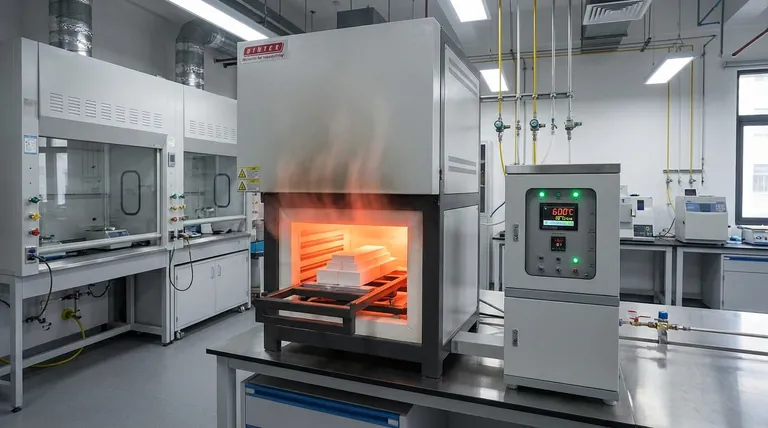
During the final stage of SiOC ceramicization, a muffle furnace provides a precisely controlled thermal environment between 427 °C and 760 °C within an open-air oxidative atmosphere. This specific combination of high temperature and oxygen availability drives the critical thermal cracking and oxidation reactions required to transform polysiloxane precursors into a SiOC glassy ceramic.
Core Takeaway The muffle furnace does not merely heat the sample; it acts as an active reaction vessel that synchronizes thermal cracking with oxidation. Its ability to maintain a stable heating rate (e.g., 10 °C/min) is the deciding factor in alleviating thermal stress during the volatile organic-to-inorganic conversion.
The Critical Thermal Conditions
To successfully convert a precursor into a functional ceramic, the furnace must provide specific thermal dynamics that go beyond simple heating.
Precise Temperature Regulation
The furnace maintains a target temperature range of 427 °C to 760 °C. This specific window is energetic enough to induce chemical changes but controlled enough to prevent rapid degradation.
Controlled Heating Rates
The muffle furnace provides a stable ramp rate, typically around 10 °C/min. This linear increase is vital for process consistency.
Alleviating Thermal Stress
As the material converts from an organic polymer to an inorganic ceramic, it undergoes significant volume changes. The controlled heating rate provided by the furnace prevents the accumulation of thermal stress, which would otherwise lead to cracking or delamination.
The Reactive Atmosphere
Unlike vacuum or inert gas furnaces, the muffle furnace in this context utilizes an "open-air" environment to facilitate chemical interaction.
Open-Air Oxidation
The furnace provides an oxygen-rich environment. This allows for controlled oxidation reactions to occur simultaneously with thermal cracking.
Driving Phase Transformation
This oxidative atmosphere facilitates the transformation of the polysiloxane precursor. It drives the specific chemical pathways necessary to form the final SiOC glassy ceramic structure.
Enabling Elemental Diffusion
The thermal environment promotes the diffusion of elements from the substrate into the coating. This interaction is essential for ensuring strong adhesion and chemical continuity between the base material and the ceramic layer.
Understanding the Trade-offs
While the muffle furnace is effective, relying on an open-air environment introduces specific variables that must be managed.
Oxidation vs. Carbon Retention
The open-air environment promotes oxidation, which is necessary for creating the glassy ceramic phase. However, excessive oxidation can potentially reduce the free carbon content within the SiOC matrix, which may alter the material's final electrical or mechanical properties compared to pyrolysis in an inert atmosphere.
Uniformity Challenges
Because the furnace relies on atmospheric air, the uniformity of the oxidation depends on ensuring consistent airflow and temperature distribution. Any gradients in the "uniform temperature field" mentioned in broader applications can lead to variations in the ceramic layer's thickness or composition.
Making the Right Choice for Your Goal
When setting up your ceramicization process, prioritize your furnace parameters based on your specific material requirements.
- If your primary focus is Structural Integrity: Prioritize a strict 10 °C/min heating rate to minimize stress accumulation during the volume shrinkage phase.
- If your primary focus is Chemical Composition: Focus on the precise 427 °C – 760 °C temperature window to balance the thermal cracking of the polymer with the oxidation rates in the open air.
Success in SiOC ceramicization relies less on maximum temperature and more on the stability of the heating ramp within the oxidative environment.
Summary Table:
| Parameter | Critical Condition | Impact on SiOC Ceramicization |
|---|---|---|
| Temperature Range | 427 °C to 760 °C | Energetic window for thermal cracking & oxidation |
| Heating Rate | ~10 °C/min (Linear) | Alleviates thermal stress and prevents cracking |
| Atmosphere | Open-Air Oxidative | Facilitates chemical transformation of polysiloxane |
| Phase Control | Phase Transformation | Ensures development of SiOC glassy ceramic structure |
| Adhesion | Elemental Diffusion | Promotes bonding between substrate and coating |
Elevate Your Material Research with KINTEK Advanced Furnaces
Precise control over thermal cracking and oxidation is the difference between a failed precursor and a high-performance SiOC glassy ceramic. At KINTEK, we specialize in providing the high-precision equipment needed for complex material transformations.
Why choose KINTEK?
- Expert R&D & Manufacturing: Our systems are built to provide the uniform temperature fields and stable ramp rates required to minimize thermal stress.
- Customizable Solutions: Whether you need Muffle, Tube, Rotary, Vacuum, or CVD systems, we tailor our technology to your specific oxidative or inert requirements.
- Unmatched Value: Our high-temp lab furnaces are designed for reliability, ensuring your SiOC ceramicization is consistent every time.
Ready to optimize your ceramic synthesis? Contact us today to discuss your project requirements!
References
- Ravi Arukula, Xiaoning Qi. Corrosion resistant coating fabrication through synergies between SiOC conversion and iron oxidation at high temperatures. DOI: 10.1038/s41529-025-00584-9
This article is also based on technical information from Kintek Furnace Knowledge Base .
Related Products
- 1400℃ Muffle Oven Furnace for Laboratory
- 1200℃ Muffle Oven Furnace for Laboratory
- High Temperature Muffle Oven Furnace for Laboratory Debinding and Pre Sintering
- Laboratory Muffle Oven Furnace with Bottom Lifting
- 1700℃ High Temperature Muffle Oven Furnace for Laboratory
People Also Ask
- What is the primary function of a high-temperature laboratory muffle furnace in chemical synthesis? Achieve Precision.
- How does a high-temperature laboratory muffle furnace affect material properties? Transform Anodic Oxide Films Fast
- How does a laboratory high-temperature muffle furnace contribute to the final formation of Bismuth Oxide nanosheets?
- What is the function of a muffle furnace in MOF-derived zirconia conversion? Optimize Phase & Pore Engineering
- What role does a laboratory high-temperature muffle furnace play in the treatment of highly contaminated waste glass?












