
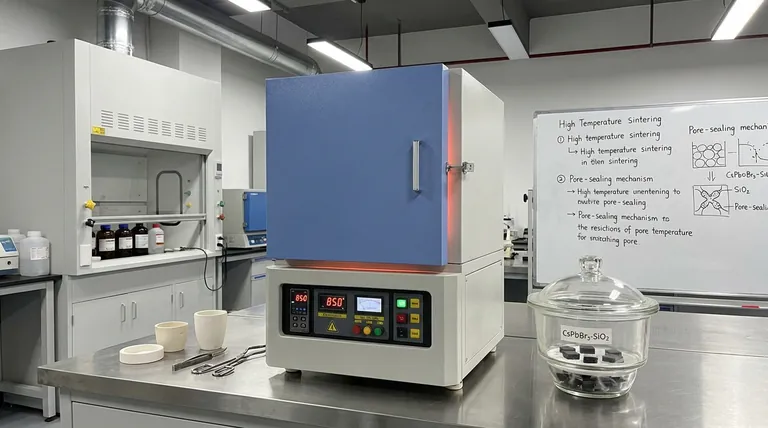
High-temperature sintering acts as a critical sealing mechanism that physically alters the protective silica shell. By subjecting the material to temperatures between 600 °C and 900 °C in a muffle or tube furnace, the process induces the controlled collapse of mesoporous channels, effectively locking the perovskite nanocrystals inside a dense, impenetrable matrix.
The core value of this thermal treatment is the transformation of the host material from a porous structure into a solid shield. This "pore-sealing" technique is the defining factor that grants the composite exceptional resistance to harsh chemical agents, such as strong acids.
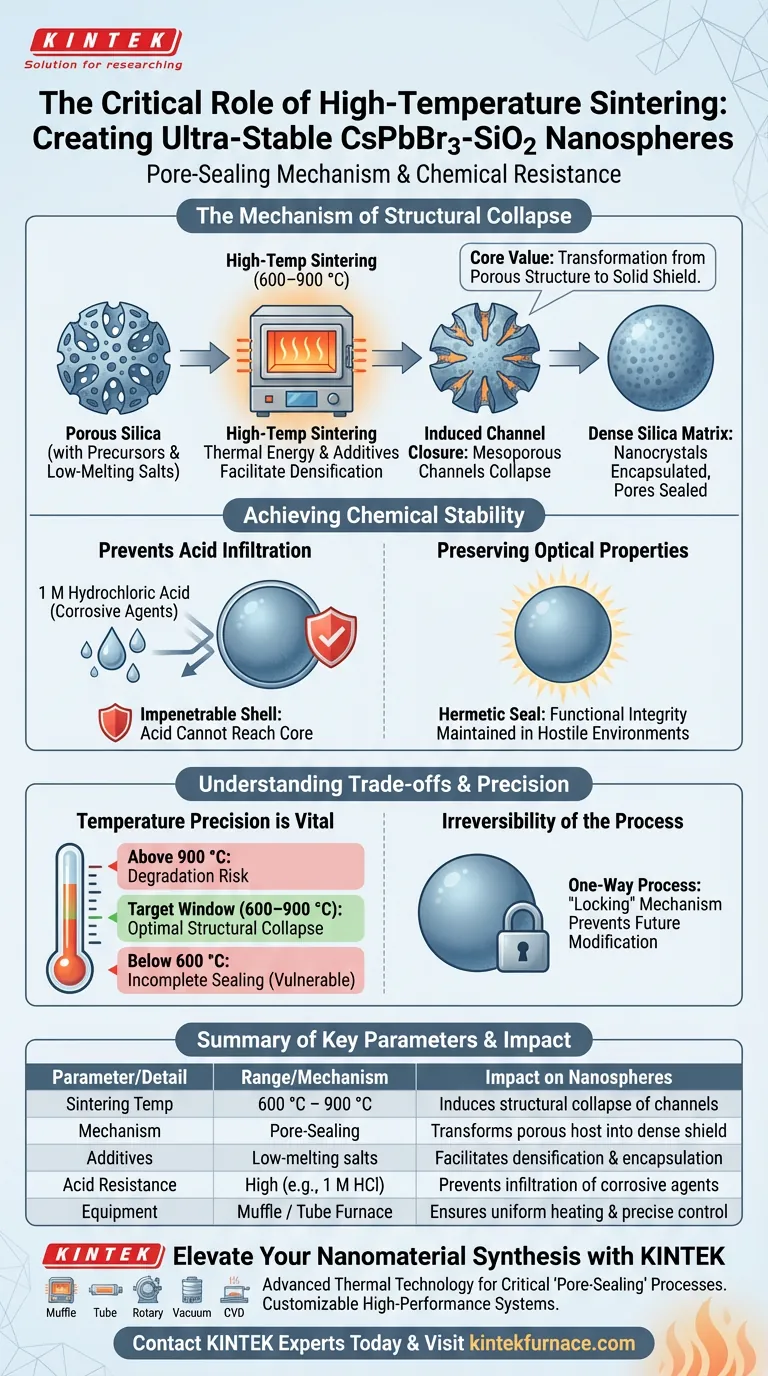
The Mechanism of Structural Collapse
Induced Channel Closure
The primary function of the furnace is to provide the thermal energy required to alter the physical structure of the silica.
When the temperature rises to the 600–900 °C range, the mesoporous channels in the silica begin to collapse. This is a deliberate structural failure that eliminates the pathways connecting the internal nanocrystals to the outside environment.
The Role of Low-Melting-Point Salts
This process is not achieved by heat alone; it relies on specific chemical additives.
The silica is impregnated with perovskite precursors and low-melting-point salts, such as potassium carbonate. These salts facilitate the densification process, ensuring the silica closes tightly around the nanocrystals without destroying them.
Creation of a Dense Matrix
The result of this sintering is a fundamental change in material density.
The originally porous framework transforms into a dense silica matrix. This completely encapsulates the CsPbBr3 nanocrystals, isolating them from external variables.
Achieving Chemical Stability
Preventing Acid Infiltration
The most significant benefit of this sealed architecture is resistance to corrosion.
Because the pores are physically closed, corrosive agents like 1 M hydrochloric acid cannot penetrate the shell. The acid is unable to reach the vulnerable perovskite core, rendering the composite ultra-stable.
Preserving Optical Properties
By creating a hermetic seal, the sintering process preserves the integrity of the nanocrystals.
The dense silica acts as a permanent barrier. This ensures that the functional properties of the perovskite are maintained even when the material is deployed in hostile environments.
Understanding the Trade-offs
Temperature Precision is Vital
While high heat is necessary, the range must be strictly controlled.
Sintering below 600 °C may fail to fully collapse the pores, leaving the nanocrystals vulnerable to chemical attack. Conversely, excessive heat beyond the target window could potentially degrade the perovskite components despite the silica protection.
Irreversibility of the Process
Once the mesoporous channels are collapsed, the process is irreversible.
This "locking" mechanism is excellent for stability but prevents any further modification of the internal nanocrystals. You must ensure the precursors are correctly impregnated before the sintering step begins.
Making the Right Choice for Your Project
To ensure you achieve the desired stability for your CsPbBr3-SiO2 nanospheres, consider the following technical focus points:
- If your primary focus is maximum chemical resistance: Ensure your sintering temperature reaches the upper effective range (near 900 °C) to guarantee the complete elimination of all mesoporous channels.
- If your primary focus is process consistency: Utilize a tube furnace or muffle furnace with precise temperature control to maintain the environment strictly between 600 °C and 900 °C, preventing thermal shock or incomplete sealing.
The ultimate success of this preparation method relies on using heat not just to dry the material, but to physically densify the silica into a permanent protective shield.
Summary Table:
| Parameter | Range/Detail | Impact on Nanospheres |
|---|---|---|
| Sintering Temp | 600 °C – 900 °C | Induces structural collapse of mesoporous channels |
| Mechanism | Pore-Sealing | Transforms porous host into a dense, impenetrable shield |
| Additives | Low-melting salts | Facilitates densification and protective encapsulation |
| Acid Resistance | High (e.g., 1 M HCl) | Prevents infiltration of corrosive chemical agents |
| Equipment | Muffle / Tube Furnace | Ensures uniform heating and precise thermal energy control |
Elevate Your Nanomaterial Synthesis with KINTEK
Precision is the difference between a porous failure and a stable masterpiece. KINTEK provides the advanced thermal technology needed for critical "pore-sealing" processes. Backed by expert R&D and manufacturing, we offer high-performance Muffle, Tube, Rotary, Vacuum, and CVD systems, all customizable to meet the rigorous demands of your lab.
Whether you are developing ultra-stable perovskites or next-generation composites, our furnaces deliver the uniform temperature control required for perfect structural densification. Ready to optimize your research?
Visual Guide
References
- Qingfeng Li, Zhenling Wang. Improving the stability of perovskite nanocrystals <i>via</i> SiO<sub>2</sub> coating and their applications. DOI: 10.1039/d3ra07231b
This article is also based on technical information from Kintek Furnace Knowledge Base .
Related Products
- High Temperature Muffle Oven Furnace for Laboratory Debinding and Pre Sintering
- 1700℃ High Temperature Muffle Oven Furnace for Laboratory
- 1800℃ High Temperature Muffle Oven Furnace for Laboratory
- 1200℃ Muffle Oven Furnace for Laboratory
- 1400℃ Muffle Oven Furnace for Laboratory
People Also Ask
- What thermal phenomena occur during polymer binder burnout in ceramic green bodies? Lab Furnace Guide
- Why is controlled heat treatment in a muffle furnace necessary for calcined clay? Achieve Optimal Pozzolanic Activity
- What role does a high-temperature muffle furnace play in STFO synthesis? Achieve Pure Perovskite Results
- How does a high-temperature muffle furnace facilitate the formation of LaNbxAl1−xO3+δ perovskite structures? Key Roles
- What role does a high-temperature muffle furnace play in the multi-stage synthesis of Li0.5MnFe1.5O4? Key to Pure Spinel



















