
A high-performance muffle furnace is required to calcinate dried precursors, typically around 400°C, to facilitate essential phase transformations during material synthesis. This equipment provides a controlled high-temperature environment that converts amorphous precursors into stable crystal phases (such as monoclinic or hexagonal structures) while simultaneously removing structural water and volatile impurities to ensure high crystallinity and activity.
The muffle furnace acts as a precision instrument for atomic rearrangement, not just a heat source; it ensures the complete thermal decomposition of organic impurities and dictates the final crystal structure required for high-performance applications like photocatalysis.
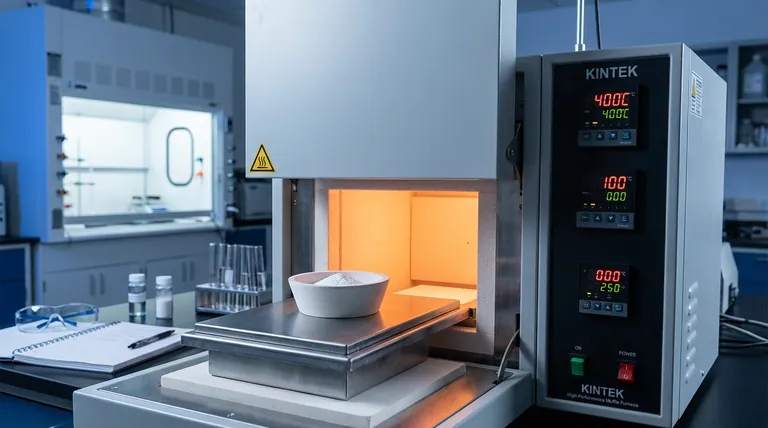
Driving Phase Transformation and Crystallinity
The primary function of the muffle furnace in this context is to force the material to evolve from a disordered state to an ordered, functional state.
Converting Amorphous Precursors
Dried precursors generally start as amorphous (disordered) solids. Subjecting these materials to specific temperatures, such as 400°C for tungsten oxide ($WO_3$), triggers heat-induced crystallization.
Stabilizing Crystal Structures
Through this thermal treatment, the material adopts stable configurations, such as monoclinic or hexagonal phases. This structural stability is a prerequisite for the material's final physical properties, including photocatalytic activity.
Grain Development
Beyond simple phase changes, the thermal activation provided by the furnace facilitates grain development. This results in nanocrystals with high crystallinity, which is directly correlated to the material's performance in electronic or chemical applications.
Achieving High Material Purity
Calcination is fundamentally a purification process. The muffle furnace ensures that non-oxide components are systematically removed from the final powder.
Eliminating Volatiles and Water
The high-temperature treatment drives off structural water and volatile impurities trapped within the precursor matrix. Removing these elements is critical to preventing defects in the final crystal lattice.
Thermal Decomposition of Organics
Synthesis often involves organic templates, surfactants, or solvents (such as starch, CTAB, or oleylamine). The furnace provides an oxidizing atmosphere that allows these organic materials to decompose and burn off completely.
Preventing Residual Contamination
Without this step, residual organic matter or nitrate impurities would remain in the powder. A high-performance furnace ensures these are fully eliminated, yielding a high-purity oxide product.
The Necessity of Precise Thermal Control
A "high-performance" furnace is distinguished by its ability to control the thermal profile accurately, which is vital for nanostructure integrity.
Controlled Heating Rates
Precision furnaces allow for programmed heating rates, such as 3°C per minute. This slow ramp-up ensures that organic templates decompose slowly rather than combusting violently, which preserves the delicate porous structure of the material.
Uniform Thermal Environment
Creating a stable and uniform thermal environment is essential for consistent results. Whether maintaining 350°C or 700°C, the furnace ensures that every part of the sample experiences the same conditions, leading to uniform crystal growth.
Understanding the Trade-offs
While high-temperature calcination is necessary, it involves critical balancing acts that require careful parameter selection.
Agglomeration Risks
Excessive heat or prolonged holding times can lead to "over-sintering." This causes nanoparticles to fuse together (agglomerate), which drastically reduces their specific surface area and effectiveness.
Incomplete Phase Transformation
Conversely, if the temperature is too low or the duration too short, the phase transformation will be incomplete. This results in a material that retains amorphous characteristics and lacks the desired magnetic or catalytic properties.
Making the Right Choice for Your Goal
The specific parameters you program into your muffle furnace should be dictated by the specific material property you value most.
- If your primary focus is High Crystallinity and Stability: Prioritize higher temperatures (e.g., 400°C–700°C) to fully drive the transition from amorphous to stable hexagonal or spinel structures.
- If your primary focus is Porosity and Surface Area: Prioritize controlled, slow heating rates to allow organic templates to decompose gently without collapsing the material's internal structure.
- If your primary focus is Chemical Purity: Ensure sufficient holding time (e.g., 6 to 24 hours) in an oxidizing atmosphere to guarantee the complete removal of stubborn surfactants and solvents.
By strictly controlling the thermal environment, you transform raw chemical precursors into engineered nanomaterials with precise functional capabilities.
Summary Table:
| Parameter | Influence on Nanomaterials | Outcome of Precision Control |
|---|---|---|
| Temperature (400°C-700°C) | Phase Transformation | Converts amorphous precursors to stable crystal phases. |
| Heating Rate (e.g., 3°C/min) | Structural Integrity | Prevents collapse of porous structures during organic burnout. |
| Holding Time (6-24 Hours) | Chemical Purity | Ensures complete removal of volatile impurities and surfactants. |
| Thermal Uniformity | Crystallinity | Promotes consistent grain development across the entire sample. |
Elevate Your Material Synthesis with KINTEK Precision
Don't let inconsistent thermal profiles compromise your research. Backed by expert R&D and manufacturing, KINTEK offers high-performance Muffle, Tube, Rotary, Vacuum, and CVD systems, all customizable for your unique lab high-temp needs. Whether you are targeting high crystallinity or maintaining porous structures, our furnaces provide the stability required for advanced nanopowder calcination.
Ready to optimize your synthesis? Contact KINTEK today to discuss your custom solution!
References
- Sivarajakrishnan Anandabaskaran, K. Krishnasamy. Photocatalytic and Antimicrobial Activities of WO3, NdWO3 and rGO/NdWO3 Nanoparticles for Environmental and Health Applications. DOI: 10.14233/ajchem.2025.33928
This article is also based on technical information from Kintek Furnace Knowledge Base .
Related Products
- 1400℃ Muffle Oven Furnace for Laboratory
- High Temperature Muffle Oven Furnace for Laboratory Debinding and Pre Sintering
- 1800℃ High Temperature Muffle Oven Furnace for Laboratory
- 1200℃ Muffle Oven Furnace for Laboratory
- 1700℃ High Temperature Muffle Oven Furnace for Laboratory
People Also Ask
- How does a high-temperature laboratory muffle furnace affect material properties? Transform Anodic Oxide Films Fast
- What is the primary function of a high-temperature laboratory muffle furnace in chemical synthesis? Achieve Precision.
- How does a laboratory high-temperature muffle furnace facilitate the homogenization of borosilicate glass samples? Expert Insights
- How is a laboratory high-temperature muffle furnace utilized to achieve the specific crystalline structure of LaFeO3 catalysts?
- What is the function of a muffle furnace in MOF-derived zirconia conversion? Optimize Phase & Pore Engineering



















