
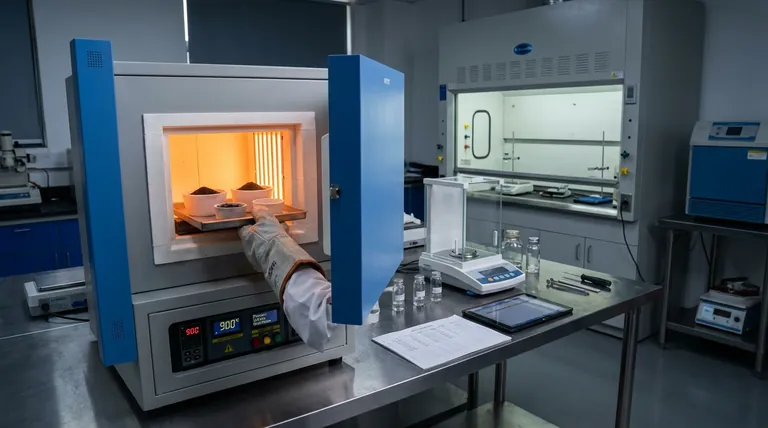
A high-temperature muffle furnace functions as a precision thermal reactor that drives the structural evolution of coated cathode precursors. It performs two distinct roles based on temperature zones: it dehydrates surface layers at 500°C to form dense oxides and subsequently provides the thermal kinetics at 750°C–950°C to induce cation migration, completing the material's phase transformation.
Core Takeaway: The muffle furnace is not merely a heating element; it is the facilitator of a solid-state chemical reorganization. By maintaining a stable thermal environment, it converts a precursor with a nickel-hydroxide shell into a unified, high-performance NMC622 cathode material through controlled dehydration and atomic migration.
The Mechanics of Thermal Processing
The Dehydration Phase (500°C)
At the initial processing stage, the furnace creates a stable environment held at approximately 500°C.
The primary function here is chemical conversion through dehydration. The furnace heat targets the surface coating of the precursor, specifically converting nickel hydroxide—Ni(OH)2—into nickel oxide (NiO).
This step is critical for densification. By removing the hydroxyl groups, the furnace ensures that the surface layer transforms into a dense, stable oxide shell before higher temperatures are applied.
High-Temperature Cation Migration (750°C – 950°C)
Once dehydration is complete, the furnace functions as a driver of continuous thermal kinetics in the 750°C to 950°C range.
The objective changes from simple decomposition to complex atomic migration. The thermal energy induces cations to move between layers. Specifically, nickel ions migrate from the nickel-rich shell into the lithium-deficient core.
Phase Transformation and Homogenization
This migration is the engine of phase transformation.
The furnace's sustained heat drives the material to evolve from an NMC111 structure into an NMC622 structure. This is a fundamental change in the material's stoichiometry and electrochemical potential, made possible only because the furnace maintains the necessary activation energy for solid-state diffusion.
Understanding the Trade-offs
Thermal Stability vs. Processing Speed
A muffle furnace is designed for stability, not necessarily rapid throughput.
The critical requirement for transforming cathode precursors is a stable thermal environment. If the temperature fluctuates or the ramp rate is too aggressive, the dehydration of Ni(OH)2 may occur too rapidly, potentially leading to structural defects rather than a dense NiO shell.
Kinetic Control Limitations
While the furnace provides the heat, the kinetics are dictated by time and temperature.
Insufficient time at the 750°C–950°C range will result in incomplete cation migration. This leads to a material that is neither NMC111 nor fully NMC622, but a hybrid with unpredictable performance characteristics. The furnace must maintain precise uniformity to ensure the core and shell interact completely.
Making the Right Choice for Your Goal
To maximize the efficacy of a high-temperature muffle furnace for cathode precursors, focus on the specific thermal profile required for each stage of the reaction.
- If your primary focus is Surface Density: Ensure the furnace has excellent stability at lower temperatures (500°C) to facilitate a slow, controlled dehydration of the Ni(OH)2 shell without cracking.
- If your primary focus is Phase Purity (NMC622): Prioritize a furnace capable of sustaining high temperatures (up to 950°C) with minimal fluctuation to drive complete cation migration from shell to core.
The value of the muffle furnace lies in its ability to decouple the dehydration process from the densification process, allowing for the precise engineering of the cathode's final crystal structure.
Summary Table:
| Process Stage | Temperature Range | Primary Function | Structural Outcome |
|---|---|---|---|
| Dehydration | ~500°C | Chemical conversion of Ni(OH)2 to NiO | Formation of a dense oxide shell |
| Cation Migration | 750°C – 950°C | Thermal kinetics & atomic migration | Nickel ions move from shell to core |
| Phase Transformation | 750°C – 950°C | Solid-state diffusion | Evolution from NMC111 to NMC622 |
Optimize Your Cathode Material Synthesis with KINTEK
Precision thermal control is the difference between structural defects and high-performance battery materials. Backed by expert R&D and world-class manufacturing, KINTEK offers a comprehensive range of Muffle, Tube, Rotary, Vacuum, and CVD systems, all designed to deliver the stable thermal environments required for advanced material phase transformations.
Whether you need precise dehydration at 500°C or sustained kinetics up to 950°C, our lab high-temp furnaces are fully customizable to meet your unique research and production needs.
Ready to elevate your material engineering? Contact our experts today to find the perfect furnace solution for your laboratory.
References
- Eva Michelle Allen, Albert L. Lipson. Cathode Upcycling for Direct Recycling of Lithium‐Ion Batteries Using a Precipitation Approach. DOI: 10.1002/aenm.202500699
This article is also based on technical information from Kintek Furnace Knowledge Base .
Related Products
- 1700℃ High Temperature Muffle Oven Furnace for Laboratory
- 1800℃ High Temperature Muffle Oven Furnace for Laboratory
- 1200℃ Muffle Oven Furnace for Laboratory
- 1400℃ Muffle Oven Furnace for Laboratory
- High Temperature Muffle Oven Furnace for Laboratory Debinding and Pre Sintering
People Also Ask
- What is the primary function of a high-temperature laboratory muffle furnace in chemical synthesis? Achieve Precision.
- How does a high-temperature laboratory muffle furnace affect material properties? Transform Anodic Oxide Films Fast
- What role does a muffle furnace play in BCZY712 electrolyte powder production? Achieve Perfect Phase Purity
- How does the two-stage sintering process contribute to the synthesis of MeCuFeO3 perovskite? Optimize crystal purity.
- What is the role of a high-temperature muffle furnace in guava leaf carbonization? Master Precise Pyrolysis Control



















