Knowledge Why is the high-precision control of argon (Ar) and nitrogen (N2) flow ratios critical in CrSiN-Y coating fabrication?
Author avatar

Tech Team · Kintek Furnace

Updated 4 hours ago

Why is the high-precision control of argon (Ar) and nitrogen (N2) flow ratios critical in CrSiN-Y coating fabrication?


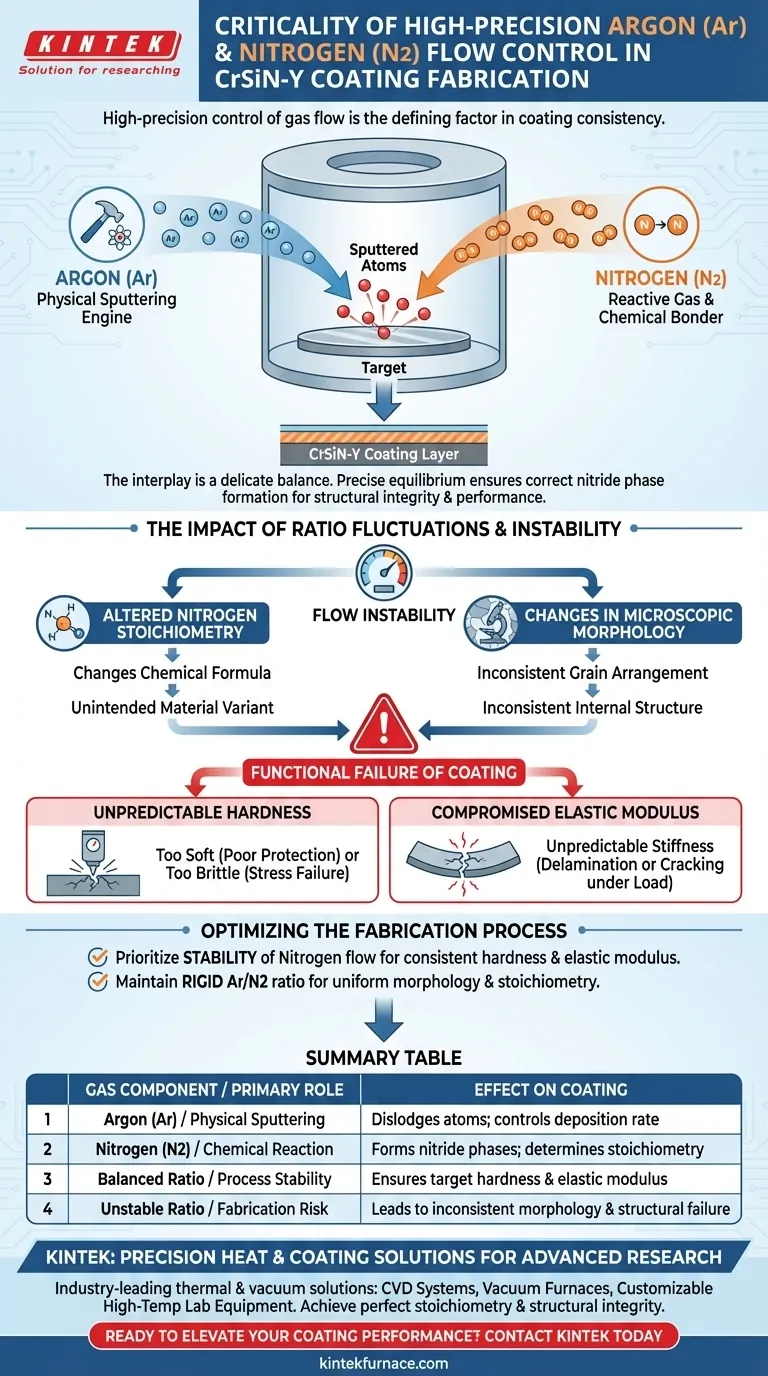
High-precision control of gas flow is the defining factor in coating consistency. In the CrSiN-Y fabrication process, the specific ratio of argon to nitrogen directly dictates the chemical composition (stoichiometry) of the final layer. Even minor fluctuations in this balance alter the coating's physical structure, fundamentally compromising its mechanical properties such as hardness and elasticity.

The interplay between argon and nitrogen is a delicate balance between physical force and chemical reaction. Maintaining a precise equilibrium ensures the correct formation of nitride phases, which are essential for the coating's structural integrity and performance.

The Distinct Roles of Working Gases

To understand why precision is non-negotiable, you must first understand the conflicting yet complementary roles these two gases play inside the vacuum chamber.

Argon Drives Physical Sputtering

Argon serves as the mechanical engine of the process. It is used exclusively for the physical sputtering of target atoms.

By bombarding the target material, argon dislodges atoms into the vacuum environment. Without stable argon flow, the rate at which source material is released becomes unpredictable.

Nitrogen Drives Chemical Reaction

Nitrogen acts as the reactive gas. Its purpose is to bond chemically with the sputtered atoms to create the necessary nitride phases.

The availability of nitrogen determines how effectively the CrSiN-Y compound forms. It transforms the raw sputtered material into a functional ceramic coating.

The Impact of Ratio Fluctuations

The critical challenge in this process is that the gases must be balanced against each other in real-time. High-precision mass flow controllers are required to maintain the necessary partial pressure balance.

Altering Nitrogen Stoichiometry

The primary risk of flow instability is a change in nitrogen stoichiometry.

If the ratio drifts, the chemical formula of the coating changes on the fly. You are no longer producing the intended material, but rather a variant with different chemical bonding ratios.

Changes in Microscopic Morphology

These chemical shifts manifest physically in the coating's microstructure.

The microscopic morphology—the actual arrangement of grains and structures within the coating—is dependent on the gas ratio. An inconsistent flow results in an inconsistent internal structure.

The Risks of Flow Instability

When the gas ratio fluctuates, the consequences are not just cosmetic; they result in a functional failure of the coating's design specifications.

Unpredictable Hardness

The hardness of the CrSiN-Y coating is directly linked to the formation of specific nitride phases.

If the nitrogen flow drops or spikes relative to the argon, the resulting stoichiometry will fail to achieve the target hardness. The coating may become too soft to protect the substrate or too brittle to endure stress.

Compromised Elastic Modulus

The elastic modulus, or the coating's stiffness, is equally sensitive to the gas ratio.

Variations in the gas mixture lead to unpredictable elasticity. This can cause the coating to delaminate or crack under loads it was designed to withstand.

Optimizing the Fabrication Process

Achieving a high-performance CrSiN-Y coating requires prioritizing the stability of your mass flow control system above all other variables.

  • If your primary focus is mechanical durability: Prioritize the stability of the nitrogen flow to ensure consistent nitride phase formation, which governs hardness and the elastic modulus.
  • If your primary focus is structural uniformity: Maintain a rigid argon-to-nitrogen ratio to prevent variations in microscopic morphology and stoichiometry.

Precision in gas regulation is the only way to transform raw sputtered atoms into a reliable, high-performance surface.

Summary Table:

Gas Component Primary Role Effect on Coating
Argon (Ar) Physical Sputtering Dislodges target atoms; controls deposition rate
Nitrogen (N2) Chemical Reaction Forms nitride phases; determines stoichiometry
Balanced Ratio Process Stability Ensures target hardness and elastic modulus
Unstable Ratio Fabrication Risk Leads to inconsistent morphology and structural failure

Precision Heat and Coating Solutions for Advanced Research

Consistency in coating fabrication depends on the precision of your equipment. KINTEK provides industry-leading thermal and vacuum solutions, including CVD systems, Vacuum Furnaces, and customizable high-temperature lab equipment designed to meet the rigorous demands of material science.

Backed by expert R&D and world-class manufacturing, we help you achieve perfect stoichiometry and structural integrity for your unique material needs.

Ready to elevate your coating performance?
Contact KINTEK today for a customized solution

Visual Guide
Why is the high-precision control of argon (Ar) and nitrogen (N2) flow ratios critical in CrSiN-Y coating fabrication? Visual Guide

References

  1. Lishan Dong, Zhifeng Wang. Porous High-Entropy Oxide Anode Materials for Li-Ion Batteries: Preparation, Characterization, and Applications. DOI: 10.3390/ma17071542

This article is also based on technical information from Kintek Furnace Knowledge Base .

Related Products

People Also Ask

Related Products

1200℃ Controlled Inert Nitrogen Atmosphere Furnace

1200℃ Controlled Inert Nitrogen Atmosphere Furnace

KINTEK 1200℃ Controlled Atmosphere Furnace: Precision heating with gas control for labs. Ideal for sintering, annealing, and material research. Customizable sizes available.

1700℃ Controlled Inert Nitrogen Atmosphere Furnace

1700℃ Controlled Inert Nitrogen Atmosphere Furnace

KT-17A Controlled Atmosphere Furnace: Precise 1700°C heating with vacuum & gas control. Ideal for sintering, research & material processing. Explore now!

Controlled Inert Nitrogen Hydrogen Atmosphere Furnace

Controlled Inert Nitrogen Hydrogen Atmosphere Furnace

Discover KINTEK's Hydrogen Atmosphere Furnace for precise sintering & annealing in controlled environments. Up to 1600°C, safety features, customizable.

High Temperature Muffle Oven Furnace for Laboratory Debinding and Pre Sintering

High Temperature Muffle Oven Furnace for Laboratory Debinding and Pre Sintering

KT-MD Debinding & Pre-Sintering Furnace for ceramics - precise temperature control, energy-efficient design, customizable sizes. Boost your lab efficiency today!

Vacuum Induction Melting Furnace and Arc Melting Furnace

Vacuum Induction Melting Furnace and Arc Melting Furnace

Explore KINTEK's Vacuum Induction Melting Furnace for high-purity metal processing up to 2000℃. Customizable solutions for aerospace, alloys, and more. Contact us today!

1200℃ Split Tube Furnace Laboratory Quartz Tube Furnace with Quartz Tube

1200℃ Split Tube Furnace Laboratory Quartz Tube Furnace with Quartz Tube

Discover KINTEK's 1200℃ Split Tube Furnace with quartz tube for precise high-temperature lab applications. Customizable, durable, and efficient. Get yours now!

Multi Heating Zones CVD Tube Furnace Machine for Chemical Vapor Deposition Equipment

Multi Heating Zones CVD Tube Furnace Machine for Chemical Vapor Deposition Equipment

KINTEK's Multi-Zone CVD Tube Furnaces offer precision temperature control for advanced thin film deposition. Ideal for research and production, customizable for your lab needs.

Vacuum Hot Press Furnace Machine Heated Vacuum Press Tube Furnace

Vacuum Hot Press Furnace Machine Heated Vacuum Press Tube Furnace

Discover KINTEK's advanced Vacuum Tube Hot Press Furnace for precise high-temperature sintering, hot pressing, and material bonding. Customizable solutions for labs.

915MHz MPCVD Diamond Machine Microwave Plasma Chemical Vapor Deposition System Reactor

915MHz MPCVD Diamond Machine Microwave Plasma Chemical Vapor Deposition System Reactor

KINTEK MPCVD Diamond Machine: High-quality diamond synthesis with advanced MPCVD technology. Faster growth, superior purity, customizable options. Boost production now!

Electric Rotary Kiln Continuous Working Small Rotary Furnace Kiln for Pyrolysis Plant Heating

Electric Rotary Kiln Continuous Working Small Rotary Furnace Kiln for Pyrolysis Plant Heating

KINTEK's electric rotary furnaces offer precision heating up to 1100°C for calcination, drying, and pyrolysis. Durable, efficient, and customizable for labs and production. Explore models now!

Stainless Steel Quick Release Vacuum Chain Three Section Clamp

Stainless Steel Quick Release Vacuum Chain Three Section Clamp

Stainless steel quick release vacuum clamps ensure leak-free connections for high vacuum systems. Durable, corrosion-resistant, and easy to install.

Ultra-High Vacuum Flange Aviation Plug Glass Sintered Airtight Circular Connector for KF ISO CF

Ultra-High Vacuum Flange Aviation Plug Glass Sintered Airtight Circular Connector for KF ISO CF

Ultra-High Vacuum Flange Aviation Plug Connector for aerospace & labs. KF/ISO/CF compatible, 10⁻⁹ mbar airtight, MIL-STD certified. Durable & customizable.

Cylindrical Resonator MPCVD Machine System for Lab Diamond Growth

Cylindrical Resonator MPCVD Machine System for Lab Diamond Growth

KINTEK MPCVD Systems: Grow high-quality diamond films with precision. Reliable, energy-efficient, and beginner-friendly. Expert support available.

Vacuum Sealed Continuous Working Rotary Tube Furnace Rotating Tube Furnace

Vacuum Sealed Continuous Working Rotary Tube Furnace Rotating Tube Furnace

Precision rotary tube furnace for continuous vacuum processing. Ideal for calcination, sintering, and heat treatment. Customizable up to 1600℃.

Vacuum Hot Press Furnace Machine for Lamination and Heating

Vacuum Hot Press Furnace Machine for Lamination and Heating

KINTEK Vacuum Lamination Press: Precision bonding for wafer, thin-film & LCP applications. 500°C max temp, 20-ton pressure, CE certified. Custom solutions available.

304 316 Stainless Steel High Vacuum Ball Stop Valve for Vacuum Systems

304 316 Stainless Steel High Vacuum Ball Stop Valve for Vacuum Systems

KINTEK's 304/316 stainless steel vacuum ball valves and stop valves ensure high-performance sealing for industrial and scientific applications. Explore durable, corrosion-resistant solutions.

600T Vacuum Induction Hot Press Vacuum Heat Treat and Sintering Furnace

600T Vacuum Induction Hot Press Vacuum Heat Treat and Sintering Furnace

600T Vacuum Induction Hot Press Furnace for precise sintering. Advanced 600T pressure, 2200°C heating, vacuum/atmosphere control. Ideal for research & production.

Laboratory Muffle Oven Furnace with Bottom Lifting

Laboratory Muffle Oven Furnace with Bottom Lifting

Boost lab efficiency with KT-BL Bottom Lifting Furnace: precise 1600℃ control, superior uniformity, and enhanced productivity for material science and R&D.

Multi Zone Laboratory Quartz Tube Furnace Tubular Furnace

Multi Zone Laboratory Quartz Tube Furnace Tubular Furnace

KINTEK Multi-Zone Tube Furnace: Precise 1700℃ heating with 1-10 zones for advanced material research. Customizable, vacuum-ready, and safety-certified.

Split Chamber CVD Tube Furnace with Vacuum Station CVD Machine

Split Chamber CVD Tube Furnace with Vacuum Station CVD Machine

Split Chamber CVD Tube Furnace with Vacuum Station - High precision 1200°C lab furnace for advanced materials research. Customizable solutions available.


Leave Your Message