Secondary calcination acts as a crucial surface reconstruction mechanism. By subjecting the Na2WO4-loaded catalyst to 1000°C, the sodium tungstate reaches a molten state and actively redistributes across the CaMnO3 support. This process creates a uniform core-shell structure that fundamentally alters the catalyst's surface chemistry and stability.
Core Takeaway: This high-temperature treatment is not merely for drying; it is an architectural modification. It creates a protective shell that prevents internal ions from migrating to the surface (cation segregation) while optimizing oxygen interactions, directly resulting in higher olefin yields during n-octane dehydrogenation.
The Mechanism of Surface Reconstruction
The improvement in surface performance is driven by a phase change that occurs specifically at high temperatures.
Thermal Redistribution via Melting
At 1000°C, the loaded Na2WO4 does not simply sit on the support; it melts. This molten state allows the material to flow and spread evenly.
Formation of Core-Shell Architecture
As the molten Na2WO4 redistributes, it encapsulates the CaMnO3 support. This results in a distinct core-shell structure, where the active components are positioned optimally on the exterior.
Chemical Stabilization and Performance
The physical restructuring leads to specific chemical benefits that enhance the catalyst's operation.
Inhibiting Surface Cation Segregation
One of the primary failure modes in complex oxide catalysts is the unwanted movement of ions to the surface. The core-shell structure formed during secondary calcination significantly inhibits surface cation segregation, locking the structural integrity in place.
Optimizing Oxygen Species
The treatment modifies how the catalyst interacts with oxygen. By redistributing the surface components, the process optimizes the activity and selectivity of oxygen species, ensuring they react more efficiently during the dehydrogenation process.
Enhancing Reaction Yields
The combination of a stable surface and optimized oxygen chemistry directly impacts the output. These changes lead to a measurable improvement in olefin yield during the n-octane dehydrogenation reaction.
Understanding the Trade-offs
While secondary calcination offers significant benefits, it is a high-energy process that requires precision.
The Cost of High-Temperature Processing
Reaching 1000°C requires specialized high-temperature heating equipment and significant energy input. This increases the operational cost of catalyst preparation compared to lower-temperature methods.
The Risk of Over-Sintering
The success of this method relies on the formation of a controlled core-shell structure. If the temperature or duration exceeds the optimal window, there is a general risk of excessive sintering, which could reduce the active surface area rather than optimizing it. Precision in thermal control is paramount.
Making the Right Choice for Your Catalyst
The decision to employ high-temperature secondary calcination depends on the specific performance metrics you need to prioritize.
- If your primary focus is long-term stability: Use this process to form the core-shell structure that effectively inhibits surface cation segregation.
- If your primary focus is maximizing product output: Leverage the optimized oxygen species distribution to specifically boost olefin yield in dehydrogenation reactions.
Mastering the secondary calcination process transforms a simple mixture into a sophisticated, high-performance catalytic tool.
Summary Table:
| Feature | Impact of Secondary Calcination (1000°C) |
|---|---|
| Physical Structure | Formation of a uniform core-shell architecture |
| Surface Chemistry | Redispersion of molten Na2WO4 across the support |
| Ion Stability | Significantly inhibits surface cation segregation |
| Oxygen Interaction | Optimizes activity and selectivity of oxygen species |
| Reaction Outcome | Increased olefin yield in n-octane dehydrogenation |
| Control Need | High precision to avoid over-sintering |
Maximize Your Catalyst Performance with Precision Heating
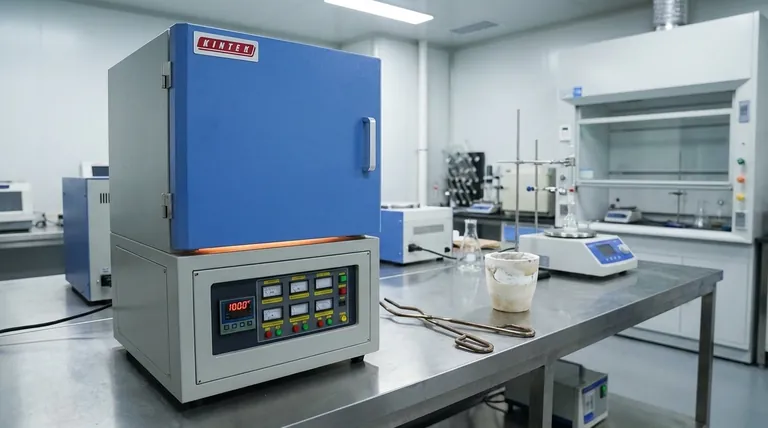
Unlock the full potential of your chemical processes with high-temperature solutions designed for excellence. Backed by expert R&D and world-class manufacturing, KINTEK offers high-performance Muffle, Tube, Rotary, Vacuum, and CVD systems—all fully customizable to meet your unique secondary calcination and surface reconstruction requirements.
Whether you are aiming to inhibit cation segregation or boost olefin yields, our lab furnaces provide the precise thermal control needed to achieve perfect core-shell architectures. Contact KINTEK today to discuss your custom furnace needs and elevate your material research to the next level.
Visual Guide

References
- Shaowei Yao, Tengwei Chen. Tandem catalysis of zeolite and perovskite for light olefins production in dehydrogenation cracking of naphtha. DOI: 10.1039/d5ra02427g
This article is also based on technical information from Kintek Furnace Knowledge Base .
Related Products
- High Temperature Muffle Oven Furnace for Laboratory Debinding and Pre Sintering
- 1200℃ Muffle Oven Furnace for Laboratory
- 2200 ℃ Graphite Vacuum Heat Treat Furnace
- 1800℃ High Temperature Muffle Oven Furnace for Laboratory
- 1700℃ High Temperature Muffle Oven Furnace for Laboratory
People Also Ask
- What thermal phenomena occur during polymer binder burnout in ceramic green bodies? Lab Furnace Guide
- What role does a high-temperature muffle furnace play in STFO synthesis? Achieve Pure Perovskite Results
- Why is controlled heat treatment in a muffle furnace necessary for calcined clay? Achieve Optimal Pozzolanic Activity
- How does a high-temperature muffle furnace facilitate the formation of LaNbxAl1−xO3+δ perovskite structures? Key Roles
- What role does a high-temperature muffle furnace play in the multi-stage synthesis of Li0.5MnFe1.5O4? Key to Pure Spinel