Preheating the mold is a fundamental requirement for achieving structural integrity in aluminum matrix composite castings. It serves to drastically reduce the temperature differential between the superheated molten slurry and the mold walls, creating a thermal environment that supports uniform solidification rather than rapid freezing.
The primary function of preheating is to minimize thermal shock and optimize the cooling rate. This control is essential for preventing internal residual stresses and eliminating the risk of thermal cracking in the final cast part.
Managing Thermal Dynamics
Reducing the Temperature Differential
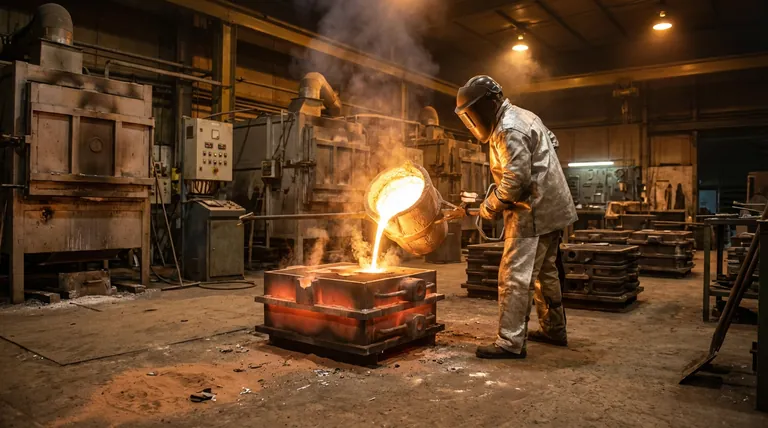
When molten aluminum matrix composite is poured, it possesses high thermal energy. If it contacts a cold mold, the temperature difference is extreme.
Preheating the mold bridges this gap. It ensures the slurry does not encounter a shocking drop in temperature immediately upon contact with the mold walls.
Optimizing the Cooling Rate
The speed at which the material cools defines its final properties. A cold mold extracts heat too quickly, leading to uncontrolled solidification.
By maintaining a controlled mold temperature, you dictate the pace of cooling. This allows for a smooth, predictable transition from the liquid state to the solid state.
Ensuring Material Integrity
Minimizing Thermal Shock
Thermal shock occurs when a material undergoes rapid temperature changes that create internal mechanical stress.
In casting, pouring hot metal into a cold vessel is a prime cause of this shock. Preheating acts as a buffer, protecting the composite material from the violent thermal reaction that occurs during sudden cooling.
Reducing Residual Stresses
As metal solidifies, it shrinks. If this happens unevenly or too fast due to a cold mold, the material locks in internal tension, known as residual stress.
A preheated mold facilitates more uniform cooling. This allows the material to settle naturally, significantly lowering the internal tension within the cast structure.
Preventing Thermal Cracking
The ultimate consequence of unmanaged thermal stress is structural failure. High residual stresses can pull the material apart, resulting in cracks.
By ensuring a smooth thermal transition, preheating directly mitigates the risk of these thermal cracks, ensuring the casting remains sound.
Understanding the Trade-offs
The Necessity of Process Control
While preheating is beneficial, it introduces an additional variable to the casting process.
It requires precise temperature management; the mold must be heated to a specific, controlled range. Inconsistent heating can lead to uneven cooling rates, negating the benefits of the process.
Balancing Cycle Time and Quality
Implementing a preheat step adds time to the casting cycle.
However, skipping this step to save time creates a high probability of rejected parts due to cracking. The "cost" of preheating is an investment in yield and reliability.
Making the Right Choice for Your Goal
To ensure high-quality castings, apply these principles based on your specific objectives:
- If your primary focus is defect reduction: Preheat the mold to lower the thermal gradient, directly removing the primary cause of thermal cracking.
- If your primary focus is mechanical reliability: Ensure the mold temperature is controlled to optimize the cooling rate, which minimizes hidden residual stresses.
Preheating is not merely a preparation step; it is a critical quality assurance measure that defines the structural success of the casting.
Summary Table:
| Factor | Impact of Cold Mold | Impact of Preheated Mold | Benefit of Preheating |
|---|---|---|---|
| Temperature Gradient | Extreme differential | Bridged/Reduced gap | Prevents rapid freezing |
| Cooling Rate | Uncontrolled/Rapid | Managed & Predictable | Uniform solidification |
| Internal Stress | High residual tension | Low/Natural settlement | Prevents structural failure |
| Part Quality | High risk of cracking | Sound structural integrity | Eliminates thermal cracks |
| Process Yield | Frequent rejected parts | Consistent high-quality output | Long-term cost efficiency |
Achieve Casting Excellence with KINTEK
Don't let thermal shock compromise your material integrity. KINTEK provides industry-leading thermal solutions backed by expert R&D and precision manufacturing. Whether you require Muffle, Tube, Rotary, Vacuum, or CVD systems, our high-temperature lab furnaces are fully customizable to meet the exacting preheating requirements of aluminum matrix composites and other advanced materials.
Ready to optimize your casting cycle and eliminate defects?
Contact KINTEK Today to Consult Our Experts
References
- Naguib G. Yakoub. Catalysts of Strength: Unveiling the Mechanical and Tribological Mastery of Al-2024 MMC with Fly ash/TiB2/SiC Reinforcements. DOI: 10.21608/jessit.2024.283185.1010
This article is also based on technical information from Kintek Furnace Knowledge Base .
Related Products
- Multi Zone Laboratory Quartz Tube Furnace Tubular Furnace
- High Temperature Muffle Oven Furnace for Laboratory Debinding and Pre Sintering
- Molybdenum Disilicide MoSi2 Thermal Heating Elements for Electric Furnace
- Vacuum Heat Treat Sintering Furnace Molybdenum Wire Vacuum Sintering Furnace
- Dental Porcelain Zirconia Sintering Ceramic Vacuum Press Furnace
People Also Ask
- Why are multi zone tube furnaces particularly useful for nanomaterial research? Unlock Precise Thermal Control for Advanced Synthesis
- What role do multi zone tube furnaces play in new energy research? Unlock Precise Thermal Control for Innovation
- What temperature-related capabilities make multi zone tube furnaces valuable for research? Unlock Precision Thermal Control
- What environmental protection applications utilize multi zone tube furnaces? Unlock Precision in Waste Treatment and Green Tech
- What are the main applications of multi zone tube furnaces in university laboratories? Unlock Precision in Material Science and Energy Research