
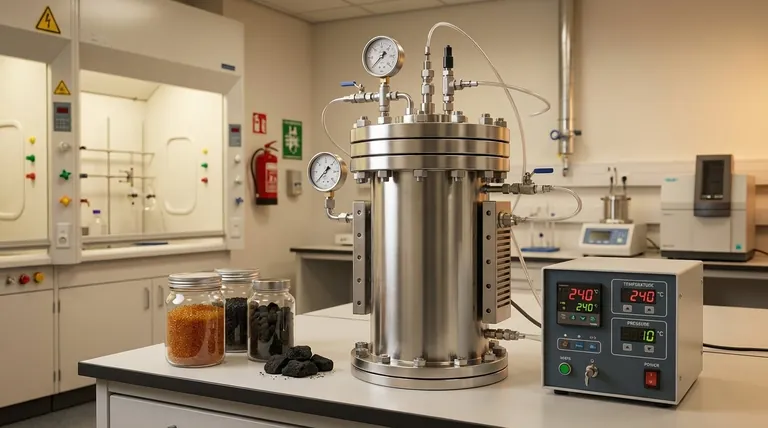
The function of a stainless steel high-pressure reactor is to generate a sealed environment that maintains deionized water in a subcritical liquid state. By sustaining high internal pressure, the reactor allows water to remain liquid at temperatures significantly above its boiling point—typically around 240 °C—which is the critical condition required to initiate the breakdown of waste ion-exchange resins.
The reactor serves as a containment vessel that forces water into a subcritical state, acting as a catalyst to decompose polymer structures and convert solid resins into porous polymer hydrochar through hydrolysis and dehydration.
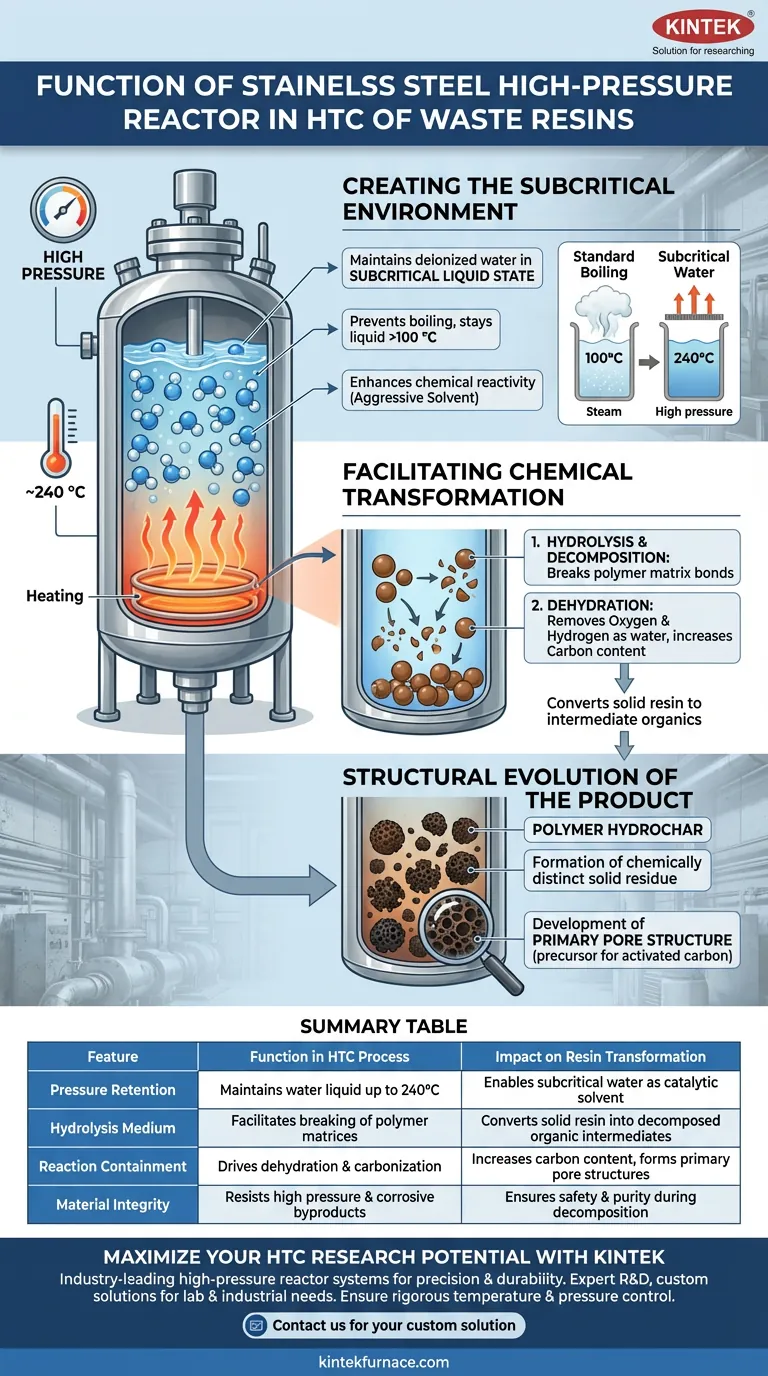
Creating the Subcritical Environment
The primary role of the reactor is not merely to hold materials, but to fundamentally alter the physical properties of the solvent (water) used in the process.
Maintaining Liquid State at High Heat
Under normal atmospheric conditions, water vaporizes at 100 °C. The stainless steel reactor is designed to withstand the pressure generated when heating water to temperatures such as 240 °C.
By sealing the system, the reactor prevents boiling. This forces the deionized water to remain in a liquid phase, creating what is known as subcritical water.
Enhancing Chemical Reactivity
In this subcritical state, water exhibits unique properties compared to ambient water. It acts as a more aggressive solvent and reaction medium.
The high-pressure environment ensures that the water penetrates the solid resin effectively, facilitating chemical reactions that would not occur under standard boiling conditions.
Facilitating Chemical Transformation
Once the subcritical environment is established, the reactor acts as the stage for the chemical metamorphosis of the waste resins.
Hydrolysis and Decomposition
The reactor environment triggers the decomposition of the stable polymer structures found in ion-exchange resins.
High-temperature liquid water drives hydrolysis, breaking the chemical bonds within the resin's polymer matrix.
Dehydration of Polymer Structures
Simultaneously, the reactor facilitates dehydration reactions. This process removes oxygen and hydrogen from the polymer structure in the form of water.
This step is vital for increasing the carbon content of the solid residue, transitioning it from a raw resin to a carbonaceous material.
Structural Evolution of the Product
The ultimate output of the reactor is a transformation of the physical form of the waste.
Formation of Polymer Hydrochar
The process successfully converts the solid waste resins into polymer hydrochar. This solid residue is chemically distinct from the original input material.
Development of Primary Pore Structure
Beyond simple chemical conversion, the reactor environment aids in developing a primary pore structure within the hydrochar.
This physical structuring provides the foundation for the material's future utility, potentially serving as a precursor for activated carbon or adsorption applications.
Understanding the Operational Requirements
While the reactor is the engine of this conversion, it imposes specific operational constraints that must be managed.
Pressure and Material Integrity
The "stainless steel" specification is not cosmetic; it is functional. The reactor must withstand significant internal pressure without deforming.
Furthermore, the decomposition of resins can release corrosive byproducts. The material construction ensures the reactor remains inert and does not degrade during the harsh hydrothermal process.
Making the Right Choice for Your Goal
The effectiveness of the Hydrothermal Carbonization (HTC) process depends heavily on how the reactor is utilized.
- If your primary focus is efficient decomposition: Ensure the reactor seal is perfect to maintain the pressure required for the subcritical state at 240 °C.
- If your primary focus is pore structure development: Regulate the temperature profile strictly, as the subcritical conditions directly influence the morphology of the resulting hydrochar.
By controlling pressure and temperature within this sealed vessel, you turn waste resin into a valuable carbon resource.
Summary Table:
| Feature | Function in HTC Process | Impact on Resin Transformation |
|---|---|---|
| Pressure Retention | Maintains water in a liquid state up to 240°C | Enables subcritical water as a catalytic solvent |
| Hydrolysis Medium | Facilitates breaking of polymer matrices | Converts solid resin into decomposed organic intermediates |
| Reaction Containment | Drives dehydration and carbonization | Increases carbon content and forms primary pore structures |
| Material Integrity | Resists high pressure and corrosive byproducts | Ensures safety and purity during the decomposition phase |
Maximize Your HTC Research Potential with KINTEK
Ready to convert complex waste streams into valuable carbon resources? KINTEK provides industry-leading high-pressure reactor systems engineered for precision and durability. Backed by expert R&D and manufacturing, we offer Muffle, Tube, Rotary, Vacuum, and CVD systems, as well as customizable stainless steel high-pressure reactors tailored to your unique lab-scale or industrial needs.
Our equipment ensures the rigorous temperature and pressure control required for successful hydrothermal carbonization and material synthesis.
Contact us today to find your custom solution and see how our advanced laboratory furnaces can enhance your process efficiency.
Visual Guide
References
- Reuse of Polymeric Resin for Production of Activated Hydrochar Applied in Removal of Bisphenol A and Diclofenac Synthetic Aqueous Solution. DOI: 10.3390/coatings15010027
This article is also based on technical information from Kintek Furnace Knowledge Base .
Related Products
- High Pressure Laboratory Vacuum Tube Furnace
- Custom Made Versatile CVD Tube Furnace Chemical Vapor Deposition CVD Equipment Machine
- 9MPa Air Pressure Vacuum Heat Treat and Sintering Furnace
- MPCVD Machine System Reactor Bell-jar Resonator for Lab and Diamond Growth
- Slide PECVD Tube Furnace with Liquid Gasifier PECVD Machine
People Also Ask
- What role does a high vacuum tube furnace play in Co-Al sintering? Master High-Purity Porous Material Synthesis
- What are the different types of tube furnaces available? Find the Perfect Fit for Your Lab's Needs
- What is the role of a vacuum tube furnace during the final thermal treatment stage of Fe3O4@CSAC catalysts?
- What are the main advantages of vacuum tube furnaces in the market? Achieve Purity and Precision in Material Processing
- What conditions do tube furnaces provide for Au-Seeded TiO2 nanowires? Master Precision Thermal Synthesis






