
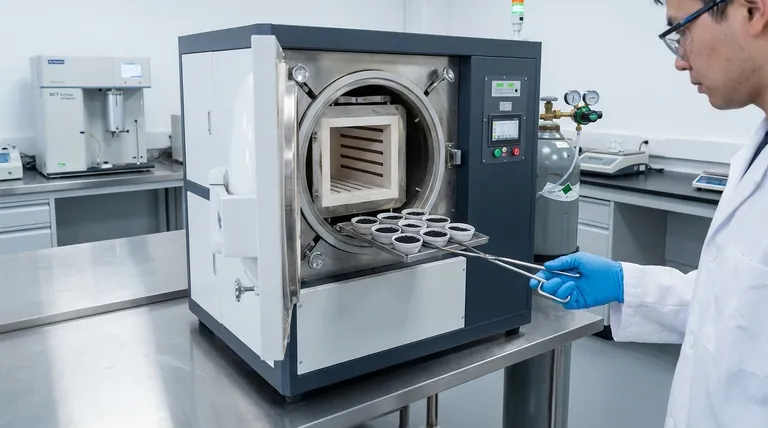
A vacuum drying oven is an absolute necessity for ensuring analytical accuracy. It provides a specialized low-pressure degassing environment capable of removing moisture and residual solvents deeply trapped within the ultra-fine micropores of activated carbon. Without this step, these adsorbed substances physically block the pores, rendering subsequent characterization data unreliable.
By lowering the pressure, the vacuum oven forces trapped molecules to evaporate at lower temperatures without damaging the carbon structure. This ensures your data reflects the true surface area of the material, rather than measuring the contaminants clogging it.
The Critical Role of Degassing
Accessing the Micropores
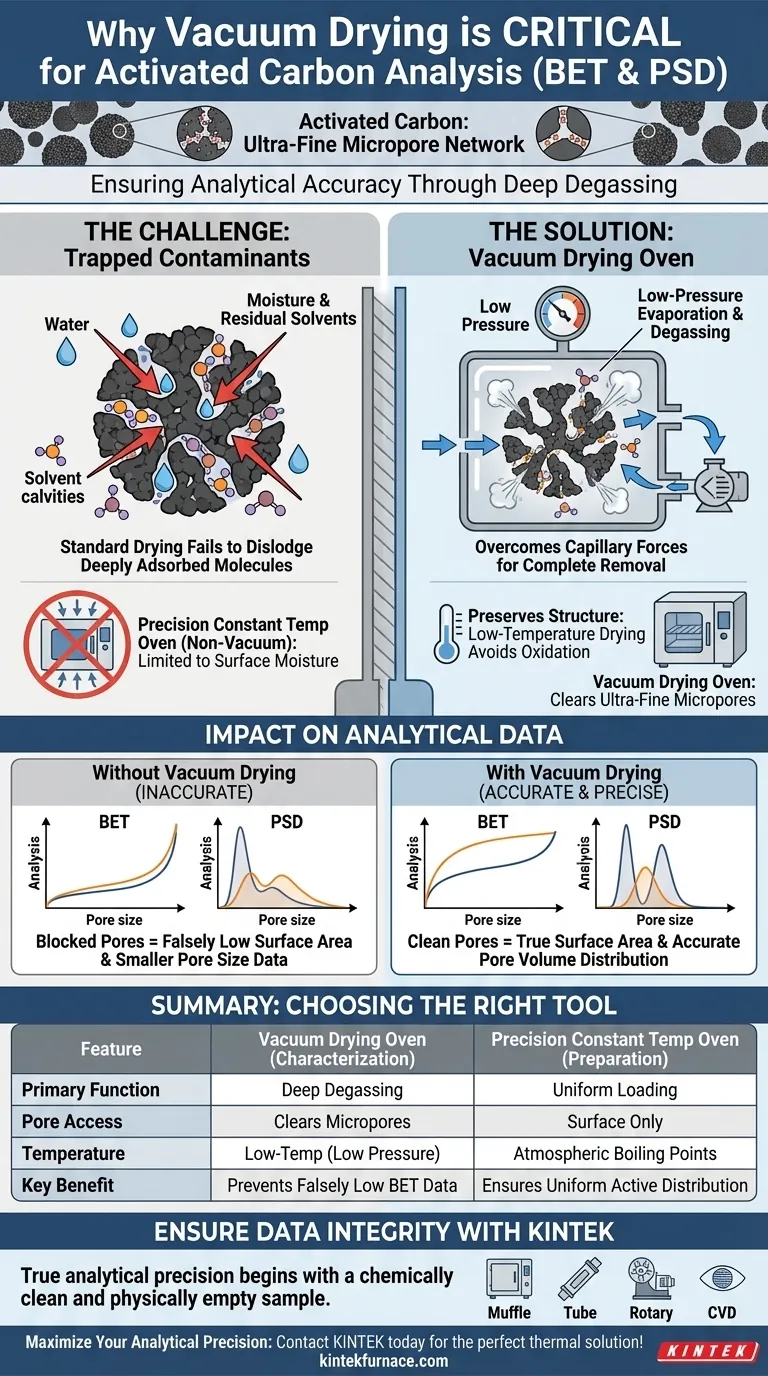
Activated carbon is defined by its complex network of ultra-fine micropores. These pores naturally adsorb moisture and solvent molecules from the atmosphere or previous processing steps.
Standard drying methods often fail to dislodge molecules trapped deep within these sub-nanometer structures. A vacuum environment is required to overcome the capillary forces holding these contaminants inside.
Low-Temperature Preservation
Heat alone can sometimes alter the chemical structure of activated carbon or cause oxidation.
By applying a vacuum, you lower the boiling point of the trapped liquids. This allows for thorough drying and degassing at relatively low temperatures, preserving the material's physical integrity before analysis.
Impact on Analytical Data
Accuracy in BET Surface Area Testing
The Brunauer-Emmett-Teller (BET) theory relies on measuring gas adsorption to calculate surface area.
If the pores are already occupied by water or solvents, the test gas (usually Nitrogen) cannot enter. This results in a falsely low surface area calculation, leading to incorrect conclusions about the material's quality.
Precision in Pore Size Distribution (PSD)
Pore Size Distribution analysis maps the volume and size of the internal cavities.
Residual solvent molecules adhering to the pore walls effectively shrink the available diameter of the pore. This causes significant data deviations, making the pores appear smaller or less voluminous than they actually are.
Understanding the Trade-offs
Vacuum vs. Precision Constant Temperature Ovens
It is vital to choose the right tool for the specific stage of your workflow.
A precision constant temperature oven (non-vacuum) is ideal during the preparation phase, such as loading carbon with chemicals like KOH or CuO. In that context, atmospheric pressure helps ensure solvents evaporate smoothly for uniform distribution.
However, for characterization, that same oven is insufficient. It lacks the negative pressure required to "pull" stubborn adsorbates out of the micropores for a clean baseline measurement.
The Risk of Incomplete Degassing
Skipping the vacuum drying step is a common source of experimental error.
Even a trace amount of residual moisture can outgas during the analysis itself (which often occurs under high vacuum). This can contaminate the analyzer's sensitive detectors and ruin the validity of the entire sample run.
Ensuring Data Integrity in Your Lab
To achieve reproducible results, match your equipment to your immediate objective:
- If your primary focus is Characterization (BET/PSD): You must use a vacuum drying oven to completely degas the sample and clear the pore structure of interferences.
- If your primary focus is Material Preparation (Loading/Impregnation): Use a precision constant temperature oven to ensure the uniform distribution of active components without aggressive degassing.
True analytical precision begins with a sample that is chemically clean and physically empty.
Summary Table:
| Feature | Vacuum Drying Oven | Precision Constant Temp Oven |
|---|---|---|
| Primary Function | Deep degassing for characterization | Uniform chemical loading & prep |
| Pore Access | Clears ultra-fine micropores | Limited to surface moisture |
| Temperature | Low-temp drying via low pressure | Atmospheric boiling points |
| Key Benefit | Prevents falsely low BET data | Ensures uniform active distribution |
Maximize Your Analytical Precision with KINTEK
Inaccurate data starts with improper sample preparation. At KINTEK, we understand that true material characterization requires the highest level of purity. Backed by expert R&D and manufacturing, we offer high-performance Vacuum Drying Ovens, Muffle, Tube, Rotary, and CVD systems specifically designed to meet the rigorous demands of laboratory research.
Whether you need to preserve the delicate structure of activated carbon or customize a high-temperature furnace for unique processing needs, our team is here to help. Don't let trapped contaminants compromise your results.
Contact KINTEK today to find the perfect thermal solution for your lab!
Visual Guide
References
- Shengfei Zhou, Markus J. Buehler. Enhanced Electrochemical Properties of Biobased Activated Carbon for Supercapacitors. DOI: 10.1002/adem.202401964
This article is also based on technical information from Kintek Furnace Knowledge Base .
Related Products
- Electric Rotary Kiln Small Rotary Furnace for Activated Carbon Regeneration
- High Temperature Muffle Oven Furnace for Laboratory Debinding and Pre Sintering
- Vacuum Heat Treat Sintering and Brazing Furnace
People Also Ask
- What are the main applications of a rotary kiln electric furnace? Achieve Uniform Heat Treatment for Powders
- What are the key components of a rotary kiln electric furnace? Unlock Efficient Thermal Processing
- What is the significance of the refractory lining in a rotary kiln electric furnace? Unlock Efficiency and Longevity
- What advantages do electric rotary kilns offer over fuel-based kilns? Boost Efficiency and Purity in Your Process
- What materials can be processed in an electric rotary kiln? Versatile Solutions for Advanced Materials


