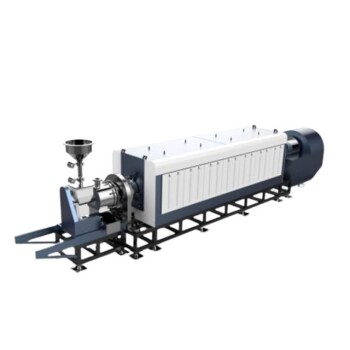
The shaft-type electric furnace acts as the thermal engine for the chlorination process in zirconium sponge production. Its primary function is to provide the high-temperature energy necessary to melt a specific mixture of salts, creating a liquid medium where chlorine gas can react with zirconium solids to produce zirconium tetrachloride.
Core Insight: The furnace does not merely heat the ingredients; it maintains a molten pool of sodium and potassium chlorides. This liquid state is the critical "thermodynamic environment" required for the gaseous chlorine to effectively interact with solid zirconium dioxide and carbon.
Creating the Reaction Environment
The Role of the Molten Pool
The furnace is designed to heat a mixture of sodium chloride (NaCl) and potassium chloride (KCl).
The goal is to bring these salts to a "predetermined temperature" where they transition from solid to liquid.
Establishing Thermal Stability
Once melted, these salts form a molten pool.
The furnace must maintain this state consistently. If the temperature fluctuates or drops, the pool solidifies, halting the ability of the reactants to mix and react.
Facilitating the Chemical Transformation
Integrating the Reactants
With the molten pool established, the furnace facilitates the introduction of several critical materials.
Chlorine gas is injected directly into this hot, liquid environment. Simultaneously, the pool holds the solid reactants: zirconium dioxide powder, carbon reducing agents, and zirconium powder.
Generating Zirconium Tetrachloride
The furnace provides the necessary thermodynamics for these diverse states of matter (gas, liquid, and solid) to interact.
Under the high heat provided by the shaft furnace, the chlorine reacts with the zirconium dioxide and reducing agents. This reaction successfully generates zirconium tetrachloride, the precursor required for zirconium sponge.
Operational Criticalities
Maintaining Thermodynamic Balance
The furnace is responsible for the overall energy balance of the system.
It must output enough heat to offset the cooling effect of adding fresh, room-temperature powders and gas to the mix.
Ensuring Reactant Contact
The efficiency of the furnace directly impacts how well the chlorine gas contacts the solid powders.
By keeping the salt bath fully molten and fluid, the furnace ensures the gas can disperse and react, rather than getting trapped or passing through unreacted.
Optimizing Process Control
- If your primary focus is Process Stability: Ensure the furnace power supply is regulated to keep the NaCl/KCl mixture continuously above its melting point to prevent "freezing" the bath.
- If your primary focus is Reaction Efficiency: Monitor the thermal consistency of the molten pool to ensure the thermodynamic environment is ideal for the conversion of zirconium dioxide to zirconium tetrachloride.
The shaft-type electric furnace is the foundational hardware that transforms raw solid inputs into a reactive liquid state, making the entire chlorination process possible.
Summary Table:
| Feature | Function in Chlorination Process |
|---|---|
| Thermal Engine | Provides high-temp energy for salt melting |
| Medium Creation | Maintains a molten pool of NaCl and KCl salts |
| Reactant Support | Facilitates interaction between Cl gas and Zr solids |
| Output | Ensures efficient generation of Zirconium Tetrachloride |
| Process Control | Offsets cooling effects to prevent bath solidification |
Optimize Your Zirconium Production Today
Precision in thermal environments is the difference between seamless reaction and costly solidification. KINTEK provides the high-performance thermal solutions you need to maintain perfect thermodynamic balance.
Backed by expert R&D and manufacturing, KINTEK offers Muffle, Tube, Rotary, Vacuum, and CVD systems, as well as specialized lab high-temp furnaces, all fully customizable for your unique material processing needs. Whether you are producing zirconium sponge or advanced alloys, our systems deliver the stability required for maximum reaction efficiency.
Ready to upgrade your lab's thermal capabilities? Contact KINTEK today to discuss your custom solution!
References
- М.М. Pylypenko, A.О. Drobyshevska. MAGNESIUM-THERMAL METHOD OF SPONGE ZIRCONIUM OBTAINING. DOI: 10.46813/2024-149-052
This article is also based on technical information from Kintek Furnace Knowledge Base .
Related Products
- Electric Rotary Kiln Continuous Working Small Rotary Furnace Kiln for Pyrolysis Plant Heating
- Spark Plasma Sintering SPS Furnace
- Electric Rotary Kiln Small Rotary Furnace for Activated Carbon Regeneration
- Electric Rotary Kiln Pyrolysis Furnace Plant Machine Small Rotary Kiln Calciner
- Electric Rotary Kiln Small Rotary Furnace Biomass Pyrolysis Plant Rotating Furnace
People Also Ask
- What are the advantages of electric rotary kilns compared to fuel-fired ones? Boost Precision and Efficiency in Your Process
- What materials can be processed in an electric rotary kiln? Versatile Solutions for Advanced Materials
- What advantages do electric rotary kilns offer over fuel-based kilns? Boost Efficiency and Purity in Your Process
- What are the primary applications of electric rotary kilns? Precision Thermal Processing for High-Value Materials
- In what ways are electric rotary kilns more environmentally friendly? Achieve Zero On-Site Emissions