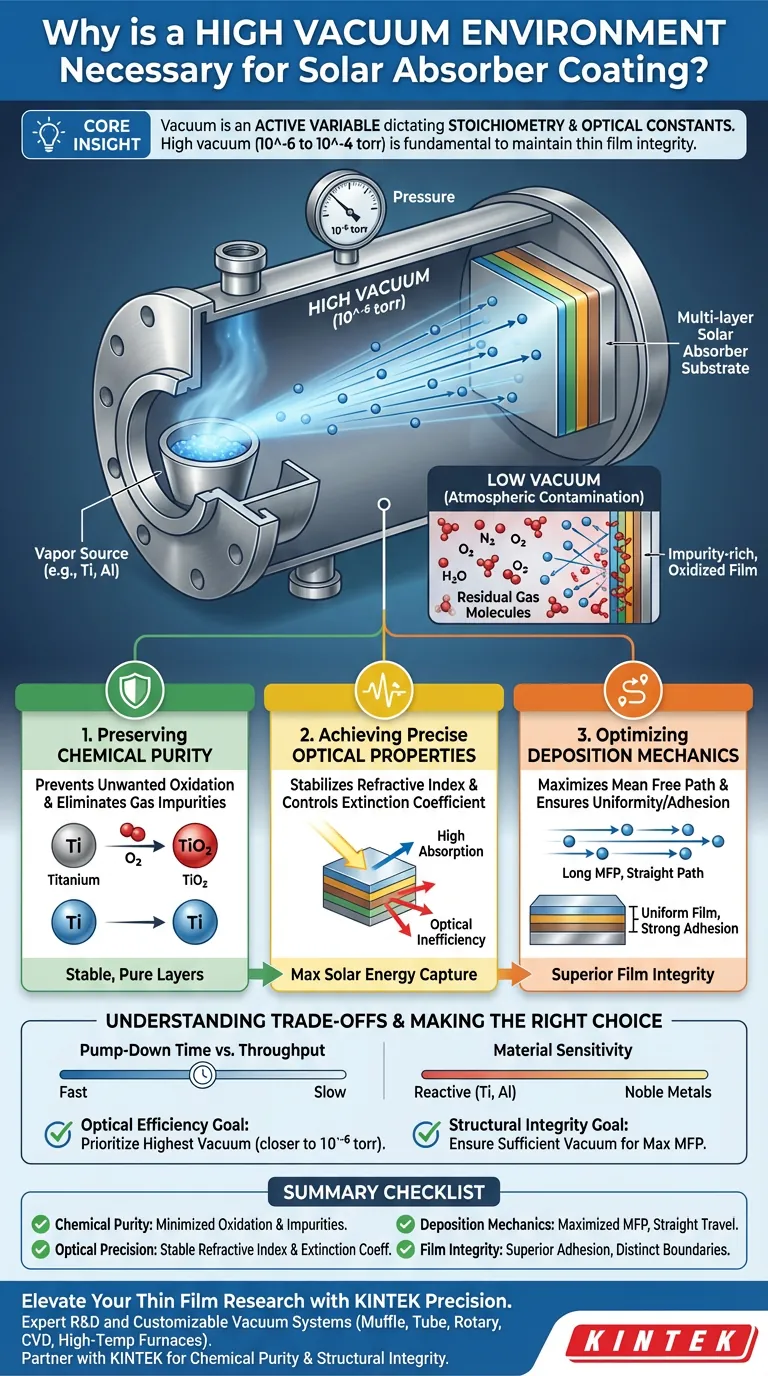
A high vacuum environment is fundamentally required to maintain the chemical and physical integrity of the thin films used in solar absorbers. Specifically, laboratory-grade systems must operate between 10^-6 and 10^-4 torr to minimize residual gas molecules, preventing them from reacting with the coating materials or physically scattering the vapor stream during deposition.
Core Insight: The vacuum is not just about keeping the chamber clean; it is an active variable that dictates the stoichiometry and optical constants of the final coating. Without high vacuum, unintended oxidation alters the refractive index of layers like alumina and titanium, rendering the multi-layer design optically inefficient.

Preserving Chemical Purity
To function correctly, a multi-layer solar absorber requires precise chemical composition. The vacuum environment is the primary defense against atmospheric contamination.
Preventing Unwanted Oxidation
Materials often used in solar absorbers, such as titanium, are highly reactive.
If residual oxygen is present in the chamber, these materials will oxidize before or during their deposition onto the substrate. This uncontrolled oxidation changes the material from a pure metal or specific dielectric into an oxide with completely different properties.
Eliminating Gas Impurities
Residual gas molecules do not just float in the chamber; they can become embedded within the growing film.
Operating at high vacuum minimizes the inclusion of these impurities. This ensures that the functional layers remain chemically pure, which is critical for the stability and longevity of the solar absorber.
Achieving Precise Optical Properties
The efficiency of a planar solar absorber is determined by how it interacts with light. This interaction is governed by strict material constants that rely on the purity established by the vacuum.
Stabilizing the Refractive Index
The refractive index determines how light propagates through the multi-layer stack.
If the chemical composition shifts due to impurities or oxidation, the refractive index changes. This mismatch causes light to reflect or scatter rather than being absorbed, degrading the device's performance.
Controlling the Extinction Coefficient
The extinction coefficient defines how strongly the material absorbs light at a given wavelength.
A high vacuum ensures that the deposited layers maintain the specific extinction coefficients calculated during the design phase. This guarantees that the solar energy is captured effectively rather than being lost.
Optimizing Deposition Mechanics
Beyond chemistry, the vacuum dictates the physical path the vaporized material takes from the source to the substrate.
Maximizing the Mean Free Path
In a high vacuum, the density of gas molecules is low enough to increase the mean free path of the vaporized atoms.
This ensures that the coating material travels in a straight line without colliding with residual gas molecules. This prevents the scattering of atoms, leading to a more efficient and direct deposition process.
Ensuring Uniformity and Adhesion
When atoms arrive at the substrate without scattering, they deposit with higher energy and directional uniformity.
This results in a film with consistent thickness and strong adhesion to the substrate. Uniformity is vital for maintaining the distinct boundaries required between the multiple layers of the absorber.
Understanding the Trade-offs
While high vacuum is essential for quality, achieving and maintaining it presents operational challenges.
Pump-Down Time vs. Throughput
Reaching pressures of 10^-6 torr requires significant time, which limits the number of runs per day.
You must balance the strict need for optical precision against the practical constraints of research timelines. However, for laboratory-grade solar absorbers, sacrificing vacuum quality for speed almost always results in unusable data.
Material Sensitivity
Not all materials are equally sensitive to vacuum levels.
While noble metals might forgive a slightly lower vacuum, reactive materials like titanium or aluminum permit no compromise. You must tailor your vacuum protocols to the most sensitive material in your multi-layer stack.
Making the Right Choice for Your Goal
The specific vacuum level you target should be dictated by the most critical performance metric of your solar absorber.
- If your primary focus is Optical Efficiency: Prioritize the highest possible vacuum (closer to 10^-6 torr) to prevent oxidation and strictly control the refractive index and extinction coefficient.
- If your primary focus is Structural Integrity: Ensure the vacuum is sufficient to maximize the mean free path, guaranteeing uniform thickness and strong adhesion between layers.
Success in vacuum evaporation depends on treating the vacuum level as a critical material component, just as important as the source metals themselves.
Summary Table:
| Key Factor | Impact of High Vacuum | Scientific Benefit |
|---|---|---|
| Chemical Purity | Minimizes residual oxygen and gas impurities | Prevents unintended oxidation of reactive materials like Ti or Al |
| Optical Precision | Stabilizes refractive index and extinction coefficient | Ensures high solar energy capture and minimal light scattering |
| Deposition Mechanics | Maximizes Mean Free Path (MFP) | Promotes straight-line vapor travel and uniform film thickness |
| Film Integrity | Enhances atom arrival energy | Results in superior adhesion and distinct layer boundaries |
Elevate Your Thin Film Research with KINTEK Precision
Precise control over vacuum levels is the difference between a high-efficiency solar absorber and a failed experiment. KINTEK provides the advanced technology required to master these variables. Backed by expert R&D and manufacturing, we offer a comprehensive range of Muffle, Tube, Rotary, Vacuum, and CVD systems, as well as specialized lab high-temp furnaces—all fully customizable to meet your unique deposition requirements.
Don't let atmospheric impurities compromise your optical constants. Partner with KINTEK to achieve the chemical purity and structural integrity your research demands.
Contact our technical experts today to discuss your custom furnace needs
Visual Guide
References
- Cheng‐Fu Yang, Kuei‐Kuei Lai. Development and Fabrication of a Multi-Layer Planar Solar Light Absorber Achieving High Absorptivity and Ultra-Wideband Response from Visible Light to Infrared. DOI: 10.3390/nano14110930
This article is also based on technical information from Kintek Furnace Knowledge Base .
Related Products
- 304 316 Stainless Steel High Vacuum Ball Stop Valve for Vacuum Systems
- Ultra Vacuum Electrode Feedthrough Connector Flange Power Lead for High Precision Applications
- Ultra High Vacuum Observation Window Stainless Steel Flange Sapphire Glass Sight Glass for KF
- High Pressure Laboratory Vacuum Tube Furnace
- Vacuum Induction Melting Furnace
People Also Ask
- What role do vacuum-sealed high-purity silica ampoules play in phase equilibrium experiments? Enhance Sample Integrity
- What is the function of quartz vacuum encapsulation in RhSeCl CVT? Mastering Pure Crystal Growth
- What role does a closed pressure vessel play during the carbonation of gamma-C2S? Unlock Rapid Mineralization
- What type of pump is used in water circulating vacuum pumps and how is it installed? Discover Robust Fluid-Based Vacuum Solutions
- What is the specific function of the water circulation cooler in zirconium sponge processing? Key for Purity & Safety