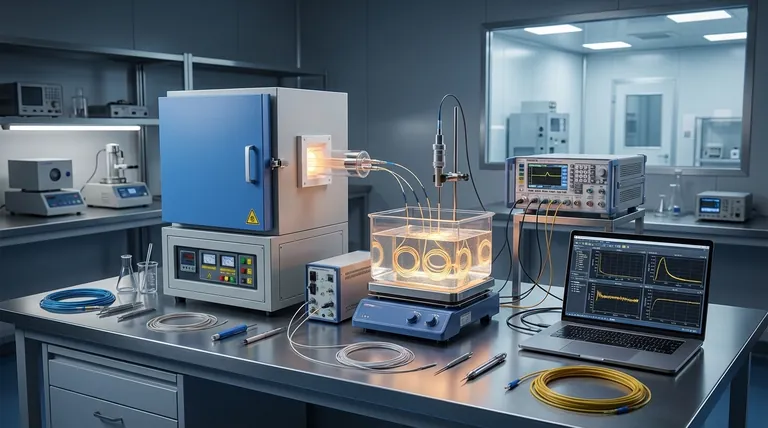
High-precision constant temperature baths are necessary because they generate a strictly controlled reference environment required for accurate data mapping. By immersing fiber optic sensors in stable mediums like ice point baths or molten salt furnaces, engineers can establish a precise correlation between the sensor's optical wavelength shift and the actual physical temperature.
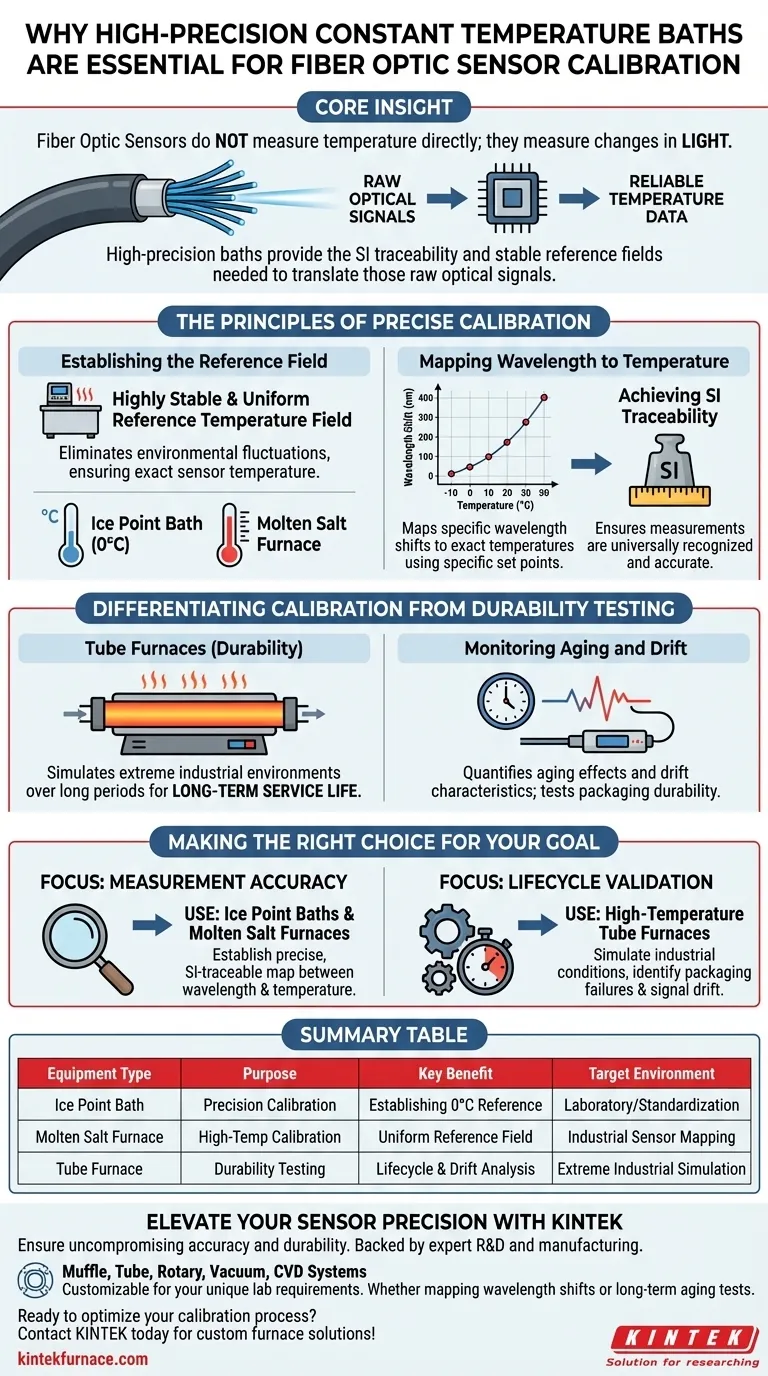
Core Insight: A fiber optic sensor does not measure temperature directly; it measures changes in light. High-precision baths provide the SI traceability and stable reference fields needed to translate those raw optical signals into reliable, standardized temperature data.
The Principles of Precise Calibration
Establishing the Reference Field
To calibrate a fiber optic sensor, you must compare its reading against a known truth.
High-precision constant temperature baths create a highly stable and uniform reference temperature field.
This uniformity eliminates environmental fluctuations, ensuring that the temperature affecting the sensor is exactly what the calibration equipment claims it is.
Mapping Wavelength to Temperature
Fiber optic sensors typically function by detecting a "wavelength shift" in the light passing through them.
However, this shift is meaningless without a reference scale.
Using specific set points—such as an ice point bath (0°C) or an industrial-grade molten salt furnace—allows researchers to map specific wavelength shifts to exact temperatures.
Achieving SI Traceability
Reliability in engineering depends on standardization.
Calibration baths allow researchers to achieve International System of Units (SI) traceability.
This ensures that the measurements taken by your sensor are not just internally consistent, but universally recognized and accurate.
Differentiating Calibration from Durability Testing
The Role of Tube Furnaces
While constant temperature baths focus on immediate calibration accuracy, other tools are required for stress testing.
High-temperature tube furnaces are used to simulate extreme industrial environments over long periods.
Unlike the precise mapping done in a bath, the tube furnace is primarily used to evaluate the long-term service life of the sensor.
Monitoring Aging and Drift
Calibration tells you if a sensor is accurate now; durability testing tells you if it will stay accurate later.
Long-term heating in a tube furnace allows researchers to quantify aging effects and drift characteristics.
This is essential for testing the durability of packaging materials, particularly for sensors destined for the energy sector.
Making the Right Choice for Your Goal
To ensure your fiber optic sensors are ready for deployment, you must match your testing equipment to your specific validation phase.
- If your primary focus is Measurement Accuracy: Prioritize ice point baths and molten salt furnaces to establish a precise, SI-traceable map between wavelength shifts and temperature.
- If your primary focus is Lifecycle Validation: Utilize high-temperature tube furnaces to simulate industrial conditions and identify potential packaging failures or signal drift over time.
Ultimately, high-precision calibration provides the foundational trust that turns a theoretical sensor into a reliable industrial instrument.
Summary Table:
| Equipment Type | Purpose | Key Benefit | Target Environment |
|---|---|---|---|
| Ice Point Bath | Precision Calibration | Establishing 0°C Reference | Laboratory/Standardization |
| Molten Salt Furnace | High-Temp Calibration | Uniform Reference Field | Industrial Sensor Mapping |
| Tube Furnace | Durability Testing | Lifecycle & Drift Analysis | Extreme Industrial Simulation |
Elevate Your Sensor Precision with KINTEK
Ensure your fiber optic sensors deliver uncompromising accuracy and durability. Backed by expert R&D and manufacturing, KINTEK offers high-performance Muffle, Tube, Rotary, Vacuum, and CVD systems, as well as specialized high-temp furnaces—all customizable for your unique lab requirements. Whether you are mapping wavelength shifts or conducting long-term aging tests, our equipment provides the stability and uniformity your research demands.
Ready to optimize your calibration process? Contact KINTEK today to discuss our custom furnace solutions!
Visual Guide
References
- Stephan Krenek, K. Anhalt. Fibre-optic thermometry to support the clean energy transition. DOI: 10.1515/teme-2025-0044
This article is also based on technical information from Kintek Furnace Knowledge Base .
Related Products
- Molybdenum Vacuum Heat Treat Furnace
- Vacuum Heat Treat Sintering Furnace Molybdenum Wire Vacuum Sintering Furnace
- High Temperature Muffle Oven Furnace for Laboratory Debinding and Pre Sintering
- 2200 ℃ Tungsten Vacuum Heat Treat and Sintering Furnace
- Laboratory Muffle Oven Furnace with Bottom Lifting
People Also Ask
- How does vacuum heat treating work in terms of temperature and time control? Master Precise Material Transformations
- What is the primary application of vacuum heat treating furnaces in aerospace? Enhance Component Performance with Precision
- How does a vacuum heat treating furnace improve the condition of metal alloys? Achieve Superior Metal Performance
- Why are vacuum heat treating furnaces essential for aerospace? Ensure Superior Material Integrity for High-Stakes Applications
- What is the process of vacuum heat treating? Achieve Superior Metallurgical Properties