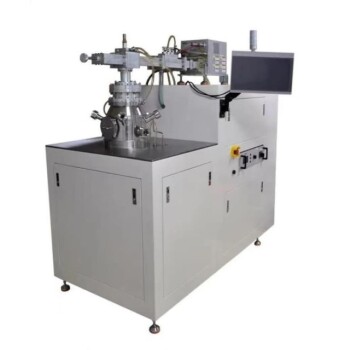
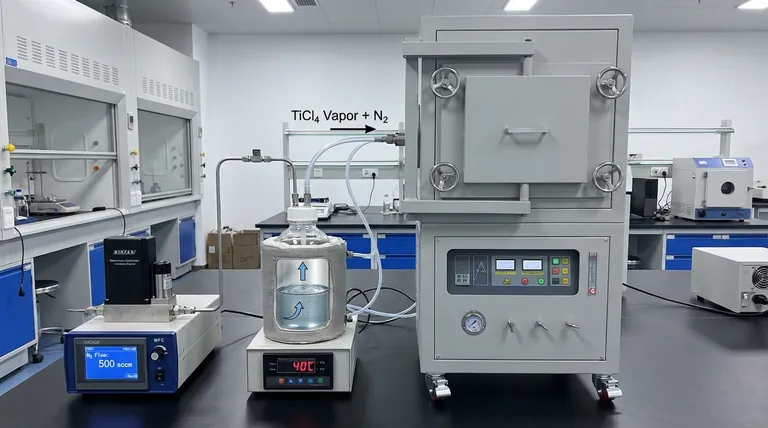
In an Atmospheric Pressure Atomic Layer Deposition (AP-ALD) system, the cooperation between the Mass Flow Controller (MFC) and the precursor source bottle is defined by a precision technique known as "vapor draw." The MFC strictly regulates the flow of high-purity nitrogen, directing it to pass over the liquid surface of a temperature-controlled precursor bottle. This method allows the carrier gas to pick up specific dosages of chemical vapor, such as Titanium Tetrachloride, and transport them to the reaction zone without physically bubbling the liquid.
The core advantage of this cooperation is the stability provided by the non-bubbling delivery method. By eliminating the turbulence of bubbling, the system ensures a consistent precursor supply, which is the absolute prerequisite for achieving uniform, atomic-level coating growth.
The Mechanics of Precision Delivery
The AP-ALD system relies on a delicate balance between gas flow and evaporation mechanics. This section breaks down how the hardware components interact to maintain that balance.
Precise Carrier Gas Regulation
The process begins with the Mass Flow Controller (MFC). Its primary role is to regulate the flow rate of high-purity nitrogen with extreme precision.
This nitrogen serves as the carrier medium. It is the vehicle that will eventually transport the reactive chemicals into the deposition chamber.
The Vapor Draw Technique
The interaction between the nitrogen and the precursor bottle utilizes a "vapor draw" mode.
In this configuration, the nitrogen does not pass through the liquid (bubbling). Instead, it flows strictly over the liquid surface of the precursor.
As the gas passes over the surface, it picks up precursor vapors through natural evaporation mechanics.
Temperature Control and Dosage
The precursor bottle itself is not a passive container; it is actively temperature-controlled.
By maintaining a specific temperature, the system ensures the liquid precursor maintains a constant vapor pressure.
This thermal stability, combined with the MFC's flow regulation, ensures that the dosage of precursor delivered to the reaction zone is constant and predictable.
Understanding the Trade-offs
While the vapor draw method described in the reference is superior for stability, it presents specific operational requirements that must be managed to avoid failure.
Dependency on Thermal Stability
The system's accuracy is entirely dependent on the temperature control of the source bottle.
If the bottle temperature fluctuates, the vapor pressure of the liquid changes.
This means that even if the MFC maintains a perfect nitrogen flow, the amount of precursor picked up will vary, leading to inconsistent coating thickness.
Saturation vs. Flow Rate
The non-bubbling method relies on surface interaction to saturate the carrier gas.
This creates a dependency between the surface area of the liquid and the speed of the gas flow.
If the MFC drives the nitrogen too quickly across the surface, the gas may not have enough time to pick up the required dosage of vapor.
Making the Right Choice for Your Goal
To achieve the best results with an AP-ALD system utilizing this configuration, you must view the MFC and the source bottle as a single, coupled variable.
- If your primary focus is Coating Uniformity: Ensure your precursor bottle's temperature controller is highly sensitive and calibrated, as this dictates the consistency of the vapor concentration.
- If your primary focus is Process Stability: Adhere strictly to the "vapor draw" (non-bubbling) configuration to eliminate the flow instabilities and pressure spikes often caused by traditional bubbling methods.
Success in AP-ALD lies in the synchronization of stable gas flow with precise thermal management of the precursor source.
Summary Table:
| Component | Role in AP-ALD System | Key Benefit |
|---|---|---|
| Mass Flow Controller (MFC) | Precise regulation of high-purity nitrogen carrier gas. | Ensures stable, consistent gas delivery to the reaction zone. |
| Precursor Source Bottle | Actively temperature-controlled liquid storage. | Maintains constant vapor pressure for predictable chemical dosage. |
| Vapor Draw Method | Directs gas flow over rather than through the liquid. | Eliminates bubbling turbulence for superior coating uniformity. |
| Nitrogen Carrier Gas | Transport medium for chemical vapors like TiCl4. | Delivers reactive precursors to the chamber without contamination. |
Elevate Your Thin-Film Precision with KINTEK
Achieving atomic-level uniformity requires the perfect synchronization of gas flow and thermal management. At KINTEK, we understand the delicate mechanics of AP-ALD and vapor delivery.
Backed by expert R&D and world-class manufacturing, we offer high-performance Muffle, Tube, Rotary, Vacuum, and CVD systems, along with specialized lab high-temp furnaces—all fully customizable to meet your unique research or production needs.
Ready to optimize your deposition process? Contact our technical experts today to discover how our precision heating and flow solutions can enhance your lab's efficiency and material performance.
References
- Michiel Nijboer, Mieke W.J. Luiten-Olieman. Tuning Nanopores in Tubular Ceramic Nanofiltration Membranes with Atmospheric-Pressure Atomic Layer Deposition: Prospects for Pressure-Based In-Line Monitoring of Pore Narrowing. DOI: 10.3390/separations11010024
This article is also based on technical information from Kintek Furnace Knowledge Base .
Related Products
- Multi Heating Zones CVD Tube Furnace Machine for Chemical Vapor Deposition Equipment
- CF KF Flange Vacuum Electrode Feedthrough Lead Sealing Assembly for Vacuum Systems
- Ultra-High Vacuum Flange Aviation Plug Glass Sintered Airtight Circular Connector for KF ISO CF
- High Performance Vacuum Bellows for Efficient Connection and Stable Vacuum in Systems
- Ultra High Vacuum CF Observation Window Flange with High Borosilicate Glass Sight Glass
People Also Ask
- What is the function of a multi-zone tube furnace in CVD synthesis? Master 2D In2Se3 Nanosheet Precision
- Why are multi zone tube furnaces particularly useful for nanomaterial research? Unlock Precise Thermal Control for Advanced Synthesis
- What temperature-related capabilities make multi zone tube furnaces valuable for research? Unlock Precision Thermal Control
- What role do multi zone tube furnaces play in new energy research? Unlock Precise Thermal Control for Innovation
- What environmental protection applications utilize multi zone tube furnaces? Unlock Precision in Waste Treatment and Green Tech