
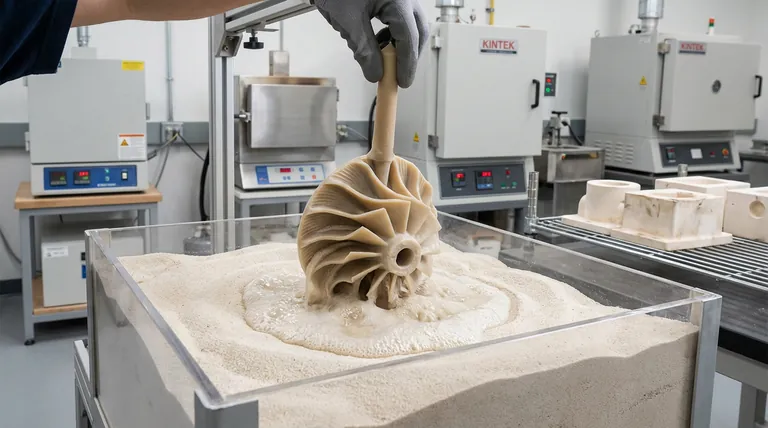
The primary problem addressed is the risk of inconsistent shell thickness and structural weakness in ceramic molds. A fluidized bed is employed specifically to ensure that refractory sand particles are applied with absolute uniformity and density over complex wax patterns.
By suspending sand particles in an air stream, the fluidized bed eliminates the uneven coating associated with manual or gravity-fed methods. This creates a homogeneous shell structure essential for surviving the extreme conditions of high-temperature casting.
Ensuring Structural Integrity in Complex Molds
The Challenge of Irregular Surfaces
Wax patterns used in high-precision casting often feature intricate geometries and deep recesses. Standard coating methods struggle to reach these areas evenly.
Without a fluidized bed, these complex shapes often suffer from localized thinning, where the ceramic shell is too thin to support the metal.
Achieving Uniform Stucco Application
The fluidized bed addresses this by suspending sand particles—typically alumina or mullite—in an upward flow of air.
This state allows the sand to behave like a fluid, flowing around the wax pattern. It ensures that every surface, regardless of orientation, receives a dense, even coating of stucco.
Preventing Catastrophic Failure
The ultimate goal of this uniformity is thermal stability.
During the directional solidification process, the mold is subjected to intense heat and pressure. Any weak point or thin spot in the shell is a potential site for cracks or total mold failure.
Understanding the Operational Trade-offs
Sensitivity to Material Properties
While effective, the fluidized bed relies on the precise behavior of the sand particles.
If the particle size distribution of the alumina or mullite is inconsistent, the "fluid" behavior breaks down. This can lead to the very segregation and uneven coating the process is meant to prevent.
Equipment Calibration
The airflow within the bed must be carefully controlled.
Too little air results in a static bed that damages the delicate wax pattern upon insertion. Too much air creates turbulence that prevents the sand from adhering densely to the pattern surface.
Maximizing Mold Reliability
To ensure your ceramic molds are prepared correctly for high-temperature environments, consider the following principles:
- If your primary focus is thermal durability: Ensure the fluidized bed is calibrated to apply a dense layer of high-grade refractory sand like mullite to withstand directional solidification.
- If your primary focus is geometric precision: Utilize the fluidization process to guarantee that stucco reaches deep crevices without bridging or creating voids.
The fluidized bed is the critical mechanism for transforming a fragile wax pattern into a robust vessel capable of containing molten metal.
Summary Table:
| Key Problem Addressed | Fluidized Bed Solution | Primary Benefit |
|---|---|---|
| Inconsistent Thickness | Uniform suspension of sand particles around complex wax patterns | Eliminates localized thinning and weak spots |
| Geometric Complexity | Air-suspended refractory sand flows into deep recesses | Guaranteed coating for intricate geometries |
| Thermal Shock Failure | High-density stucco application using alumina/mullite | Maximum structural integrity during solidification |
| Manual Coating Risks | Controlled airflow replaces gravity-fed or manual methods | Repeatable, homogeneous shell structure |
Precision Casting Starts with Superior Mold Integrity
Don't let inconsistent ceramic shells compromise your high-temperature casting results. KINTEK provides the advanced heating and processing solutions you need to ensure every mold survives the most demanding directional solidification.
Backed by expert R&D and world-class manufacturing, KINTEK offers Muffle, Tube, Rotary, Vacuum, and CVD systems, alongside specialized lab high-temp furnaces—all fully customizable to meet your unique materials research and production needs.
Ready to elevate your lab's precision? Contact us today to discuss your custom furnace requirements and see how our expertise can optimize your thermal processes.
References
- Dariusz Szeliga, Artur Wiechczyński. Directional Solidification of Single-Crystal Blades in Industrial Conditions Using the Developed Gas Cooling Casting Method. DOI: 10.1007/s11661-024-07391-y
This article is also based on technical information from Kintek Furnace Knowledge Base .
Related Products
- High Temperature Muffle Oven Furnace for Laboratory Debinding and Pre Sintering
- Multi Heating Zones CVD Tube Furnace Machine for Chemical Vapor Deposition Equipment
- Vertical Laboratory Quartz Tube Furnace Tubular Furnace
- Inclined Rotary Plasma Enhanced Chemical Deposition PECVD Tube Furnace Machine
- 1400℃ Muffle Oven Furnace for Laboratory
People Also Ask
- What thermal phenomena occur during polymer binder burnout in ceramic green bodies? Lab Furnace Guide
- What role does a high-temperature muffle furnace play in STFO synthesis? Achieve Pure Perovskite Results
- Why is controlled heat treatment in a muffle furnace necessary for calcined clay? Achieve Optimal Pozzolanic Activity
- How does a high-temperature muffle furnace facilitate the formation of LaNbxAl1−xO3+δ perovskite structures? Key Roles
- What role does a high-temperature muffle furnace play in the multi-stage synthesis of Li0.5MnFe1.5O4? Key to Pure Spinel



















