
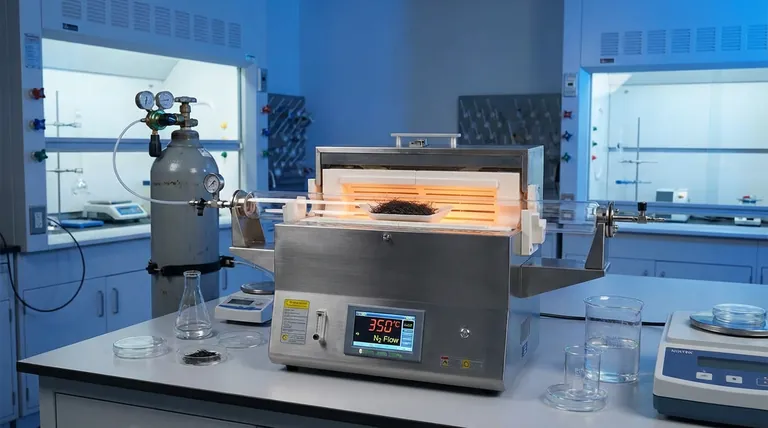
The annealing process acts as the critical structural architect for these nanowires. By utilizing a lab high-temperature tube furnace at 350 °C under a nitrogen atmosphere, you facilitate the complete dehydration and transformation of hydroxide precursors. This thermal treatment is responsible for converting basic stacked components into sophisticated Co3O4/Cu2+1O heterojunction nanowires.
Annealing is not merely a drying step; it is the mechanism that drives structural hybridization. By strictly controlling temperature and atmosphere, the process generates abundant pores and maximizes the exposure of active sites, which is essential for efficient electrocatalysis.
The Mechanics of Structural Transformation
Controlled Dehydration
The primary function of the 350 °C environment is to drive the complete dehydration of hydroxide precursors.
This thermal energy forces water molecules out of the precursor structure. The removal of these molecules is the first step in converting the raw chemical stack into a stable oxide form.
Structural Hybridization
Beyond simple drying, the furnace facilitates a complex structural hybridization between the different components.
The process converts what were initially simple stacked structures into integrated heterojunctions. This fusion creates the specific Co3O4/Cu2+1O interface necessary for the material's advanced properties.
Impact on Electrocatalytic Performance
Formation of Abundant Pores
The transformation process within the tube furnace directly results in the formation of abundant pores throughout the nanowires.
These pores are not defects; they are critical features engineered by the annealing process. They increase the specific surface area of the material significantly.
Increasing Active Site Exposure
The ultimate goal of this structural change is to increase the exposure rate of active sites.
By creating a porous, heterojunction structure, the material allows for greater interaction with electrolytes. This directly correlates to improved performance in electrocatalysis applications.
Critical Process Control Factors
The Necessity of a Protective Atmosphere
The reference explicitly states the need for a nitrogen protective atmosphere.
Without this inert environment, the specific oxidation states (Co3O4 and Cu2+1O) could be compromised by uncontrolled atmospheric oxygen. Nitrogen ensures that the chemical transformation follows the intended pathway without unwanted side reactions.
Temperature Precision
The specific temperature of 350 °C is identified as the catalyst for this transformation.
Deviating from this temperature could lead to incomplete dehydration (if too low) or potential structural collapse (if too high). Adhering to this precise thermal parameter is vital for achieving the correct crystalline phase.
Making the Right Choice for Your Goal
To optimize the synthesis of Co3O4/Cu2+1O nanowires, consider the following based on your specific objectives:
- If your primary focus is structural integrity: Ensure the nitrogen flow is constant to prevent environmental contamination during the hybridization phase.
- If your primary focus is catalytic efficiency: Prioritize the 350 °C set point to guarantee the formation of the porous architecture that exposes active sites.
Precision in the annealing environment is the key to unlocking the full electrochemical potential of these heterojunction nanowires.
Summary Table:
| Parameter | Process Role | Impact on Nanowires |
|---|---|---|
| Temperature (350°C) | Controlled Dehydration | Converts hydroxides into stable oxide phases |
| Atmosphere (Nitrogen) | Protective Environment | Prevents unwanted oxidation; ensures phase purity |
| Thermal Treatment | Structural Hybridization | Creates Co3O4/Cu2+1O interface for heterojunctions |
| Morphology Control | Pore Formation | Increases surface area and active site exposure |
Elevate Your Materials Synthesis with KINTEK
Precise control over temperature and atmosphere is the difference between a failed precursor and a high-performance heterojunction. At KINTEK, we understand that advanced electrocatalysis research demands absolute accuracy.
Backed by expert R&D and world-class manufacturing, KINTEK offers Tube, Muffle, Rotary, Vacuum, and CVD systems designed to meet the rigorous demands of your laboratory. Our high-temperature furnaces are fully customizable, ensuring you maintain the exact 350°C nitrogen-protected environment required for superior nanowire architecture.
Ready to optimize your annealing process? Contact us today to find the perfect furnace for your unique needs!
References
- Kinetic Understanding of the Enhanced Electroreduction of Nitrate to Ammonia for Co3O4–Modified Cu2+1O Nanowire Electrocatalyst. DOI: 10.3390/catal15050491
This article is also based on technical information from Kintek Furnace Knowledge Base .
Related Products
- 1400℃ High Temperature Laboratory Tube Furnace with Alumina Tube
- 1700℃ High Temperature Laboratory Tube Furnace with Alumina Tube
- 1200℃ Split Tube Furnace Laboratory Quartz Tube Furnace with Quartz Tube
- Vertical Laboratory Quartz Tube Furnace Tubular Furnace
- 1800℃ High Temperature Muffle Oven Furnace for Laboratory
People Also Ask
- How does zone-melting in tube furnaces synthesize bismuth micro-wires? Master Single-Crystal Thermoelectric Growth
- How are high-temp tube furnaces used to measure diffusion coefficients per Fick's law? Master Precision Annealing
- How do high-temperature laboratory tube furnaces ensure environmental stability? Precision Thermal Reduction Tips
- How are high-temperature laboratory tube furnaces applied in long-term vacuum homogenization heat treatments for intermetallic samples?
- How are high-temperature tube furnaces applied in testing ceramic-supported alloy membranes? Insights



















