
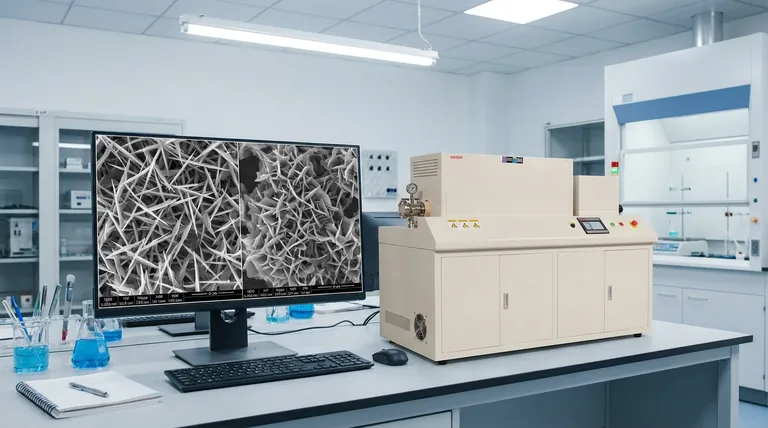
Scanning Electron Microscopy (SEM) serves as the definitive tool for verifying that manganese phosphate catalysts maintain their structural integrity throughout the thermal transformation process. By providing high-resolution imaging of the material’s micro-morphology, SEM allows researchers to confirm that the nanosheet structure of the precursor is successfully preserved in the final $KMnPO_4$ product after dehydration calcination.
Core Takeaway: SEM evaluation ensures that the macroscopic shape of the catalyst remains constant while its internal coordination chemistry changes, allowing for scientifically valid comparisons in electrochemical performance.
The Role of SEM in Morphology Verification
Observing Pre- and Post-Calcination States
SEM is utilized to capture the micro-morphology of manganese phosphate at two critical stages: before and after the dehydration calcination process.
By comparing these images, researchers can visually audit the physical transition and ensure the material does not collapse or aggregate into a different form.
Confirming Nanosheet Retention
A primary goal in synthesizing these catalysts is to ensure the resulting $KMnPO_4$ retains the nanosheet structure of its precursor.
SEM provides the visual evidence required to prove that the high-surface-area geometry survived the intense heat of the calcination oven.
Why Morphology Consistency Matters
Isolating Structural Variables
The dehydration process is designed to alter the manganese coordination structure, which is a chemical change rather than a physical one.
If the morphology remains consistent, researchers can attribute changes in catalytic activity solely to these coordination shifts rather than changes in shape.
Enabling Fair Physical Comparisons
Maintaining the same macroscopic morphology ensures that physical parameters, such as specific surface area, remain relatively stable.
This consistency is essential for a fair comparison during subsequent electrochemical testing, preventing surface area fluctuations from skewing the results.
Understanding the Trade-offs
The Risk of Thermal Degradation
While the goal is consistency, excessive calcination temperatures can lead to the "sintering" or melting of nanosheets.
SEM is the only way to detect these micro-scale failures that would otherwise go unnoticed in bulk chemical analysis.
Limitations of Visual Inspection
While SEM confirms shape retention, it cannot verify the internal crystal phase or chemical purity of the catalyst.
Researchers must pair SEM data with X-ray Diffraction (XRD) to ensure that while the shape stayed the same, the internal chemistry transitioned correctly.
Applying SEM Data to Your Catalyst Evaluation
Strategic Use of Imaging Results
To effectively utilize SEM in your evaluation, focus on how the physical structure impacts your final testing environment.
- If your primary focus is electrochemical performance: Use SEM to verify that surface area is not a hidden variable caused by morphology collapse.
- If your primary focus is synthesis optimization: Use SEM to identify the exact temperature threshold where nanosheets begin to lose their structural definition.
By confirming that the macroscopic structure survives the transition to $KMnPO_4$, you ensure that your experimental conclusions are based on chemical evolution rather than physical degradation.
Summary Table:
| Stage | SEM Evaluation Focus | Key Benefit |
|---|---|---|
| Pre-Calcination | Establishing baseline micro-morphology | Defines initial nanosheet structure |
| Post-Calcination | Verifying structural retention of $KMnPO_4$ | Confirms success of thermal transformation |
| Comparison | Detecting sintering or aggregation | Ensures valid electrochemical testing results |
| Quality Control | Identifying thermal degradation thresholds | Optimizes calcination temperature profiles |
Optimize Your Catalyst Synthesis with KINTEK
Precise morphology retention starts with superior thermal control. KINTEK provides industry-leading Muffle, Tube, Rotary, and Vacuum furnaces, along with advanced CVD systems, designed to meet the rigorous demands of catalyst calcination.
Our customizable high-temperature solutions ensure your manganese phosphate precursors transform chemically without sacrificing their critical nanosheet structure. Backed by expert R&D and precision manufacturing, we help researchers achieve the morphology consistency required for breakthrough electrochemical performance.
Ready to elevate your lab's thermal processing? Contact us today to find the perfect furnace solution!
References
- Shujiao Yang, Wei Zhang. Electrocatalytic water oxidation with manganese phosphates. DOI: 10.1038/s41467-024-45705-1
This article is also based on technical information from Kintek Furnace Knowledge Base .
Related Products
- 1400℃ High Temperature Laboratory Tube Furnace with Alumina Tube
- 1700℃ High Temperature Laboratory Tube Furnace with Alumina Tube
- High Temperature Muffle Oven Furnace for Laboratory Debinding and Pre Sintering
- 1200℃ Muffle Oven Furnace for Laboratory
- 1800℃ High Temperature Muffle Oven Furnace for Laboratory
People Also Ask
- How does zone-melting in tube furnaces synthesize bismuth micro-wires? Master Single-Crystal Thermoelectric Growth
- How do high-temperature laboratory tube furnaces ensure environmental stability? Precision Thermal Reduction Tips
- How are high-temp tube furnaces used to measure diffusion coefficients per Fick's law? Master Precision Annealing
- How are high-temperature laboratory tube furnaces applied in long-term vacuum homogenization heat treatments for intermetallic samples?
- How are high-temperature tube furnaces applied in testing ceramic-supported alloy membranes? Insights



















