
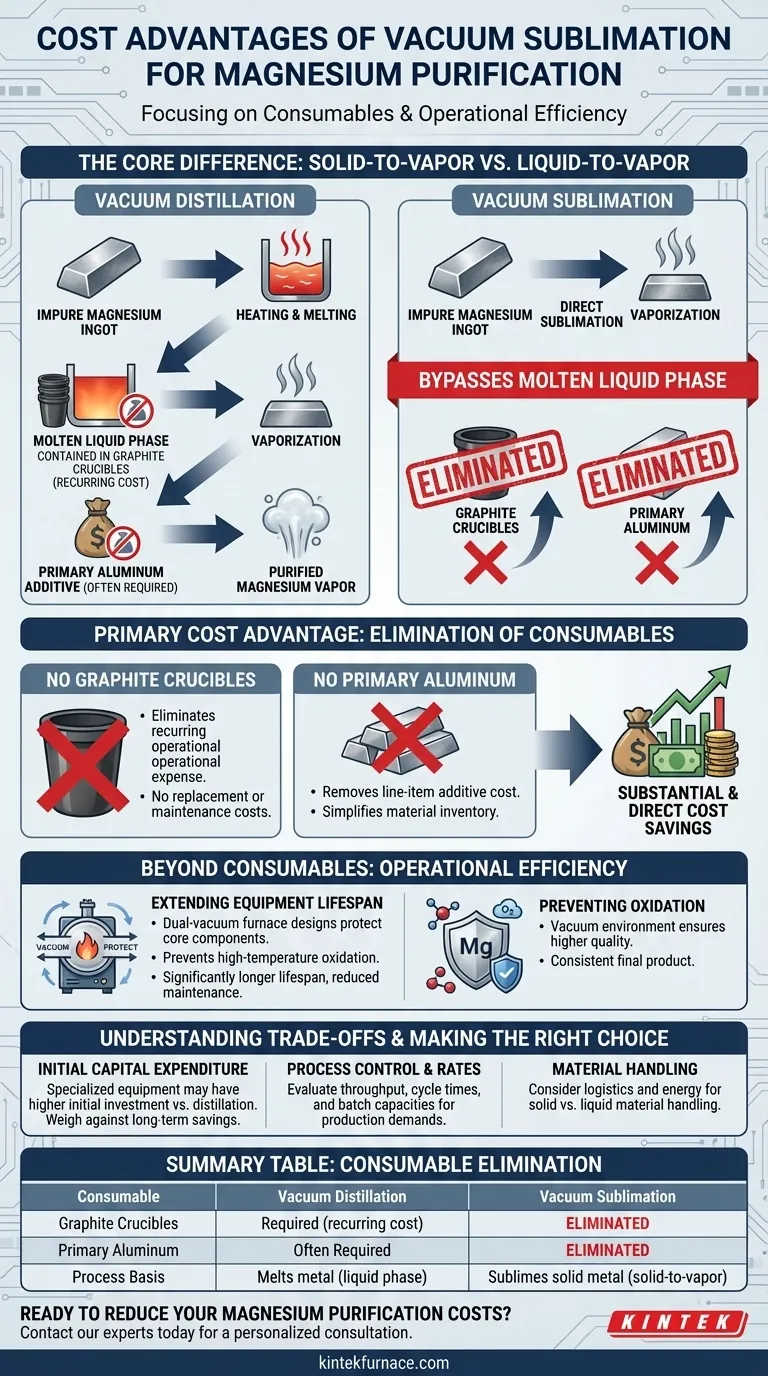
The primary cost advantage is one of elimination. Unlike vacuum distillation, the vacuum sublimation method for magnesium purification completely removes the need for two significant consumables: graphite crucibles and primary aluminum. This is because sublimation converts solid magnesium directly into a vapor, bypassing the molten liquid phase that necessitates these materials.
By avoiding the intermediate step of melting the magnesium, the sublimation process fundamentally redesigns the workflow to make key consumables required by distillation entirely obsolete, leading to substantial and direct cost savings.
The Core Difference: Solid-to-Vapor vs. Liquid-to-Vapor
To understand the cost implications, we must first look at the fundamental mechanics of each purification process. The need for specific consumables is tied directly to the physical state of the magnesium during treatment.
How Vacuum Distillation Works
Vacuum distillation is a two-step process. First, the impure magnesium is heated until it becomes a molten liquid. Then, this liquid is further heated under a vacuum until it vaporizes, leaving impurities behind.
The Role of Graphite Crucibles
Molten magnesium is highly corrosive. The distillation process requires robust graphite crucibles simply to contain this liquid metal during the heating and vaporization stages. These crucibles are a significant and recurring operational expense.
The Need for Primary Aluminum
In many distillation setups, primary aluminum is used as an additive within the molten bath. This consumable is another line-item cost inherent to the distillation method.
How Vacuum Sublimation Works
Vacuum sublimation streamlines the purification process into a single phase change. Solid magnesium ingots are heated directly under a vacuum, causing them to transition from a solid straight to a vapor (sublimation).
Eliminating the Consumables
Because the magnesium never enters a liquid state, the need for a container to hold molten metal is gone. This completely eliminates the cost of purchasing and replacing graphite crucibles. Likewise, the process does not require primary aluminum, removing that expense as well.
Beyond Consumables: A Look at Operational Efficiency
While the savings on consumables are the most direct financial advantage, the design of sublimation systems can also lead to other long-term cost benefits.
Preventing High-Temperature Oxidation
A key benefit of performing this process under a vacuum is the prevention of oxidation. This ensures a higher quality and more consistent final product, regardless of the method used.
Extending Equipment Lifespan
Modern sublimation systems often use a dual-vacuum furnace design. This creates a vacuum not only for the magnesium but also in the space between the inner reaction canister and the outer furnace wall.
This design brilliantly protects the inner canister from being oxidized by ambient air and prevents it from deforming under pressure. The result is a significantly longer lifespan for the core reaction vessel, reducing major replacement and maintenance costs over time.
Understanding the Trade-offs
No technical decision is without trade-offs. While sublimation offers clear advantages in consumables, a complete analysis requires considering the entire operational picture.
Initial Capital Expenditure
The specialized equipment for vacuum sublimation, such as an advanced dual-vacuum furnace, may represent a different initial capital investment compared to traditional distillation setups. This initial cost must be weighed against the long-term savings on consumables.
Process Control and Rates
The rate of purification, or throughput, is a critical factor in overall cost-effectiveness. You must evaluate the cycle times and batch capacities for each method to determine which aligns better with your production demands.
Material Handling
Sublimation begins with solid ingots, while distillation requires melting. The logistics and energy requirements for material handling in each process will differ and should be factored into a total cost analysis.
Making the Right Choice for Your Goal
Your optimal choice depends on which economic factors are most critical to your operation.
- If your primary focus is minimizing recurring operational costs: Vacuum sublimation is the superior choice due to the complete elimination of crucible and aluminum expenses.
- If your primary focus is long-term equipment reliability: The advanced furnace designs associated with sublimation can offer a longer lifespan for core components, reducing maintenance and replacement costs.
- If you are evaluating a new installation: You must weigh the significant long-term consumable savings of sublimation against the initial capital investment and specific throughput requirements of your project.
By understanding these fundamental process differences, you can accurately assess the total cost of ownership for each method.
Summary Table:
| Consumable | Vacuum Distillation | Vacuum Sublimation |
|---|---|---|
| Graphite Crucibles | Required (recurring cost) | Eliminated |
| Primary Aluminum | Often Required | Eliminated |
| Process Basis | Melts metal (liquid phase) | Sublimes solid metal (solid-to-vapor) |
Ready to reduce your magnesium purification costs?
By eliminating the need for expensive graphite crucibles and primary aluminum, the vacuum sublimation method offers a direct path to significant operational savings. Our expertise in high-temperature vacuum furnace systems, including advanced dual-vacuum designs, ensures a reliable and cost-effective purification process tailored to your specific production goals.
Let's discuss how our solutions can enhance your efficiency and profitability. Contact our experts today for a personalized consultation.
Visual Guide
Related Products
- Magnesium Extraction and Purification Condensing Tube Furnace
- Vacuum Hot Press Furnace Machine for Lamination and Heating
- Vacuum Heat Treat Sintering Furnace Molybdenum Wire Vacuum Sintering Furnace
- Vacuum Heat Treat Sintering Furnace with Pressure for Vacuum Sintering
- Small Vacuum Heat Treat and Tungsten Wire Sintering Furnace
People Also Ask
- What are the advantages of using a condensing tube furnace for magnesium extraction? Achieve High Purity and Efficient Metal Recovery
- How does thermal treatment in a tube furnace improve biomass films? Enhance Heat Management via Graphitization
- What are the three main types of tube furnaces? Choose the Right One for Your Lab
- What are the features of more elaborate tube furnaces? Precision Control for Advanced Thermal Processing
- How does a tube furnace contribute to the ammonia reduction annealing process for (NiZnMg)MoN catalysts? Optimize Phase Transitions






