
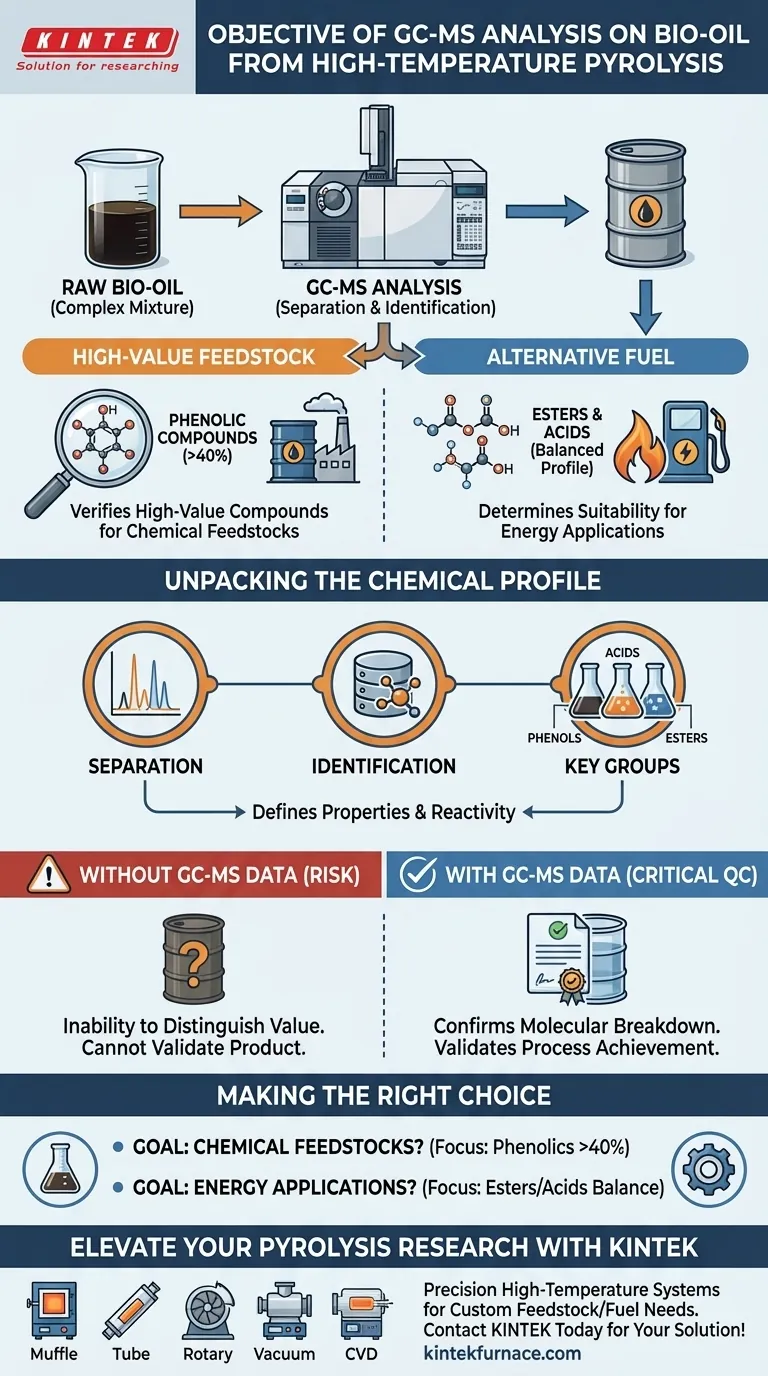
The primary objective of performing Gas Chromatography-Mass Spectrometry (GC-MS) on bio-oil derived from high-temperature furnace pyrolysis is to rigorously separate and identify its complex chemical constituents. This analytical process generates a detailed chemical profile, allowing researchers to verify the presence of high-value compounds and determine the oil's specific industrial utility.
GC-MS analysis moves bio-oil from a raw, unknown mixture to a defined product. By quantifying specific chemical groups, this analysis provides the decisive data needed to categorize the oil as either a source for high-value chemical feedstocks or a viable alternative fuel.
Unpacking the Chemical Profile
Separation and Identification
Bio-oil produced via high-temperature pyrolysis is a highly complex mixture. GC-MS is utilized to break down this mixture into individual components to understand its exact composition.
Identifying Key Functional Groups
The analysis specifically targets the identification of distinct chemical families. The primary groups of interest include phenols, acids, and esters, which define the oil's chemical properties and potential reactivity.
Determining Commercial Viability
Verifying High-Value Components
A major objective of this analysis is to assess the economic potential of the bio-oil. GC-MS is used to verify the concentration of lucrative chemicals, specifically looking for phenolic compounds exceeding 40%.
Defining the End-Use Case
The chemical profile dictates the final application of the product. Data showing high concentrations of specific compounds supports use as a chemical feedstock, whereas different profiles determines suitability as an alternative fuel.
Understanding the Stakes
The Risk of Lack of Data
The trade-off in skipping or under-utilizing GC-MS analysis is the inability to distinguish value. Without a detailed chemical profile, it is impossible to validate whether the bio-oil is a commodity product or a simple fuel.
Critical Quality Control
Reliance on general physical properties alone is insufficient for high-temperature pyrolysis products. The specific molecular breakdown provided by GC-MS is the only way to confirm that the pyrolysis process achieved the desired chemical transformation.
Making the Right Choice for Your Goal
To maximize the value of your bio-oil analysis, align your interpretation of the GC-MS data with your specific end goals:
- If your primary focus is Chemical Feedstocks: Prioritize the quantification of phenolic compounds to confirm they meet or exceed the 40% concentration threshold.
- If your primary focus is Energy Applications: Analyze the profile for a balance of esters and acids that suggests stability and suitability for combustion as an alternative fuel.
GC-MS analysis provides the essential evidentiary basis required to certify bio-oil for specific industrial applications.
Summary Table:
| Analytical Objective | Key Components Identified | Industrial Outcome |
|---|---|---|
| Chemical Separation | Complex mixture of organic molecules | Detailed chemical fingerprinting |
| Functional Grouping | Phenols, acids, and esters | Definition of chemical reactivity |
| Economic Valuation | High-value chemicals (>40% phenols) | Validation as premium feedstock |
| Application Definition | Esters and volatile organic compounds | Determination as alternative fuel |
Elevate Your Pyrolysis Research with KINTEK
Maximize the potential of your bio-oil production with precision equipment designed for high-performance research. Backed by expert R&D and manufacturing, KINTEK offers high-temperature Muffle, Tube, Rotary, Vacuum, and CVD systems—all fully customizable to meet your unique chemical feedstock or fuel development needs.
Ready to achieve superior chemical transformation? Contact us today to find your custom lab furnace solution!
Visual Guide
References
- Hussien Elshareef, Yuguang Zhou. Investigation of Bio-Oil and Biochar Derived from Cotton Stalk Pyrolysis: Effect of Different Reaction Conditions. DOI: 10.3390/resources14050075
This article is also based on technical information from Kintek Furnace Knowledge Base .
Related Products
- Electric Rotary Kiln Continuous Working Small Rotary Furnace Kiln for Pyrolysis Plant Heating
- 1700℃ High Temperature Muffle Oven Furnace for Laboratory
- 1800℃ High Temperature Muffle Oven Furnace for Laboratory
- 1400℃ Muffle Oven Furnace for Laboratory
- 1200℃ Muffle Oven Furnace for Laboratory
People Also Ask
- What are the advantages of electric rotary kilns compared to fuel-fired ones? Boost Precision and Efficiency in Your Process
- What materials can be processed in an electric rotary kiln? Versatile Solutions for Advanced Materials
- What advantages do electric rotary kilns offer over fuel-based kilns? Boost Efficiency and Purity in Your Process
- What are the primary applications of electric rotary kilns? Precision Thermal Processing for High-Value Materials
- How do electric rotary kilns achieve high thermal efficiency? Unlock Over 95% Thermal Efficiency



















