Knowledge Why is instantaneous heating required for N-GC-X catalyst synthesis? Achieve Superior 2D Nanosheet Morphology
Author avatar

Tech Team · Kintek Furnace

Updated 3 hours ago

Why is instantaneous heating required for N-GC-X catalyst synthesis? Achieve Superior 2D Nanosheet Morphology


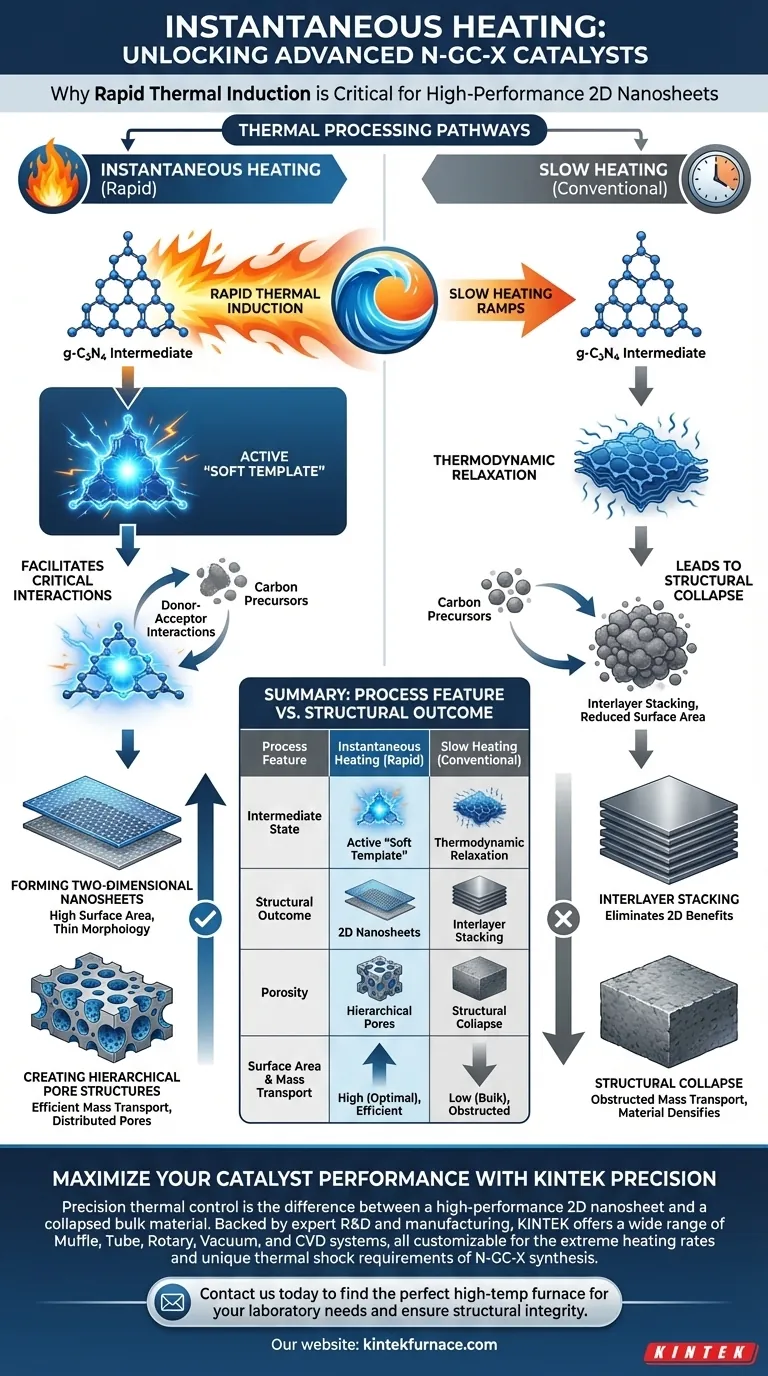
Instantaneous heating is strictly required to generate the extremely high heating rates necessary for transforming the g-C3N4 intermediate into an effective soft template. Without this rapid thermal induction, the essential donor-acceptor interactions with carbon precursors cannot be properly sustained to shape the final catalyst.

By utilizing rapid thermal induction, you prevent the structural collapse inherent to slower heating methods. This specific thermal shock is the only way to preserve the interactions required to form two-dimensional carbon nanosheets with hierarchical porosity.
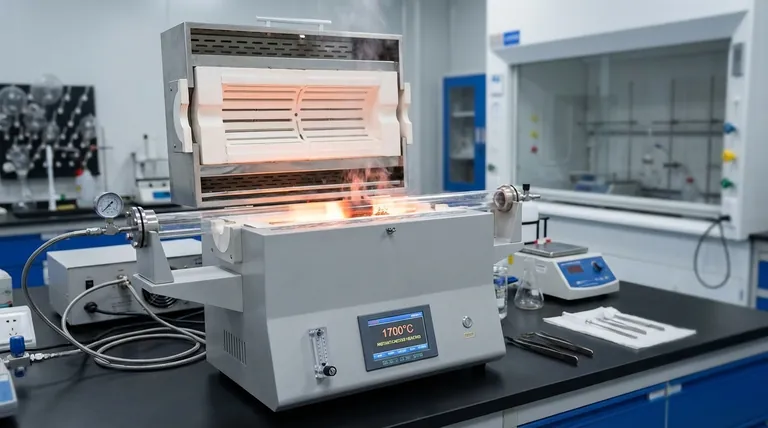
Why is instantaneous heating required for N-GC-X catalyst synthesis? Achieve Superior 2D Nanosheet Morphology

The Mechanism of Soft Templating

Activating the Intermediate

The primary function of instantaneous heating is to activate the g-C3N4 intermediate.

Under high heating rates, this compound behaves as a "soft template." This state is transient and requires rapid energy input to be maintained effectively during synthesis.

Facilitating Donor-Acceptor Interactions

Once active as a soft template, g-C3N4 engages in critical donor-acceptor interactions with the carbon precursors.

These chemical interactions guide the assembly of the material. They are responsible for directing the carbon precursors into the desired architectural configuration rather than a random bulk mass.

Structural Implications

Forming Two-Dimensional Nanosheets

The ultimate goal of this synthesis is the creation of two-dimensional carbon nanosheets.

The rapid thermal induction allows these thin, sheet-like structures to form. This morphology offers a significant surface area advantage compared to bulk materials.

Creating Hierarchical Pore Structures

Beyond the 2D shape, the catalyst requires a specific internal architecture known as hierarchical porosity.

Instantaneous heating ensures that pores of various sizes are distributed throughout the nanosheets. This structure is vital for mass transport within the catalyst during its final application.

Understanding the Trade-offs

The Risks of Slow Heating

It is critical to understand why standard, slower heating ramps fail in this specific synthesis.

Slow heating allows time for thermodynamic relaxation, which leads to structural collapse. Instead of retaining an open, porous network, the material densifies.

Preventing Interlayer Stacking

A major pitfall of insufficient heating rates is interlayer stacking.

Without the shock of instantaneous heating, the developing carbon layers tend to stack on top of one another. This reduces the exposed surface area and eliminates the benefits of the 2D nanosheet morphology.

Making the Right Choice for Your Synthesis

To ensure you achieve the desired N-GC-X catalyst properties, align your thermal processing with your structural goals:

  • If your primary focus is high surface area: You must use instantaneous heating to prevent interlayer stacking and ensure the formation of separated nanosheets.
  • If your primary focus is mass transport efficiency: You must prioritize the high heating rate to secure the hierarchical pore structure that prevents structural collapse.

The success of N-GC-X synthesis relies entirely on the speed of thermal induction to lock in the template's structure before it can degrade.

Summary Table:

Process Feature Instantaneous Heating (Rapid) Slow Heating (Conventional)
Intermediate State Active "Soft Template" Thermodynamic Relaxation
Structural Outcome 2D Nanosheets Interlayer Stacking
Porosity Hierarchical Pores Structural Collapse
Surface Area High (Optimal) Low (Bulk Material)
Mass Transport Efficient Obstructed

Maximize Your Catalyst Performance with KINTEK Precision

Precision thermal control is the difference between a high-performance 2D nanosheet and a collapsed bulk material. Backed by expert R&D and manufacturing, KINTEK offers a wide range of Muffle, Tube, Rotary, Vacuum, and CVD systems, all customizable for the extreme heating rates and unique thermal shock requirements of N-GC-X synthesis.

Don't let slow heating compromise your research. Contact us today to find the perfect high-temp furnace for your laboratory needs and ensure the structural integrity of your advanced materials.

Visual Guide
Why is instantaneous heating required for N-GC-X catalyst synthesis? Achieve Superior 2D Nanosheet Morphology Visual Guide

References

  1. Ganchang Lei, Lilong Jiang. Atom-economical insertion of hydrogen and sulfur into carbon–nitrogen triple bonds using H<sub>2</sub>S <i>via</i> synergistic C–N sites. DOI: 10.1039/d5ey00110b

This article is also based on technical information from Kintek Furnace Knowledge Base .

Related Products

People Also Ask

Related Products

1700℃ High Temperature Laboratory Tube Furnace with Quartz or Alumina Tube

1700℃ High Temperature Laboratory Tube Furnace with Quartz or Alumina Tube

KINTEK's Tube Furnace with Alumina Tube: Precision heating up to 1700°C for material synthesis, CVD, and sintering. Compact, customizable, and vacuum-ready. Explore now!

2200 ℃ Tungsten Vacuum Heat Treat and Sintering Furnace

2200 ℃ Tungsten Vacuum Heat Treat and Sintering Furnace

2200°C Tungsten Vacuum Furnace for high-temperature materials processing. Precise control, superior vacuum, customizable solutions. Ideal for research & industrial applications.

1700℃ Controlled Inert Nitrogen Atmosphere Furnace

1700℃ Controlled Inert Nitrogen Atmosphere Furnace

KT-17A Controlled Atmosphere Furnace: Precise 1700°C heating with vacuum & gas control. Ideal for sintering, research & material processing. Explore now!

Vacuum Heat Treat Sintering Furnace Molybdenum Wire Vacuum Sintering Furnace

Vacuum Heat Treat Sintering Furnace Molybdenum Wire Vacuum Sintering Furnace

KINTEK's Vacuum Molybdenum Wire Sintering Furnace excels in high-temperature, high-vacuum processes for sintering, annealing, and material research. Achieve precise 1700°C heating with uniform results. Custom solutions available.

1400℃ Controlled Inert Nitrogen Atmosphere Furnace

1400℃ Controlled Inert Nitrogen Atmosphere Furnace

KT-14A Controlled Atmosphere Furnace for labs & industry. 1400°C max temp, vacuum sealing, inert gas control. Customizable solutions available.

Vacuum Heat Treat Furnace with Ceramic Fiber Liner

Vacuum Heat Treat Furnace with Ceramic Fiber Liner

KINTEK's Vacuum Furnace with Ceramic Fiber Lining offers precise high-temperature processing up to 1700°C, ensuring uniform heat distribution and energy efficiency. Ideal for labs and production.

1400℃ High Temperature Laboratory Tube Furnace with Quartz and Alumina Tube

1400℃ High Temperature Laboratory Tube Furnace with Quartz and Alumina Tube

KINTEK's Tube Furnace with Alumina Tube: Precision high-temperature processing up to 2000°C for labs. Ideal for material synthesis, CVD, and sintering. Customizable options available.

Vacuum Heat Treat Sintering Furnace with Pressure for Vacuum Sintering

Vacuum Heat Treat Sintering Furnace with Pressure for Vacuum Sintering

KINTEK's Vacuum Pressure Sintering Furnace offers 2100℃ precision for ceramics, metals, and composites. Customizable, high-performance, and contamination-free. Get a quote now!

1700℃ High Temperature Muffle Oven Furnace for Laboratory

1700℃ High Temperature Muffle Oven Furnace for Laboratory

KT-17M Muffle Furnace: High-precision 1700°C lab furnace with PID control, energy efficiency, and customizable sizes for industrial & research applications.

High Pressure Laboratory Vacuum Tube Furnace Quartz Tubular Furnace

High Pressure Laboratory Vacuum Tube Furnace Quartz Tubular Furnace

KINTEK High Pressure Tube Furnace: Precision heating up to 1100°C with 15Mpa pressure control. Ideal for sintering, crystal growth, and lab research. Customizable solutions available.

2200 ℃ Graphite Vacuum Heat Treat Furnace

2200 ℃ Graphite Vacuum Heat Treat Furnace

2200℃ Graphite Vacuum Furnace for high-temperature sintering. Precise PID control, 6*10⁻³Pa vacuum, durable graphite heating. Ideal for research & production.

1400℃ Muffle Oven Furnace for Laboratory

1400℃ Muffle Oven Furnace for Laboratory

KT-14M Muffle Furnace: Precision 1400°C heating with SiC elements, PID control, and energy-efficient design. Ideal for labs.

Multi Heating Zones CVD Tube Furnace Machine for Chemical Vapor Deposition Equipment

Multi Heating Zones CVD Tube Furnace Machine for Chemical Vapor Deposition Equipment

KINTEK's Multi-Zone CVD Tube Furnaces offer precision temperature control for advanced thin film deposition. Ideal for research and production, customizable for your lab needs.

9MPa Air Pressure Vacuum Heat Treat and Sintering Furnace

9MPa Air Pressure Vacuum Heat Treat and Sintering Furnace

Achieve superior ceramic densification with KINTEK's advanced air pressure sintering furnace. High-pressure up to 9MPa, precise 2200℃ control.

Small Vacuum Heat Treat and Tungsten Wire Sintering Furnace

Small Vacuum Heat Treat and Tungsten Wire Sintering Furnace

Compact vacuum tungsten wire sintering furnace for labs. Precise, mobile design with superior vacuum integrity. Ideal for advanced material research. Contact us!

Custom Made Versatile CVD Tube Furnace Chemical Vapor Deposition CVD Equipment Machine

Custom Made Versatile CVD Tube Furnace Chemical Vapor Deposition CVD Equipment Machine

KINTEK's CVD Tube Furnace offers precision temperature control up to 1600°C, ideal for thin film deposition. Customizable for research and industrial needs.

Laboratory Muffle Oven Furnace with Bottom Lifting

Laboratory Muffle Oven Furnace with Bottom Lifting

Boost lab efficiency with KT-BL Bottom Lifting Furnace: precise 1600℃ control, superior uniformity, and enhanced productivity for material science and R&D.

1800℃ High Temperature Muffle Oven Furnace for Laboratory

1800℃ High Temperature Muffle Oven Furnace for Laboratory

KINTEK Muffle Furnaces: Precision 1800°C heating for labs. Energy-efficient, customizable, with PID control. Ideal for sintering, annealing, and research.

Vacuum Heat Treat Sintering and Brazing Furnace

Vacuum Heat Treat Sintering and Brazing Furnace

KINTEK Vacuum Brazing Furnaces deliver precision, clean joints with superior temperature control. Customizable for diverse metals, ideal for aerospace, medical, and thermal applications. Get a quote!

High Temperature Muffle Oven Furnace for Laboratory Debinding and Pre Sintering

High Temperature Muffle Oven Furnace for Laboratory Debinding and Pre Sintering

KT-MD Debinding & Pre-Sintering Furnace for ceramics - precise temperature control, energy-efficient design, customizable sizes. Boost your lab efficiency today!


Leave Your Message



















