
A precision constant temperature drying oven is strictly required to ensure the uniform distribution of active components within the activated carbon's complex pore structure. By maintaining a stable thermal environment—typically at 85°C for impregnants like Potassium Hydroxide (KOH) or Copper Oxide (CuO)—the oven facilitates smooth solvent evaporation, preventing local overheating that leads to pore blockage and uneven catalytic activity.
Core Takeaway The effectiveness of modified activated carbon relies not just on the chemical agent, but on how that agent is deposited. Precision thermal control prevents the "crusting" effect caused by rapid evaporation, ensuring active sites remain accessible deep within the material’s micropores.
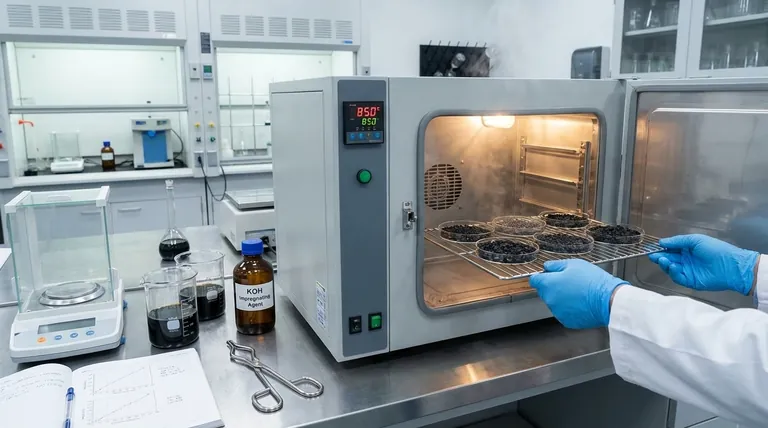
The Role of Thermal Stability in Impregnation
Facilitating Smooth Solvent Evaporation
The impregnation process involves dissolving an active component (such as KOH or CuO) into a solvent and soaking the activated carbon. The critical step is removing that solvent without disturbing the solute.
A precision oven maintains a steady temperature (e.g., 85°C) that promotes gradual, controlled evaporation. If the temperature fluctuates or spikes, the solvent may boil violently or evaporate too quickly, disrupting the deposition process.
Ensuring Uniform Distribution
Activated carbon is defined by its massive internal surface area and intricate network of micropores. For modification to work, the active agents must line these internal walls evenly.
Precise heat control ensures that as the solvent leaves, the active component is deposited uniformly across the entire surface area. This creates a consistent material where the chemical properties are predictable throughout the batch.
Preventing Pore Blockage
One of the greatest risks during drying is local overheating. If a standard oven creates "hot spots," the solvent at the pore openings evaporates instantly.
This rapid evaporation causes the solute to precipitate at the pore mouth, effectively sealing it off. This "pore blockage" renders the deep internal surface area inaccessible, significantly reducing the performance of the final material.
Understanding the Trade-offs and Risks
Precision Drying vs. High-Temperature Activation
It is crucial to distinguish this drying step from chemical activation. As noted in supplementary data, chemical activation requires extreme heat (around 800°C) to expand pore structures.
In contrast, impregnation drying is a low-temperature preservation step. Using high-temperature equipment lacking low-range precision can lead to aggressive drying that degrades the impregnant or oxidizes the carbon substrate prematurely.
The Cost of Thermal Inconsistency
Using a general-purpose oven with wide temperature swings introduces variables that are difficult to isolate during quality control.
If the temperature drops too low, residual solvents remain trapped in the micropores, occupying space that should be available for adsorption. If it spikes, you risk structural damage or uneven loading, leading to data deviations in surface area analysis and poor filtration performance.
Making the Right Choice for Your Goal
To select the correct thermal treatment equipment, you must identify the specific stage of your carbon preparation process.
- If your primary focus is Impregnation Modification (Loading): Prioritize a precision drying oven (±1°C accuracy) operating around 85°C to ensure uniform dispersion of agents like KOH or CuO without pore blockage.
- If your primary focus is Chemical Activation: You require a high-temperature furnace capable of reaching 800°C with controlled heating rates to drive the reaction between the carbon matrix and the activator.
- If your primary focus is Analytical Preparation (BET/PSD): You need a vacuum drying oven to degas the material at low pressures, ensuring micropores are completely cleared of adsorbed moisture before testing.
Success in activated carbon modification is determined by the ability to remove solvents without trapping the active chemistry at the surface.
Summary Table:
| Process Feature | Precision Drying Oven (Impregnation) | High-Temp Furnace (Activation) |
|---|---|---|
| Temperature Range | Typically low-temp (~85°C) | High-temp (up to 800°C+) |
| Primary Goal | Controlled solvent evaporation | Pore structure expansion |
| Thermal Stability | High (±1°C accuracy) | Controlled heating rates |
| Risk of Failure | Pore blockage / Uneven loading | Structural collapse / Oxidation |
| Mechanism | Preserves active sites in micropores | Drives chemical-carbon reactions |
Elevate Your Materials Research with KINTEK
Precision is the difference between a blocked pore and a high-performance catalyst. KINTEK provides industry-leading thermal solutions designed for the most delicate impregnation and activation processes.
Backed by expert R&D and manufacturing, we offer a comprehensive range of Muffle, Tube, Rotary, Vacuum, and CVD systems, as well as precision drying ovens, all fully customizable for your unique laboratory needs. Whether you are performing low-temperature solvent removal or high-temperature chemical activation, our equipment ensures uniform distribution and repeatable results for your modified activated carbon.
Ready to optimize your thermal processing? Contact KINTEK today to consult with our experts on the perfect furnace or oven for your application.
Visual Guide

References
- Bin Liu, Songlin Zuo. Significance of micropores for the removal of hydrogen sulfide from oxygen-free gas streams by activated carbon. DOI: 10.1515/htmp-2025-0085
This article is also based on technical information from Kintek Furnace Knowledge Base .
Related Products
- High Temperature Muffle Oven Furnace for Laboratory Debinding and Pre Sintering
- Electric Rotary Kiln Small Rotary Furnace for Activated Carbon Regeneration
- 1400℃ Muffle Oven Furnace for Laboratory
- 1200℃ Muffle Oven Furnace for Laboratory
- 1700℃ High Temperature Muffle Oven Furnace for Laboratory
People Also Ask
- What thermal phenomena occur during polymer binder burnout in ceramic green bodies? Lab Furnace Guide
- Why is controlled heat treatment in a muffle furnace necessary for calcined clay? Achieve Optimal Pozzolanic Activity
- What role does a high-temperature muffle furnace play in STFO synthesis? Achieve Pure Perovskite Results
- How does a high-temperature muffle furnace facilitate the formation of LaNbxAl1−xO3+δ perovskite structures? Key Roles
- What role does a high-temperature muffle furnace play in the formation of biochar catalysts? Master Catalyst Synthesis





