
A Simultaneous Thermal Analyzer (STA) provides a comprehensive profile of lignite combustion by concurrently recording mass changes and heat flow variations during a controlled heating process. This dual-stream data allows for the precise identification of critical temperature thresholds and the calculation of activation energy, which serves as a direct indicator of re-ignition risk.
By integrating mass loss data with heat flow measurements, STA transforms abstract thermal reactions into quantifiable safety metrics, specifically pinpointing the temperature thresholds where stable coal transitions into a combustion hazard.
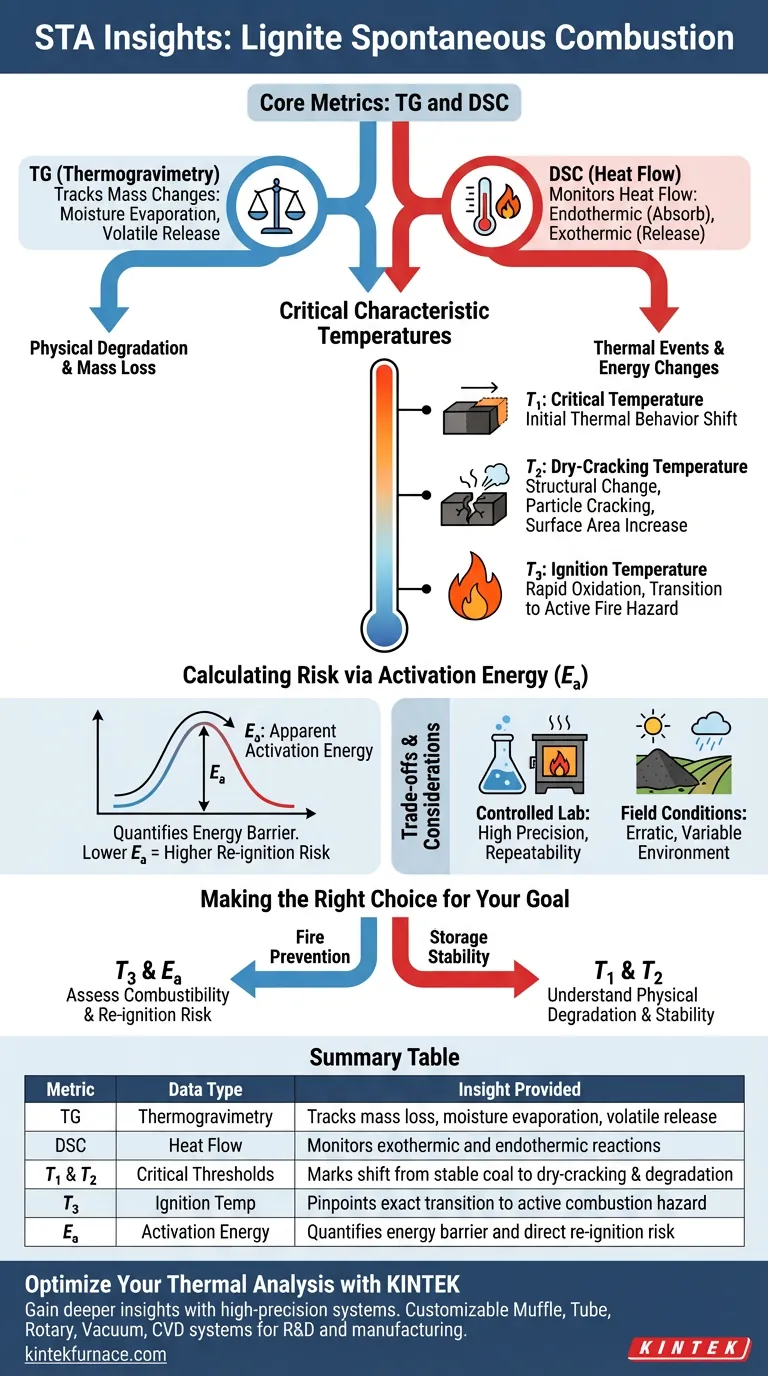
The Core Metrics: TG and DSC
Tracking Mass Changes (TG)
The STA records Thermogravimetry (TG) data, which measures the change in the mass of the coal sample as the temperature rises.
This data stream is essential for observing physical degradation, such as moisture evaporation and the release of volatiles, which precede combustion.
Monitoring Heat Flow (DSC)
Simultaneously, the system records Differential Scanning Calorimetry (DSC) data to track heat flow variations.
This reveals endothermic (heat-absorbing) and exothermic (heat-releasing) reactions, helping you correlate physical mass loss with specific thermal events.
Critical Characteristic Temperatures
The primary value of STA lies in identifying specific temperature points that mark the stages of spontaneous combustion.
Critical Temperature ($T_1$)
This is the first major thermal benchmark identified by the analyzer.
It represents the initial threshold where the coal's thermal behavior begins to shift significantly from its stable state.
Dry-Cracking Temperature ($T_2$)
The STA identifies the dry-cracking temperature ($T_2$), which occurs as the coal continues to heat.
This point marks a structural change in the lignite, often associated with the completion of drying and the onset of particle cracking, which exposes more surface area to oxygen.
Ignition Temperature ($T_3$)
Perhaps the most vital safety metric is the ignition temperature ($T_3$).
This is the point where the oxidation rate becomes rapid enough to sustain combustion, marking the transition from a passive solid to an active fire hazard.
Calculating Risk via Activation Energy
The Significance of Apparent Activation Energy ($E_a$)
Beyond raw temperature data, the STA provides the necessary inputs to calculate the apparent activation energy ($E_a$).
This calculated value is critical because it quantifies the energy barrier that must be overcome for the reaction to occur.
Reflecting Re-ignition Risk
The $E_a$ value directly reflects the degree of re-ignition risk for the specific coal sample.
A lower activation energy typically implies that the coal requires less energy to react, making it more prone to spontaneous combustion and re-ignition.
Understanding the Trade-offs
Controlled Environment vs. Field Conditions
The STA operates using controlled heating, which ensures high precision and repeatability.
However, this controlled ramp rate may not perfectly simulate the erratic and variable environmental conditions found in a stockpile or mine.
Data Interpretation
While STA provides high-precision data points like $T_1$ and $T_3$, these are specific to the sample size and heating rate used in the lab.
Directly extrapolating these specific temperature points to large-scale scenarios requires careful engineering judgment.
Making the Right Choice for Your Goal
To effectively utilize STA data for lignite investigation, align your focus with your specific safety or operational objectives.
- If your primary focus is Fire Prevention: Prioritize the Ignition Temperature ($T_3$) and Activation Energy ($E_a$) to assess how easily the coal will combust under standard conditions.
- If your primary focus is Storage Stability: Analyze the Critical Temperature ($T_1$) and Dry-Cracking Temperature ($T_2$) to understand how the coal degrades physically before it ever reaches the point of ignition.
By leveraging STA data, you move from guessing about coal stability to making decisions based on precise thermal evidence.
Summary Table:
| Metric | Data Type | Insight Provided |
|---|---|---|
| TG | Thermogravimetry | Tracks mass loss, moisture evaporation, and volatile release. |
| DSC | Heat Flow | Monitors exothermic and endothermic reactions during combustion. |
| T1 & T2 | Critical Thresholds | Marks the shift from stable coal to dry-cracking and degradation. |
| T3 | Ignition Temp | Pinpoints the exact transition to active combustion hazard. |
| Ea | Activation Energy | Quantifies the energy barrier and direct re-ignition risk levels. |
Optimize Your Thermal Analysis with KINTEK
Gain deeper insights into material stability with high-precision laboratory solutions. KINTEK provides industry-leading Muffle, Tube, Rotary, Vacuum, and CVD systems, all customizable to meet your specific R&D and manufacturing requirements.
Whether you are investigating spontaneous combustion in coal or developing advanced materials, our expert-backed thermal equipment ensures repeatable, accurate results.
Ready to elevate your research? Contact KINTEK today to discuss your custom furnace needs!
Visual Guide
References
- Baoshan Jia, Xian Wu. Effects of pre-oxidation temperature and air volume on oxidation thermogravimetric and functional group change of lignite. DOI: 10.1371/journal.pone.0316705
This article is also based on technical information from Kintek Furnace Knowledge Base .
Related Products
- Multi Heating Zones CVD Tube Furnace Machine for Chemical Vapor Deposition Equipment
- Multi Zone Laboratory Quartz Tube Furnace Tubular Furnace
- High Temperature Muffle Oven Furnace for Laboratory Debinding and Pre Sintering
- Laboratory Quartz Tube Furnace RTP Heating Tubular Furnace
- Vertical Laboratory Quartz Tube Furnace Tubular Furnace
People Also Ask
- What is the function of a multi-zone tube furnace in CVD synthesis? Master 2D In2Se3 Nanosheet Precision
- What role do multi zone tube furnaces play in new energy research? Unlock Precise Thermal Control for Innovation
- Why are multi zone tube furnaces particularly useful for nanomaterial research? Unlock Precise Thermal Control for Advanced Synthesis
- What temperature-related capabilities make multi zone tube furnaces valuable for research? Unlock Precision Thermal Control
- What environmental protection applications utilize multi zone tube furnaces? Unlock Precision in Waste Treatment and Green Tech



















