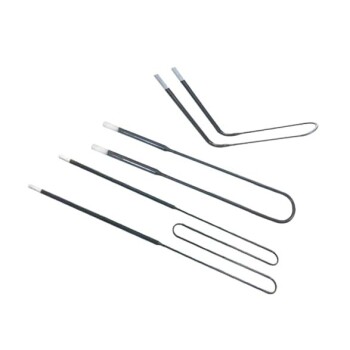
An industrial heating furnace provides a specific thermal environment of 1200 °C during the hot forging of Fe-Mn-Si alloy ingots. This precise temperature is maintained to fundamentally alter the alloy's physical state, preparing it for the intense mechanical stress of forging.
The core function of this high-temperature environment is to push the material into the austenite single-phase region. This transformation drastically lowers the alloy's resistance to deformation and homogenizes the internal structure, ensuring the ingot is pliable enough for effective shaping.
Achieving the Optimal Microstructure
To successfully forge Fe-Mn-Si alloys, the material must undergo a specific phase transformation.
Entering the Austenite Single-Phase Region
The furnace heats the ingots to 1200 °C to transition the steel into the austenite phase.
In this single-phase region, the crystal structure of the alloy changes. This change is the primary enabler for the subsequent mechanical work.
Eliminating Dendritic Segregation
Material straight from the casting process often contains structural inconsistencies known as dendritic segregation.
The sustained high heat at 1200 °C helps diffuse these inconsistencies. This results in a more uniform, homogenized as-cast structure, which significantly improves the final processing performance of the material.
Enhancing Mechanical Workability
Beyond microstructural changes, the furnace conditions directly impact how the metal reacts to physical force.
Reducing Plastic Deformation Resistance
At lower temperatures, Fe-Mn-Si alloys naturally resist changing shape.
Heating the ingot to 1200 °C significantly lowers this resistance. This allows the forging equipment to reshape the metal with greater efficiency and less wear on the machinery.
Providing Necessary Plasticity
Forging and blooming (the initial breakdown of the ingot) require the material to stretch and flow without cracking.
The high-temperature environment imbues the alloy with the necessary plasticity. This ensures the material can withstand the heavy deformation required during the blooming process.
Understanding the Process Constraints
While heating to 1200 °C is beneficial, it represents a critical process boundary that must be respected to ensure quality.
The Temperature-Structure Dependency
The success of the forging process is entirely dependent on reaching the austenite single-phase region.
If the furnace fails to maintain this specific temperature, the material may not fully enter this phase.
Risks of Inadequate Heating
Without the reduced plastic deformation resistance provided by this high heat, the material retains its rigidity.
Attempting to forge below this temperature threshold invites structural failure or poor processing performance, as the dendritic segregation may not be fully eliminated.
Making the Right Choice for Your Goal
When configuring your industrial heating process for Fe-Mn-Si alloys, keep your specific metallurgical objectives in mind.
- If your primary focus is Ease of Fabrication: Prioritize reaching 1200 °C to minimize plastic deformation resistance, ensuring the material is soft enough for blooming.
- If your primary focus is Material Homogeneity: Ensure the soak time at this temperature is sufficient to eliminate dendritic segregation in the as-cast structure.
By strictly maintaining the 1200 °C environment, you ensure the alloy possesses both the internal uniformity and external plasticity required for high-quality forging.
Summary Table:
| Condition/Factor | Parameter/Effect | Purpose in Hot Forging |
|---|---|---|
| Temperature | 1200 °C | Reaches austenite single-phase region |
| Phase State | Austenite Single-Phase | Lowers deformation resistance and increases plasticity |
| Structural Goal | Homogenization | Eliminates dendritic segregation in as-cast ingots |
| Workability | High Plasticity | Prevents cracking during blooming and mechanical stress |
| Risk Control | Precise Heat Control | Ensures material doesn't retain rigidity or structural flaws |
Elevate Your Forging Precision with KINTEK
Achieving the perfect 1200 °C environment for Fe-Mn-Si alloys requires uncompromising temperature uniformity and control. KINTEK provides industry-leading Muffle, Tube, Rotary, Vacuum, and CVD systems designed to meet the rigorous demands of advanced metallurgy.
Backed by expert R&D and precision manufacturing, our high-temp lab furnaces are fully customizable to your unique processing needs, ensuring material homogeneity and reduced deformation resistance every time.
Ready to optimize your thermal processing? Contact us today to find the perfect furnace solution for your lab!
References
- Haojie Niu, Chengxin Lin. Study on the Effect of Solid Solution Treatment on the Bending Fatigue Property of Fe-Mn-Si Shape Memory Alloys. DOI: 10.3390/met14040441
This article is also based on technical information from Kintek Furnace Knowledge Base .
Related Products
- Vacuum Heat Treat Sintering Furnace Molybdenum Wire Vacuum Sintering Furnace
- 2200 ℃ Tungsten Vacuum Heat Treat and Sintering Furnace
- Small Vacuum Heat Treat and Tungsten Wire Sintering Furnace
- 600T Vacuum Induction Hot Press Vacuum Heat Treat and Sintering Furnace
- Vacuum Heat Treat Sintering and Brazing Furnace
People Also Ask
- What are the main structural components of a vacuum sintering furnace? Unlock Precision in High-Temperature Processing
- How does vacuum sintering improve dimensional tolerances? Achieve Uniform Shrinkage and Precision
- What are the key components of a vacuum sintering furnace? Essential Parts for Precision Material Processing
- What is the purpose of setting a mid-temperature dwell stage? Eliminate Defects in Vacuum Sintering
- How does vacuum sintering contribute to cost reduction in material processing? Lower Expenses with Superior Parts