
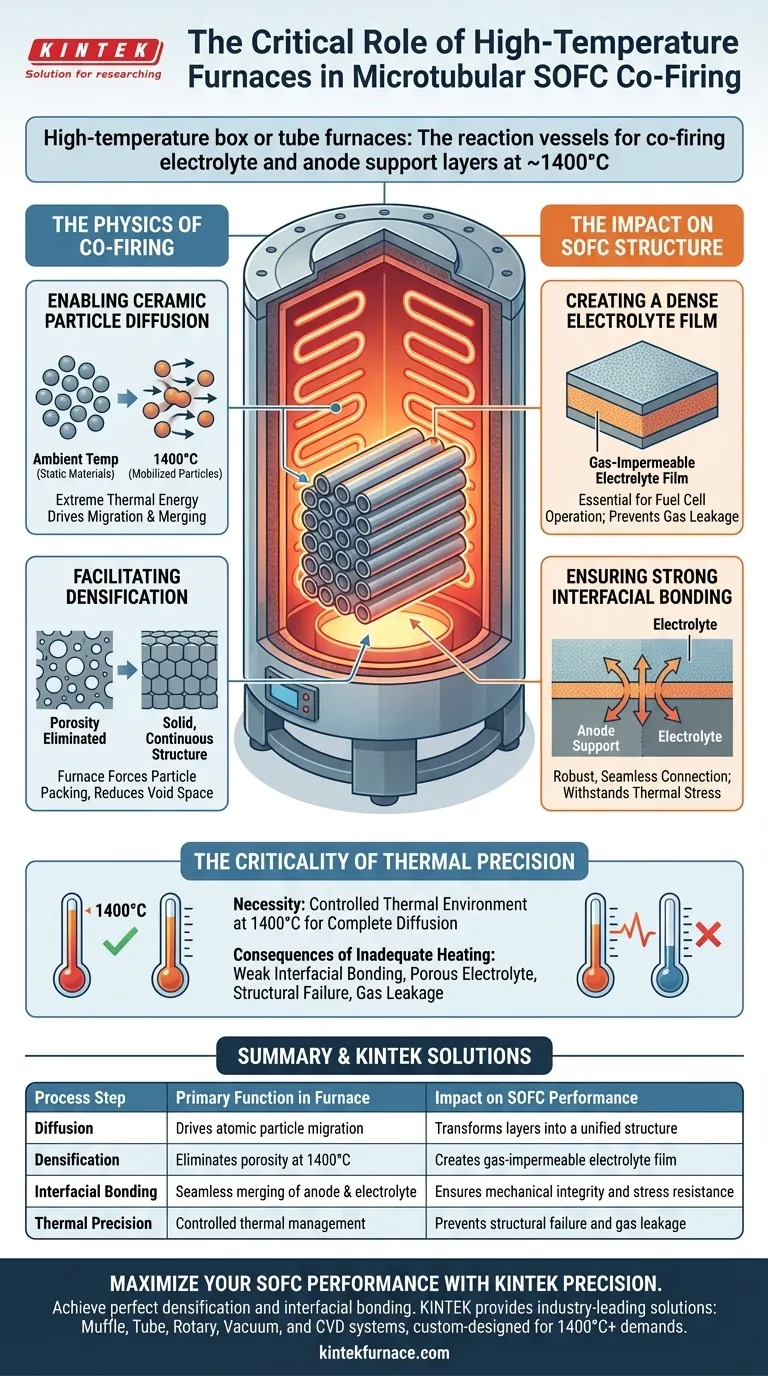
High-temperature box or tube furnaces serve as the critical reaction vessel for co-firing the electrolyte and anode support layers of microtubular Solid Oxide Fuel Cells (SOFCs). They provide a highly controlled thermal environment, typically reaching temperatures around 1400 °C, which is necessary to simultaneously sinter these distinct ceramic layers into a unified component.
The furnace enables ceramic particle diffusion and densification, transforming separate material layers into a unified, high-performance core structure with a dense electrolyte film and strong interfacial bonds.

The Physics of Co-Firing
Enabling Ceramic Particle Diffusion
The primary function of the furnace is to drive ceramic particle diffusion.
At ambient temperatures, the materials in the anode and electrolyte are static. The furnace provides the extreme thermal energy required to mobilize these particles at the atomic level, allowing them to migrate and merge.
Facilitating Densification
Alongside diffusion, the furnace drives the process of densification.
This mechanism eliminates porosity within the ceramic layers. By holding the materials at high temperatures (e.g., 1400 °C), the furnace forces the particles to pack tightly together, reducing void space and creating a solid, continuous structure.
The Impact on SOFC Structure
Creating a Dense Electrolyte Film
The ultimate goal of the co-firing process is to produce a dense electrolyte film.
The furnace ensures that the electrolyte layer becomes impermeable to gas, which is a fundamental requirement for the fuel cell's operation. Without the specific heat profile provided by the furnace, the film would remain porous and ineffective.
Ensuring Strong Interfacial Bonding
The furnace is responsible for the mechanical integrity of the cell through interfacial bonding.
Because the anode support and electrolyte are fired together (co-fired), the diffusion process occurs across the boundary between them. This creates a robust, seamless connection between layers, ensuring the core structure can withstand thermal stress and operation.
The Criticality of Thermal Precision
The Necessity of Controlled Environments
The primary reference highlights that these furnaces must provide a controlled thermal environment, not just raw heat.
If the temperature fluctuates or fails to reach the target (e.g., 1400 °C), the diffusion process will be incomplete.
Consequences of Inadequate Heating
Failure to maintain this precise environment compromises the entire cell.
Insufficient heat results in weak interfacial bonding and a porous electrolyte. This leads to structural failure or gas leakage, rendering the SOFC incapable of high-performance operation.
Making the Right Choice for Your Goal
To achieve a functional microtubular SOFC, the furnace selection must align with the specific material requirements of your ceramic layers.
- If your primary focus is structural integrity: Ensure your furnace can maintain stable temperatures at 1400 °C to guarantee strong interfacial bonding between the anode and electrolyte.
- If your primary focus is electrochemical performance: Prioritize a furnace with precise thermal control to ensure complete densification of the electrolyte film, preventing gas crossover.
The success of the co-firing process relies entirely on the furnace's ability to facilitate particle diffusion through precise thermal management.
Summary Table:
| Process Step | Primary Function in Furnace | Impact on SOFC Performance |
|---|---|---|
| Diffusion | Drives atomic particle migration | Transforms layers into a unified structure |
| Densification | Eliminates porosity at 1400°C | Creates gas-impermeable electrolyte film |
| Interfacial Bonding | Seamless merging of anode & electrolyte | Ensures mechanical integrity and stress resistance |
| Thermal Precision | Controlled thermal management | Prevents structural failure and gas leakage |
Maximize Your SOFC Performance with KINTEK Precision
Achieving perfect densification and interfacial bonding in microtubular Solid Oxide Fuel Cells requires unmatched thermal stability. KINTEK provides industry-leading high-temperature solutions, including Muffle, Tube, Rotary, Vacuum, and CVD systems, all designed to meet the rigorous 1400°C+ demands of ceramic co-firing. Backed by expert R&D and manufacturing, our systems are fully customizable to your specific laboratory or production needs.
Ready to elevate your fuel cell research? Contact KINTEK today to discuss your custom furnace requirements!
Visual Guide
References
- Dhruba Panthi, Hai Feng. Extreme Thermal Cycling of Anode‐Supported Microtubular Solid Oxide Fuel Cells Using a Novel Test Setup. DOI: 10.1002/aesr.202500119
This article is also based on technical information from Kintek Furnace Knowledge Base .
Related Products
- 1400℃ High Temperature Laboratory Tube Furnace with Alumina Tube
- 1700℃ Controlled Inert Nitrogen Atmosphere Furnace
- 1700℃ High Temperature Laboratory Tube Furnace with Alumina Tube
- High Temperature Muffle Oven Furnace for Laboratory Debinding and Pre Sintering
- 1200℃ Muffle Oven Furnace for Laboratory
People Also Ask
- How does zone-melting in tube furnaces synthesize bismuth micro-wires? Master Single-Crystal Thermoelectric Growth
- How do high-temperature laboratory tube furnaces ensure environmental stability? Precision Thermal Reduction Tips
- How are high-temp tube furnaces used to measure diffusion coefficients per Fick's law? Master Precision Annealing
- How are high-temperature laboratory tube furnaces applied in long-term vacuum homogenization heat treatments for intermetallic samples?
- How are high-temperature tube furnaces applied in testing ceramic-supported alloy membranes? Insights



















