
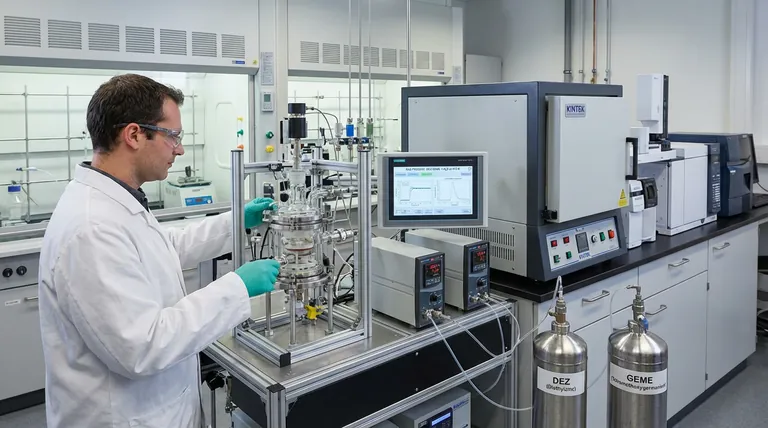
Diethylzinc (DEZ) and Tetramethoxygermanium (GEME) are selected as precursors primarily because they possess the ideal combination of appropriate vapor pressure and thermal stability. These specific chemical properties allow the precursors to react efficiently with water vapor at a deposition temperature of 473 K, facilitating a controlled Atomic Layer Deposition (ALD) process.
Core Takeaway The physical properties of DEZ and GEME enable the uniform atomic-level substitution of Germanium within the Zinc Oxide lattice. This precise chemical capability is the key to effectively tuning the electronic properties of the resulting Ge:ZnO semiconductor.
The Physical Criteria for Precursor Selection
Appropriate Vapor Pressure
For ALD to function correctly, the precursor must transition from liquid or solid to gas easily. DEZ and GEME are chosen because they possess appropriate vapor pressures. This ensures they can be transported effectively into the reaction chamber to reach the substrate surface.
Thermal Stability
A precursor must remain intact until it reaches the substrate. DEZ and GEME exhibit high thermal stability, meaning they do not decompose prematurely in the delivery lines or gas phase. This stability ensures that the reaction occurs exclusively at the intended surface sites.
The Mechanism of Deposition
Efficient Reactivity with Co-Reactants
Selection is also driven by how well the precursor interacts with the co-reactant. DEZ and GEME react efficiently with water vapor at the specific deposition temperature of 473 K. This reactivity is crucial for completing the chemical half-cycles necessary to build the film.
Achieving Atomic-Level Substitution
The ultimate goal of using these specific precursors is structural precision. By alternately pulsing these chemicals, Germanium (Ge) atoms are able to substitute for Zinc atoms within the Zinc Oxide (ZnO) crystal lattice. This substitution is uniform, avoiding the clusters or defects common in less controlled deposition methods.
Understanding the Trade-offs
Temperature Sensitivity
While 473 K is cited as the effective deposition temperature, sticking to this window is critical. Deviating significantly from this temperature can compromise the thermal stability of the precursors or reduce their reactivity with water.
Process Speed vs. Control
ALD is a process based on sequential, self-limiting reactions. While DEZ and GEME offer precision, the requirement to pulse them alternately to achieve atomic substitution is inherently slower than bulk deposition methods.
Making the Right Choice for Your Goal
The selection of DEZ and GEME is a strategic choice to balance process control with material performance.
- If your primary focus is Electronic Performance: Prioritize the precise pulsing ratios of DEZ and GEME to fine-tune the doping concentration and electronic properties.
- If your primary focus is Film Quality: Ensure strictly maintained temperatures at 473 K to maximize the efficiency of the water vapor reaction and maintain precursor stability.
By leveraging the specific vapor pressure and stability of these precursors, you achieve the atomic precision required for high-performance semiconductors.
Summary Table:
| Feature | Diethylzinc (DEZ) | Tetramethoxygermanium (GEME) |
|---|---|---|
| Function | Zinc (Zn) Precursor | Germanium (Ge) Dopant |
| Optimal Temp | 473 K | 473 K |
| Co-reactant | Water Vapor (H2O) | Water Vapor (H2O) |
| Key Property | High Vapor Pressure | Thermal Stability |
| Benefit | Uniform ZnO Lattice | Atomic-level Substitution |
Elevate Your Semiconductor Research with KINTEK Precision
Achieving the perfect Ge-doped Zinc Oxide thin film requires more than just the right precursors; it demands a high-performance thermal environment. KINTEK provides industry-leading CVD and ALD-compatible high-temperature furnace systems designed to maintain the rigorous thermal stability required for DEZ and GEME reactions.
Backed by expert R&D and manufacturing, our customizable systems ensure your deposition processes achieve maximum atomic precision and uniform doping concentrations. Contact KINTEK today to discuss how our specialized lab furnaces can optimize your thin-film growth and electronic material performance.
References
- Rafał Knura, Robert P. Socha. Evaluation of the Electronic Properties of Atomic Layer Deposition-Grown Ge-Doped Zinc Oxide Thin Films at Elevated Temperatures. DOI: 10.3390/electronics13030554
This article is also based on technical information from Kintek Furnace Knowledge Base .
Related Products
People Also Ask
- What are the essential components of an MPCVD reactor system? Build a Pristine Environment for High-Purity Materials
- How does pressure affect the MPCVD growth process? Master Plasma Control for Superior Film Quality
- How do carbon-containing groups contribute to diamond growth in the MPCVD method? Unlock High-Quality Diamond Synthesis
- Why is temperature control important in the MPCVD growth process? Ensure High-Quality, Reliable Diamond Film Deposition
- What are the key components of an MPCVD system? Unlock High-Purity Crystal Growth
