
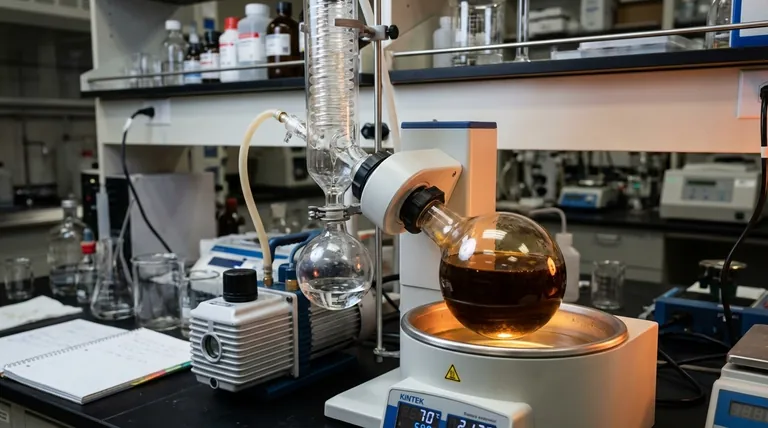
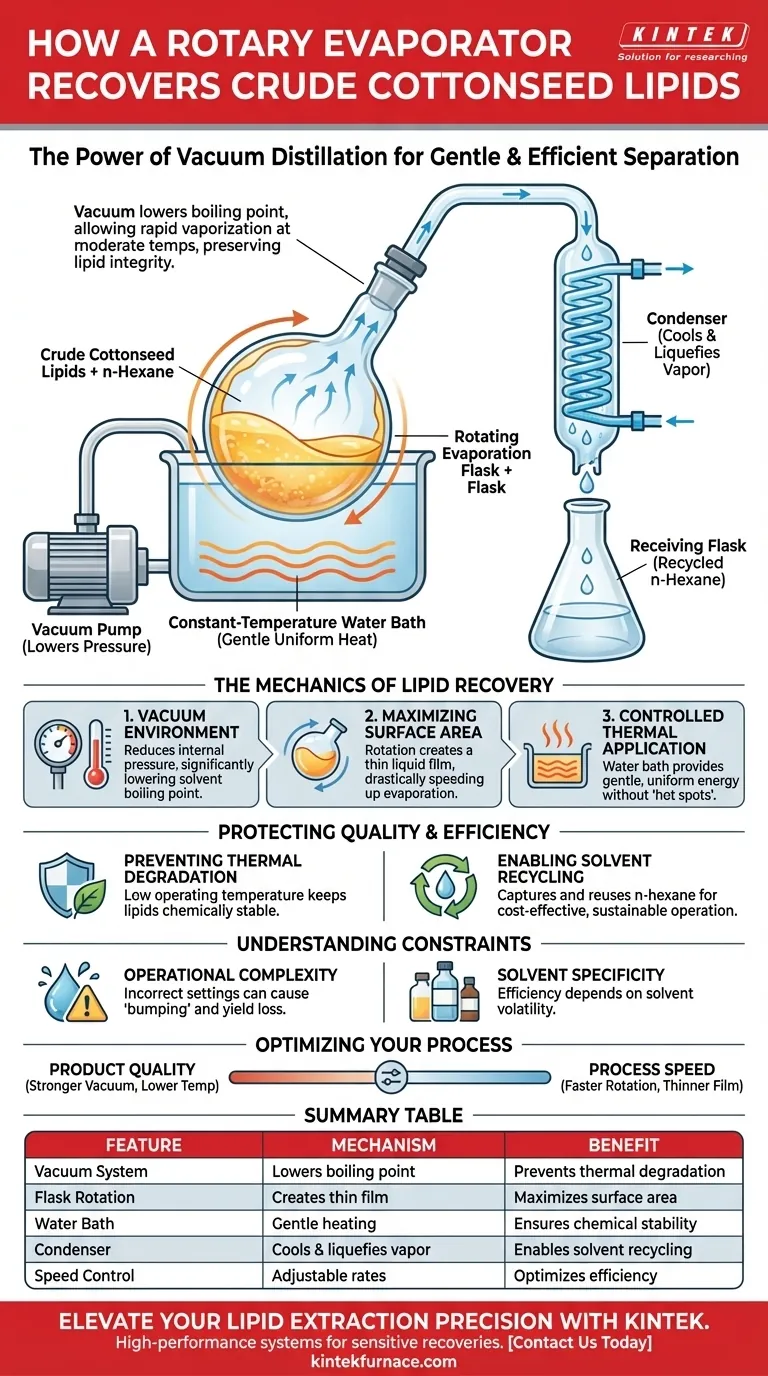
A rotary evaporator facilitates the recovery of crude cottonseed lipids by utilizing vacuum distillation to separate the lipids from the n-hexane solvent. By lowering the pressure within the system, the device reduces the boiling point of the solvent, allowing it to vaporize rapidly at moderate temperatures while the rotation of the flask maximizes the surface area for evaporation.
The primary advantage of this method is the preservation of chemical integrity; it achieves efficient solvent removal without subjecting the heat-sensitive cottonseed lipids to temperatures that cause thermal degradation.
The Mechanics of Lipid Recovery
Creating a Vacuum Environment
The core function of the rotary evaporator in this context is vacuum distillation.
By reducing the internal pressure of the system, the device significantly lowers the boiling point of the n-hexane solvent.
This allows the solvent to transition from liquid to vapor at a much lower temperature than would be required at atmospheric pressure.
Maximizing Surface Area
A crucial component of the process is the rotation of the evaporation flask.
This rotation spreads the crude cottonseed lipid mixture across the inner wall of the flask, creating a thin liquid film.
This significantly increases the surface area exposed to the vacuum, which drastically speeds up the evaporation rate of the solvent.
Controlled Thermal Application
While the vacuum lowers the boiling point, energy is still required to drive the phase change.
A constant-temperature water bath applies gentle, uniform heat to the rotating flask.
This provides the necessary energy for the n-hexane to vaporize without creating "hot spots" that could damage the lipids.
Protecting Quality and Efficiency
Preventing Thermal Degradation
Crude cottonseed lipids are sensitive to high temperatures.
Excessive heat can alter the chemical structure of these lipids, reducing the quality of the final product.
The rotary evaporator mitigates this risk by keeping the operating temperature low, ensuring the lipids remain thermally stable throughout the recovery process.
Enabling Solvent Recycling
The system does not just vent the vaporized solvent; it captures it.
The vaporized n-hexane travels to a condenser where it cools and reverts to liquid form for collection.
This allows for the recycling of the n-hexane, making the extraction process more cost-effective and environmentally sustainable.
Understanding the Constraints
Operational Complexity
While efficient, rotary evaporators require precise balancing of vacuum pressure and water bath temperature.
Incorrect settings can lead to "bumping" (sudden boiling), which may splash the crude lipids into the condenser, causing loss of yield.
Solvent Specificity
This process relies heavily on the volatility of the solvent being used.
While highly effective for volatile solvents like n-hexane, the efficiency drops if the solvent has a very high boiling point or interacts strongly with the lipids.
Optimizing Your Recovery Process
To achieve the best results when recovering cottonseed lipids, consider your specific operational priorities.
- If your primary focus is Product Quality: Prioritize a stronger vacuum to minimize the water bath temperature, ensuring the lowest possible thermal stress on the lipids.
- If your primary focus is Process Speed: Maximize the rotation speed of the flask to create the thinnest possible film, facilitating the fastest possible evaporation rate.
By balancing the vacuum strength with the rotation speed, you ensure a rapid recovery that maintains the chemical integrity of your cottonseed lipids.
Summary Table:
| Feature | Mechanism in Lipid Recovery | Benefit to Process |
|---|---|---|
| Vacuum System | Lowers boiling point of n-hexane | Prevents thermal degradation of sensitive lipids |
| Flask Rotation | Creates a thin liquid film | Maximizes surface area for rapid solvent evaporation |
| Water Bath | Provides gentle, uniform heating | Eliminates hot spots and ensures chemical stability |
| Condenser | Cools and liquefies solvent vapor | Enables cost-effective solvent recycling and reuse |
| Speed Control | Adjustable rotation rates | Optimizes evaporation efficiency based on sample volume |
Elevate Your Lipid Extraction Precision with KINTEK
Don't compromise the chemical integrity of your botanical extracts. KINTEK’s high-performance rotary evaporators are engineered to provide the precise vacuum control and thermal stability required for the most sensitive crude lipid recoveries.
Backed by expert R&D and manufacturing, KINTEK offers Muffle, Tube, Rotary, Vacuum, and CVD systems, along with a full range of lab high-temp furnaces—all customizable for your unique research or production needs.
Ready to optimize your lab's efficiency and yield? Contact us today to find your perfect solution!
Visual Guide
References
- Gyeongnam Park, Eilhann E. Kwon. Use of defatted cottonseed-derived biochar for biodiesel production: a closed-loop approach. DOI: 10.1007/s42773-024-00394-3
This article is also based on technical information from Kintek Furnace Knowledge Base .
Related Products
- Electric Rotary Kiln Continuous Working Small Rotary Furnace Kiln for Pyrolysis Plant Heating
- Electric Rotary Kiln Pyrolysis Furnace Plant Machine Small Rotary Kiln Calciner
- Electric Rotary Kiln Small Rotary Furnace Biomass Pyrolysis Plant Rotating Furnace
- Inclined Rotary Plasma Enhanced Chemical Deposition PECVD Tube Furnace Machine
- Electric Rotary Kiln Small Rotary Furnace for Activated Carbon Regeneration
People Also Ask
- What are the advantages of electric rotary kilns compared to fuel-fired ones? Boost Precision and Efficiency in Your Process
- What materials can be processed in an electric rotary kiln? Versatile Solutions for Advanced Materials
- What advantages do electric rotary kilns offer over fuel-based kilns? Boost Efficiency and Purity in Your Process
- What are the primary applications of electric rotary kilns? Precision Thermal Processing for High-Value Materials
- How do electric rotary kilns achieve high thermal efficiency? Unlock Over 95% Thermal Efficiency








