Knowledge Why is a stainless steel high-pressure autoclave essential for starch hydrogenation? Unlock Peak Reaction Efficiency
Author avatar

Tech Team · Kintek Furnace

Updated 3 hours ago

Why is a stainless steel high-pressure autoclave essential for starch hydrogenation? Unlock Peak Reaction Efficiency


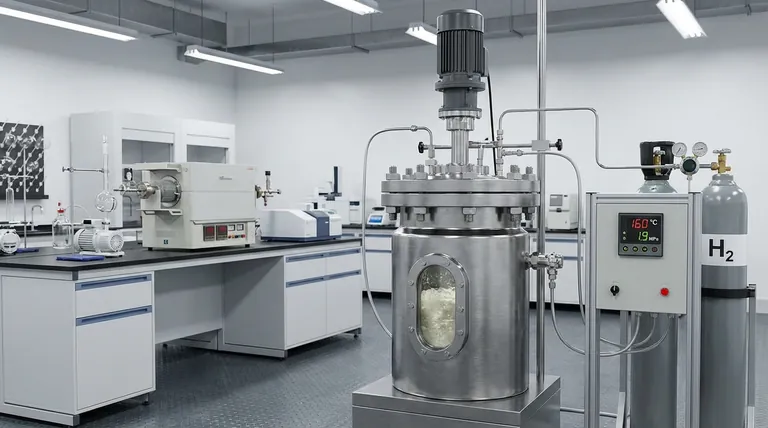
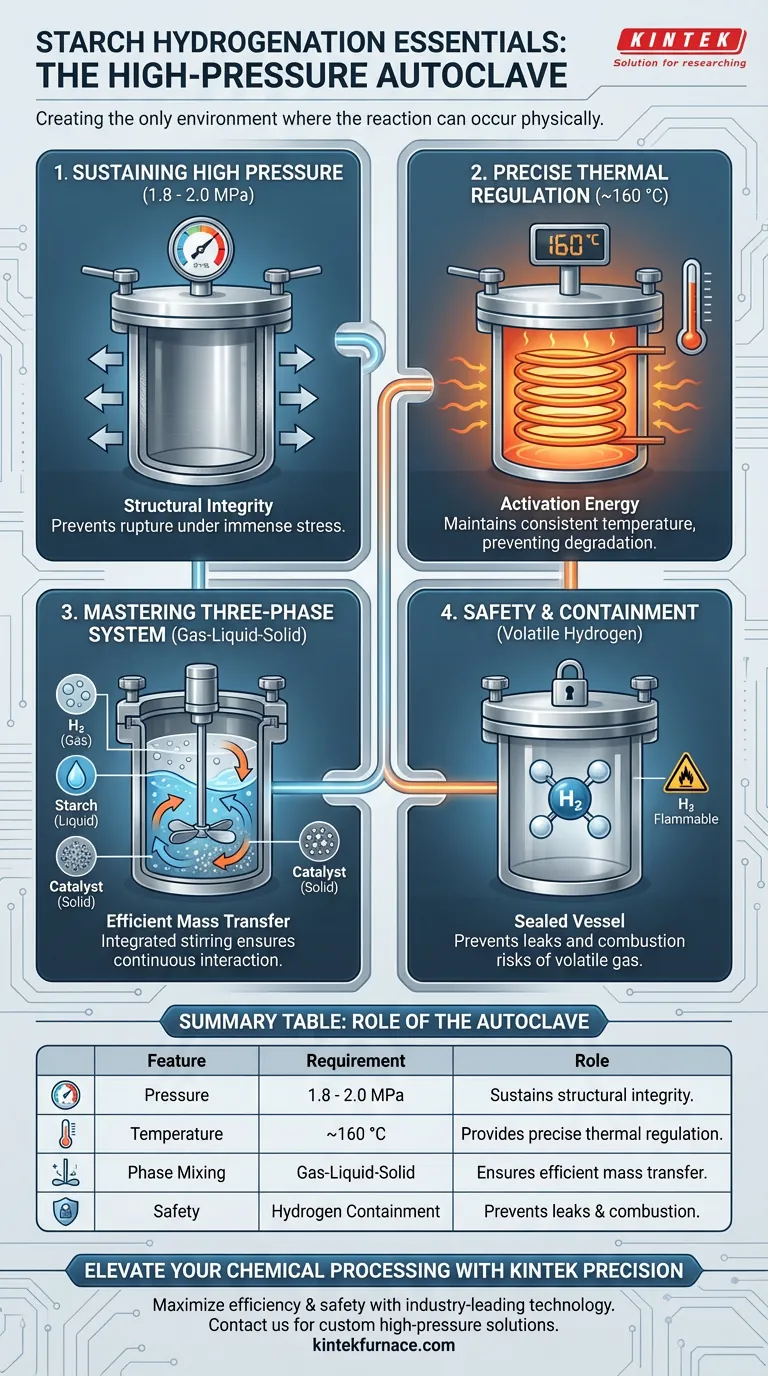
A stainless steel high-pressure autoclave is essential because it creates the only environment where starch hydrogenation can physically occur. It provides a sealed, robust vessel capable of sustaining pressures between 1.8 and 2.0 MPa and temperatures around 160 °C. Furthermore, it incorporates the mechanical agitation necessary to mix hydrogen gas, liquid starch, and solid catalysts safely.

Starch hydrogenation is a complex, multiphase reaction that demands aggressive environmental conditions. The autoclave serves as a pressurized containment system that forces hydrogen into solution while simultaneously managing the safety risks of high-pressure gas.
Why is a stainless steel high-pressure autoclave essential for starch hydrogenation? Unlock Peak Reaction Efficiency

Creating the Required Reaction Environment

To convert starch into sugar alcohols efficiently, standard atmospheric conditions are insufficient. The autoclave bridges the gap between the reactants and the necessary activation energy.

Sustaining High Pressure

The primary barrier to this reaction is pressure. The process requires a steady internal pressure of 1.8 to 2.0 MPa.

Standard vessels would rupture or leak under this stress. The stainless steel construction ensures the structural integrity needed to hold this pressure safely for the duration of the reaction.

Precise Thermal Regulation

Pressure alone is not enough; thermal energy is required to drive the chemical conversion.

The vessel maintains a consistent temperature, typically 160 °C. The autoclave allows for precise thermal control, preventing temperature spikes that could degrade the starch or stall the reaction.

Mastering the Three-Phase System

The most difficult engineering challenge in starch hydrogenation is that the reactants exist in three different states: gas, liquid, and solid.

The Gas-Liquid-Solid Challenge

The reaction involves hydrogen (gas), the starch solution (liquid), and a catalyst (solid).

For the reaction to work, these three distinct phases must interact intimately. If they separate, the hydrogenation process stops immediately.

Enhancing Mass Transfer via Stirring

The autoclave solves the separation issue with an integrated stirring system.

This mechanism is critical for efficient mass transfer. It actively disperses the hydrogen gas bubbles throughout the liquid and keeps the solid catalyst suspended, ensuring all three components collide and react continuously.

Safety and Operational Considerations

While the autoclave is the correct tool for the job, using high-pressure equipment introduces specific operational demands.

Containing Volatile Hydrogen

Hydrogen is highly flammable and difficult to contain due to its small molecular size.

The "sealed reaction space" provided by the autoclave is a critical safety feature. It prevents hydrogen leaks, which could lead to combustion or explosion outside the vessel.

The Complexity of Maintenance

Operating at 2.0 MPa imposes significant stress on seals and mechanical parts.

Operators must recognize that the "stability" provided by the vessel relies on rigorous maintenance. If the stirring seals fail, the pressure integrity is compromised, risking both the batch quality and operator safety.

Optimizing Your Equipment Choice

When selecting or operating a high-pressure autoclave for this specific application, focus on the following parameters.

  • If your primary focus is Reaction Speed: Prioritize the efficiency of the integrated stirring system to maximize the contact between hydrogen gas and the liquid starch.
  • If your primary focus is Process Safety: Ensure the vessel is rated significantly higher than the operating max of 2.0 MPa and inspect the seal integrity for hydrogen containment.

The autoclave is not just a container; it is an active participant that forces the physics of the reaction to occur.

Summary Table:

Feature Requirement for Starch Hydrogenation Role of the Autoclave
Pressure 1.8 - 2.0 MPa Sustains structural integrity under high stress
Temperature Approximately 160 °C Provides precise thermal regulation and activation energy
Phase Mixing Gas-Liquid-Solid Interaction Integrated stirring system ensures efficient mass transfer
Safety Hydrogen Containment Sealed vessel prevents leaks and combustion risks

Elevate Your Chemical Processing with KINTEK Precision

Maximize the efficiency of your starch hydrogenation and high-pressure reactions with KINTEK’s industry-leading technology. Backed by expert R&D and manufacturing, KINTEK offers high-performance Muffle, Tube, Rotary, Vacuum, and CVD systems, alongside fully customizable lab high-temperature furnaces designed to meet your unique specifications.

Whether you need to master three-phase mass transfer or ensure absolute safety in volatile environments, our engineering team is ready to deliver the robust solutions your lab requires.

Ready to optimize your reaction environment? Contact KINTEK today to discuss your custom equipment needs!

Visual Guide
Why is a stainless steel high-pressure autoclave essential for starch hydrogenation? Unlock Peak Reaction Efficiency Visual Guide

References

  1. Shenghua Zhu, Jinghua Liang. Forming a Cu-Based Catalyst for Efficient Hydrogenation Conversion of Starch into Glucose. DOI: 10.3390/catal14020132

This article is also based on technical information from Kintek Furnace Knowledge Base .

Related Products

People Also Ask

Related Products

High Pressure Laboratory Vacuum Tube Furnace Quartz Tubular Furnace

High Pressure Laboratory Vacuum Tube Furnace Quartz Tubular Furnace

KINTEK High Pressure Tube Furnace: Precision heating up to 1100°C with 15Mpa pressure control. Ideal for sintering, crystal growth, and lab research. Customizable solutions available.

Vacuum Hot Press Furnace Machine Heated Vacuum Press Tube Furnace

Vacuum Hot Press Furnace Machine Heated Vacuum Press Tube Furnace

Discover KINTEK's advanced Vacuum Tube Hot Press Furnace for precise high-temperature sintering, hot pressing, and material bonding. Customizable solutions for labs.

304 316 Stainless Steel High Vacuum Ball Stop Valve for Vacuum Systems

304 316 Stainless Steel High Vacuum Ball Stop Valve for Vacuum Systems

KINTEK's 304/316 stainless steel vacuum ball valves and stop valves ensure high-performance sealing for industrial and scientific applications. Explore durable, corrosion-resistant solutions.

Vacuum Heat Treat Sintering and Brazing Furnace

Vacuum Heat Treat Sintering and Brazing Furnace

KINTEK Vacuum Brazing Furnaces deliver precision, clean joints with superior temperature control. Customizable for diverse metals, ideal for aerospace, medical, and thermal applications. Get a quote!

Stainless Steel Quick Release Vacuum Chain Three Section Clamp

Stainless Steel Quick Release Vacuum Chain Three Section Clamp

Stainless steel quick release vacuum clamps ensure leak-free connections for high vacuum systems. Durable, corrosion-resistant, and easy to install.

HFCVD Machine System Equipment for Drawing Die Nano Diamond Coating

HFCVD Machine System Equipment for Drawing Die Nano Diamond Coating

KINTEK's HFCVD system delivers high-quality nano-diamond coatings for wire drawing dies, enhancing durability with superior hardness and wear resistance. Explore precision solutions now!

2200 ℃ Graphite Vacuum Heat Treat Furnace

2200 ℃ Graphite Vacuum Heat Treat Furnace

2200℃ Graphite Vacuum Furnace for high-temperature sintering. Precise PID control, 6*10⁻³Pa vacuum, durable graphite heating. Ideal for research & production.

Electric Rotary Kiln Small Rotary Furnace Biomass Pyrolysis Plant Rotating Furnace

Electric Rotary Kiln Small Rotary Furnace Biomass Pyrolysis Plant Rotating Furnace

KINTEK's Rotary Biomass Pyrolysis Furnace converts biomass to biochar, bio-oil, and syngas efficiently. Customizable for research or production. Get your solution now!

Multi Heating Zones CVD Tube Furnace Machine for Chemical Vapor Deposition Equipment

Multi Heating Zones CVD Tube Furnace Machine for Chemical Vapor Deposition Equipment

KINTEK's Multi-Zone CVD Tube Furnaces offer precision temperature control for advanced thin film deposition. Ideal for research and production, customizable for your lab needs.

1200℃ Controlled Inert Nitrogen Atmosphere Furnace

1200℃ Controlled Inert Nitrogen Atmosphere Furnace

KINTEK 1200℃ Controlled Atmosphere Furnace: Precision heating with gas control for labs. Ideal for sintering, annealing, and material research. Customizable sizes available.

1700℃ Controlled Inert Nitrogen Atmosphere Furnace

1700℃ Controlled Inert Nitrogen Atmosphere Furnace

KT-17A Controlled Atmosphere Furnace: Precise 1700°C heating with vacuum & gas control. Ideal for sintering, research & material processing. Explore now!

Vacuum Hot Press Furnace Machine for Lamination and Heating

Vacuum Hot Press Furnace Machine for Lamination and Heating

KINTEK Vacuum Lamination Press: Precision bonding for wafer, thin-film & LCP applications. 500°C max temp, 20-ton pressure, CE certified. Custom solutions available.

Controlled Inert Nitrogen Hydrogen Atmosphere Furnace

Controlled Inert Nitrogen Hydrogen Atmosphere Furnace

Discover KINTEK's Hydrogen Atmosphere Furnace for precise sintering & annealing in controlled environments. Up to 1600°C, safety features, customizable.

High Temperature Muffle Oven Furnace for Laboratory Debinding and Pre Sintering

High Temperature Muffle Oven Furnace for Laboratory Debinding and Pre Sintering

KT-MD Debinding & Pre-Sintering Furnace for ceramics - precise temperature control, energy-efficient design, customizable sizes. Boost your lab efficiency today!

Vacuum Heat Treat Furnace with Ceramic Fiber Liner

Vacuum Heat Treat Furnace with Ceramic Fiber Liner

KINTEK's Vacuum Furnace with Ceramic Fiber Lining offers precise high-temperature processing up to 1700°C, ensuring uniform heat distribution and energy efficiency. Ideal for labs and production.

Spark Plasma Sintering SPS Furnace

Spark Plasma Sintering SPS Furnace

Discover KINTEK's advanced Spark Plasma Sintering (SPS) Furnace for rapid, precise material processing. Customizable solutions for research and production.

Laboratory Vacuum Tilt Rotary Tube Furnace Rotating Tube Furnace

Laboratory Vacuum Tilt Rotary Tube Furnace Rotating Tube Furnace

KINTEK Laboratory Rotary Furnace: Precision heating for calcination, drying, sintering. Customizable solutions with vacuum & controlled atmosphere. Enhance research now!

915MHz MPCVD Diamond Machine Microwave Plasma Chemical Vapor Deposition System Reactor

915MHz MPCVD Diamond Machine Microwave Plasma Chemical Vapor Deposition System Reactor

KINTEK MPCVD Diamond Machine: High-quality diamond synthesis with advanced MPCVD technology. Faster growth, superior purity, customizable options. Boost production now!

Electric Rotary Kiln Pyrolysis Furnace Plant Machine Small Rotary Kiln Calciner

Electric Rotary Kiln Pyrolysis Furnace Plant Machine Small Rotary Kiln Calciner

KINTEK Electric Rotary Kiln: Precise 1100℃ calcination, pyrolysis & drying. Eco-friendly, multi-zone heating, customizable for lab & industrial needs.

Cylindrical Resonator MPCVD Machine System for Lab Diamond Growth

Cylindrical Resonator MPCVD Machine System for Lab Diamond Growth

KINTEK MPCVD Systems: Grow high-quality diamond films with precision. Reliable, energy-efficient, and beginner-friendly. Expert support available.


Leave Your Message
