Using a powder mixture offers significant process control advantages, primarily by ensuring uniform coverage on complex geometries and maintaining physical stability during high-temperature treatment. By employing the pack cementation method, this approach utilizes chemical reactions to release active silicon atoms that penetrate areas difficult to reach with other methods, while specific additives prevent the mixture from degrading.
Core Takeaway The primary value of using a powder mixture lies in its ability to envelop complex workpieces completely. It solves the dual challenge of accessing intricate surfaces (like welded joints) and preventing material failure (clumping) through the use of stabilizing additives.
Overcoming Geometric Complexity
achieving Full Contact
Standard coating methods often struggle with irregular shapes. A powder mixture, however, behaves like a fluid medium before the reaction leads to diffusion.
Handling Intricate Parts
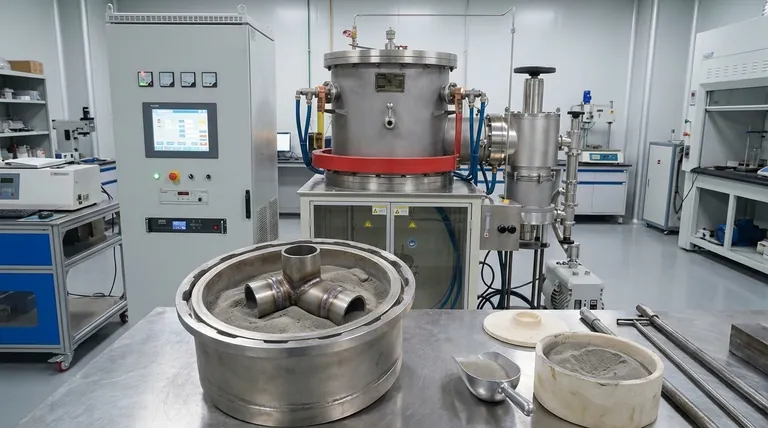
This "full contact" capability is particularly effective for complex workpieces, such as welded pipe sections. The powder packs into crevices and joints that line-of-sight methods might miss.
Ensuring Uniformity
Because the powder surrounds the part entirely, the resulting siliconized layer is highly consistent. The uniform coverage extends across the entire surface area of the component.
The Mechanism of Active Release
High-Temperature Activation
The process is not merely physical; it is chemical. At high temperatures, the powder mixture undergoes reactions that release active silicon atoms.
Chemical Diffusion
These active atoms are liberated directly against the surface of the metal. This proximity ensures efficient transfer and diffusion of silicon into the substrate.
Ensuring Physical Stability
The Risk of Sintering
At the high temperatures required for diffusion, pure powders can fuse together. This phenomenon, known as sintering, can ruin the process by creating solid clumps rather than a free-flowing reactive medium.
The Role of Additives
To counter this, the powder mixture includes inert additives, specifically alumina.
Preventing Clumping
These additives act as physical spacers between reactive particles. By preventing sintering and clumping, they maintain the physical stability of the diffusion process from start to finish.
Understanding Process Constraints
Reliance on Additive Balance
While the powder mixture is robust, its success is strictly dependent on the inclusion of additives. Without the correct proportion of agents like alumina, the process is prone to failure via agglomeration.
Thermal Requirements
The release of active silicon atoms is triggered only via chemical reactions at high temperatures. This method is not suitable for temperature-sensitive substrates that cannot withstand the activation heat of the pack cementation process.
Making the Right Choice for Your Goal
When evaluating siliconization methods, consider the geometry of your parts and your stability requirements.
- If your primary focus is treating complex geometries: Choose a powder mixture to ensure full contact and uniform coverage on parts like welded pipes.
- If your primary focus is process reliability: Ensure your mixture includes alumina additives to strictly prevent sintering and maintain diffusion consistency.
The powder mixture method ultimately transforms a difficult coating challenge into a stable, chemically driven process for uniform protection.
Summary Table:
| Advantage Category | Key Benefit | Mechanism/Role |
|---|---|---|
| Geometric Coverage | Uniformity on complex parts | Full contact behavior, ideal for welded pipe sections and crevices. |
| Chemical Efficiency | Active atom release | High-temperature activation ensures efficient diffusion into the substrate. |
| Process Stability | Prevention of sintering | Alumina additives act as spacers to prevent clumping and agglomeration. |
| Method Type | Pack Cementation | Chemically driven process suitable for intricate, non-line-of-sight surfaces. |
Elevate Your Surface Engineering with KINTEK
Ready to achieve flawless thermal diffusion layers? KINTEK’s advanced thermal solutions are engineered to handle the rigorous demands of siliconization and pack cementation processes.
Backed by expert R&D and precision manufacturing, we provide the high-performance Muffle, Tube, and Vacuum furnaces necessary to maintain the strict temperature controls required for active silicon release and sintering prevention. Whether you are treating complex pipe geometries or specialized industrial components, our customizable lab high-temp systems deliver the stability and uniformity your project demands.
Transform your coating reliability today—Contact KINTEK for a custom solution!
Visual Guide

References
- Nikita V. Lemeshko, Ruslan M. Tazetdinov. Production of silicon-based thermodiffusion layer in tube furnace coil weld after long-term operation. DOI: 10.1051/epjconf/202531801007
This article is also based on technical information from Kintek Furnace Knowledge Base .
Related Products
- 1400℃ Muffle Oven Furnace for Laboratory
- Silicon Carbide SiC Thermal Heating Elements for Electric Furnace
- Custom Made Versatile CVD Tube Furnace Chemical Vapor Deposition CVD Equipment Machine
- Slide PECVD Tube Furnace with Liquid Gasifier PECVD Machine
- Small Vacuum Heat Treat and Tungsten Wire Sintering Furnace
People Also Ask
- What is the primary function of a high-temperature laboratory muffle furnace in chemical synthesis? Achieve Precision.
- How does a high-temperature laboratory muffle furnace affect material properties? Transform Anodic Oxide Films Fast
- How is a laboratory high-temperature muffle furnace utilized in g-C3N4 synthesis? Optimize Your Thermal Polycondensation
- What function does a muffle furnace perform in perovskite formation? Optimize Your Thermal Synthesis
- How does a laboratory high-temperature muffle furnace facilitate the homogenization of borosilicate glass samples? Expert Insights