
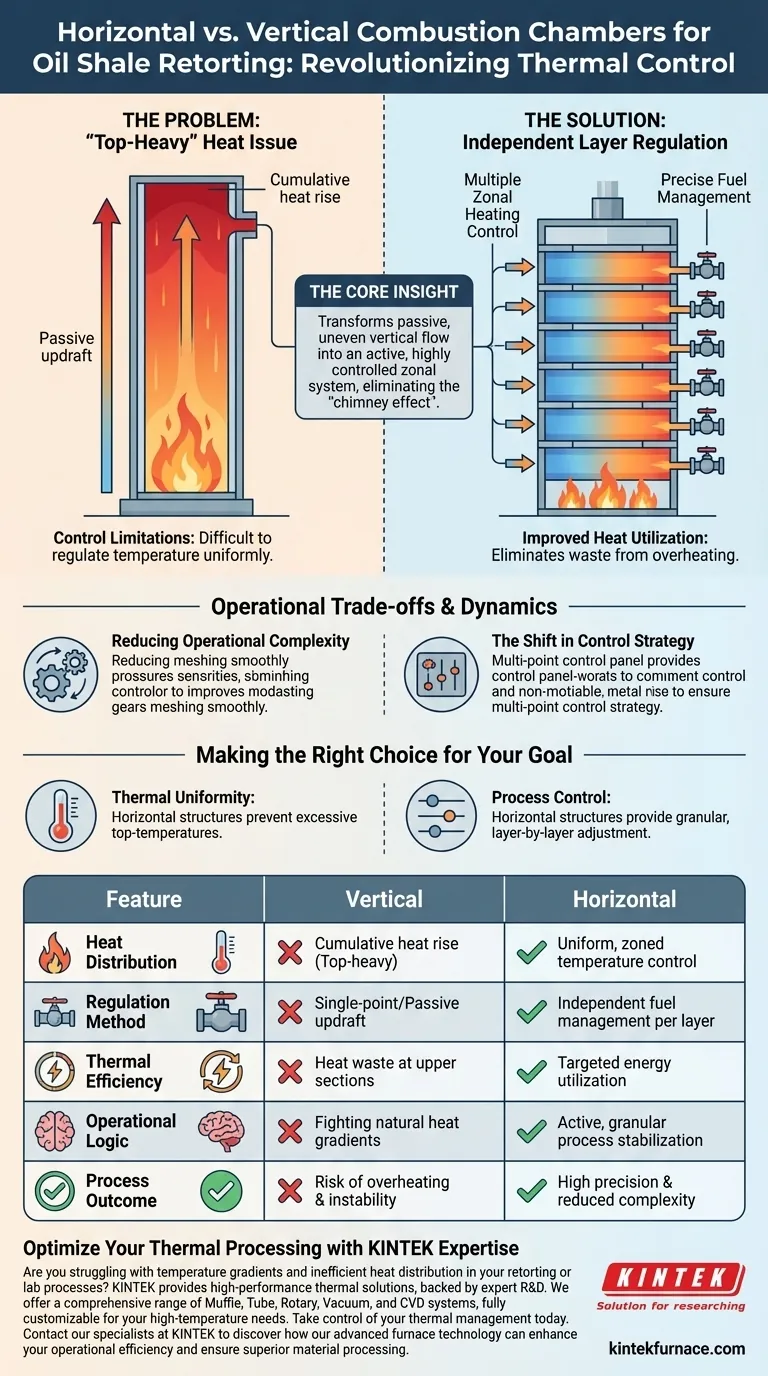
Horizontal combustion chamber structures revolutionize thermal control by enabling independent temperature regulation at specific heights within the oil shale retort. Unlike vertical structures, which suffer from cumulative heat rise, horizontal designs allow operators to adjust fuel consumption for each individual combustion layer, ensuring precise thermal management and preventing overheating at the top of the chamber.
The Core Insight By segmenting the heating wall into independent horizontal layers, this design eliminates the "chimney effect" inherent in vertical channels. It transforms the heating process from a passive, uneven vertical flow into an active, highly controlled zonal system.
The Problem with Vertical Structures
The "Top-Heavy" Heat Issue
Traditional vertical channels often face significant thermal imbalances.
Because heat naturally rises, the temperature at the top of a vertical combustion chamber tends to become excessively high.
Control Limitations
This natural thermal gradient makes it extremely difficult to regulate temperature distribution uniformly.
Operators often struggle to cool the top section without disrupting the heat required at the bottom, leading to inefficient processing.
How Horizontal Structures Solve the Problem
Independent Layer Regulation
Horizontal combustion chamber structures are designed to break the heating wall into distinct, manageable zones.
This allows for the independent regulation of the temperature distribution at different heights.
Precise Fuel Management
The system achieves this control by regulating the fuel consumption of each individual combustion layer.
Operators can increase fuel in cooler zones and decrease it in hotter zones, creating a tailored heat profile.
Improved Heat Utilization
By eliminating the waste associated with overheating the top of the chamber, the system utilizes heat more effectively.
Energy is directed exactly where it is needed, rather than accumulating where it causes damage or inefficiency.
Operational Trade-offs and Dynamics
Reducing Operational Complexity
While moving to a segmented system might sound more complex mechanically, the source indicates that it actually reduces operational complexity.
This is because the difficulty of fighting against the physics of a vertical heat column is removed.
The Shift in Control Strategy
The trade-off involves moving from a single-point control strategy to a multi-point strategy.
Success relies on the operator's ability to monitor and adjust the fuel consumption for multiple layers rather than managing a single updraft.
Making the Right Choice for Your Goal
When evaluating retort design, the choice between vertical and horizontal structures depends on your need for precision.
- If your primary focus is Thermal Uniformity: Horizontal structures are superior because they prevent the excessive top-temperatures common in vertical designs.
- If your primary focus is Process Control: Horizontal structures provide the granular ability to adjust fuel consumption layer-by-layer, simplifying the stabilization of the retort.
Horizontal layering turns temperature distribution into a manageable variable rather than a difficult constraint.
Summary Table:
| Feature | Vertical Combustion Chambers | Horizontal Combustion Chambers |
|---|---|---|
| Heat Distribution | Cumulative heat rise (Top-heavy) | Uniform, zoned temperature control |
| Regulation Method | Single-point/Passive updraft | Independent fuel management per layer |
| Thermal Efficiency | Heat waste at upper sections | Targeted energy utilization |
| Operational Logic | Fighting natural heat gradients | Active, granular process stabilization |
| Process Outcome | Risk of overheating & instability | High precision & reduced complexity |
Optimize Your Thermal Processing with KINTEK Expertise
Are you struggling with temperature gradients and inefficient heat distribution in your retorting or lab processes? KINTEK provides high-performance thermal solutions designed to meet the most demanding industrial and research standards. Backed by expert R&D and manufacturing, we offer a comprehensive range of Muffle, Tube, Rotary, Vacuum, and CVD systems, all of which can be fully customized for your unique high-temperature needs.
Take control of your thermal management today. Contact our specialists at KINTEK to discover how our advanced furnace technology can enhance your operational efficiency and ensure superior material processing.
Visual Guide
References
- Lixin Zhao, Luwei Pan. Numerical Study of the Combustion-Flow-Thermo-Pyrolysis Process in an Innovative Externally Heated Oil Shale Retort. DOI: 10.3390/sym17071055
This article is also based on technical information from Kintek Furnace Knowledge Base .
Related Products
People Also Ask
- What role does a Tube Furnace play in the CVD growth of carbon nanotubes? Achieve High-Purity CNT Synthesis
- What are the advantages of using a CVD tube furnace for preparing gate dielectrics? Achieve High-Quality Thin Films for Transistors
- How does a CVD tube furnace achieve high purity in gate media preparation? Master Precision Control for Flawless Films
- What are the operational and maintenance requirements for a CVD tube furnace? Ensure Precision for Thin Film Deposition
- What improvements can be made to the bonding force of gate dielectric films using a CVD tube furnace? Enhance Adhesion for Reliable Devices
