
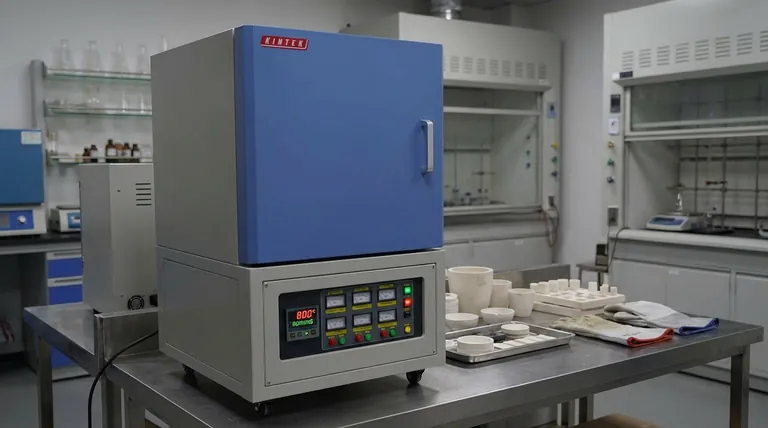
Precision is the dividing line between material failure and structural integrity. A high-precision program-controlled furnace is critical for heat-treating refractory castables because it ensures strict adherence to specific heating curves, such as 5 °C/h, and maintains exact isothermal soaking times. This automation is the only reliable method to manage the delicate chemical and physical changes required to preserve the material's residual flexural and compressive strength.
The core value of a programmable furnace is its ability to synchronize thermal application with material kinetics. By strictly controlling the environment, it facilitates the formation of high-temperature phases like anorthite while preventing structural damage caused by thermal expansion mismatches.
The Necessity of Strict Heating Curves
Eliminating Human Error
Manual adjustments cannot achieve the consistency required for advanced refractory treatments. A program-controlled furnace automates the ramp-up process, removing fluctuations that occur with manual control.
Achieving Slow Heating Rates
Specific treatments require extremely slow heating rates, such as 5 °C/h. Maintaining this rate over several days is impossible without high-precision programming. This gradual rise is essential to prevent thermal shock.
Precise Isothermal Soaking
Beyond the ramp-up, the material must be held at specific temperatures (e.g., 800 °C or 1100 °C) for exact durations. This "soaking" period allows heat to penetrate the core of the sample fully, ensuring temperature uniformity throughout the castable.
Facilitating Phase Transformations
Converting Hydration Products
Refractory castables often contain aluminate cement. As the temperature rises, the hydration products within this cement must undergo a controlled conversion.
Forming High-Temperature Phases
The ultimate goal of this heat treatment is to synthesize specific high-temperature mineral phases. Specifically, the precise thermal environment promotes the transformation into anorthite.
Enhancing Material Properties
The formation of anorthite is not just a chemical change; it is a structural enhancement. This phase contributes directly to the mechanical robustness of the final product.
Alleviating Internal Thermal Stresses
Managing Expansion Mismatches
Refractory castables are composite materials. In this context, they contain Cenospheres embedded within a matrix. These two components have different coefficients of thermal expansion.
Reducing Structural Tension
As the material heats, the Cenospheres and the matrix expand at different rates. If heating is too rapid, this mismatch creates internal destructive forces.
Preserving Residual Strength
A programmed, slow heating curve allows the material to accommodate these stresses gradually. This controlled expansion is vital for ensuring the castable retains high residual flexural and compressive strength after cooling.
Understanding the Operational Trade-offs
Process Duration vs. Throughput
The primary trade-off of high-precision heating is time. Adhering to a 5 °C/h ramp rate significantly extends cycle times, potentially creating a bottleneck in high-throughput testing environments.
Equipment Complexity
Program-controlled furnaces require more sophisticated calibration and setup than standard kilns. Operators must be trained to program complex multi-segment schedules rather than simply setting a target temperature.
Making the Right Choice for Your Goal
To determine if this level of precision is required for your specific application, consider the following:
- If your primary focus is Maximum Mechanical Strength: You must use a program-controlled furnace to alleviate expansion mismatches between Cenospheres and the matrix.
- If your primary focus is Mineralogical Development: You require precise soaking times to ensure the complete transformation of hydration products into anorthite.
Ultimately, the furnace is not just a heating element; it is a tool for controlling the microscopic architecture of your material.
Summary Table:
| Feature | Requirement for Refractories | Benefit of Program Control |
|---|---|---|
| Heating Rate | Ultra-slow (e.g., 5 °C/h) | Prevents thermal shock and internal cracking |
| Soaking Precision | Exact isothermal hold times | Ensures complete phase transformation to anorthite |
| Thermal Stress | Differential expansion management | Preserves residual flexural and compressive strength |
| Consistency | Repeatable thermal curves | Eliminates human error in complex multi-segment cycles |
Elevate Your Material Research with KINTEK Precision
Don't let thermal shock compromise your refractory research. KINTEK provides industry-leading Muffle, Tube, Rotary, Vacuum, and CVD systems, all engineered to deliver the precise heating curves and isothermal stability required for advanced material kinetics. Backed by expert R&D and manufacturing, our high-temperature lab furnaces are fully customizable to meet your unique thermal processing needs.
Ready to master your material architecture?
Contact KINTEK today for a custom furnace solution
References
- Effect of Prewetting Cenospheres on Hydration Kinetics, Microstructure, and Mechanical Properties of Refractory Castables. DOI: 10.3390/cryst15010068
This article is also based on technical information from Kintek Furnace Knowledge Base .
Related Products
- 1700℃ Controlled Inert Nitrogen Atmosphere Furnace
- High Temperature Muffle Oven Furnace for Laboratory Debinding and Pre Sintering
- Spark Plasma Sintering SPS Furnace
- Controlled Inert Nitrogen Hydrogen Atmosphere Furnace
- 1200℃ Controlled Inert Nitrogen Atmosphere Furnace
People Also Ask
- How does oxygen partial pressure control affect ceramic sintering? Master Defect Chemistry
- How does real-time dilatometric analysis in a controlled-atmosphere furnace optimize PZT ceramic sintering?
- How do controlled-atmosphere furnaces support polymer pyrolysis? Master SiC & Si3N4 Ceramic Conversion
- Why is thorough binder burnout necessary before sintering advanced ceramics? Ensure Peak Density & Zero Defects
- Why is controlled-atmosphere heating required for functional ceramics and sensors? Master Defect Engineering



















