
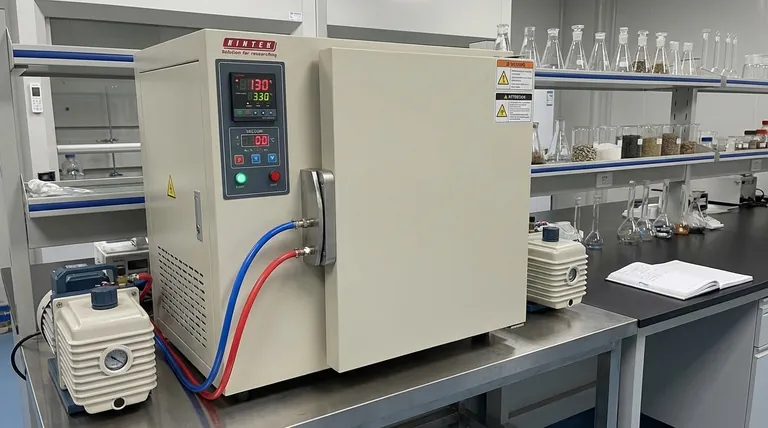
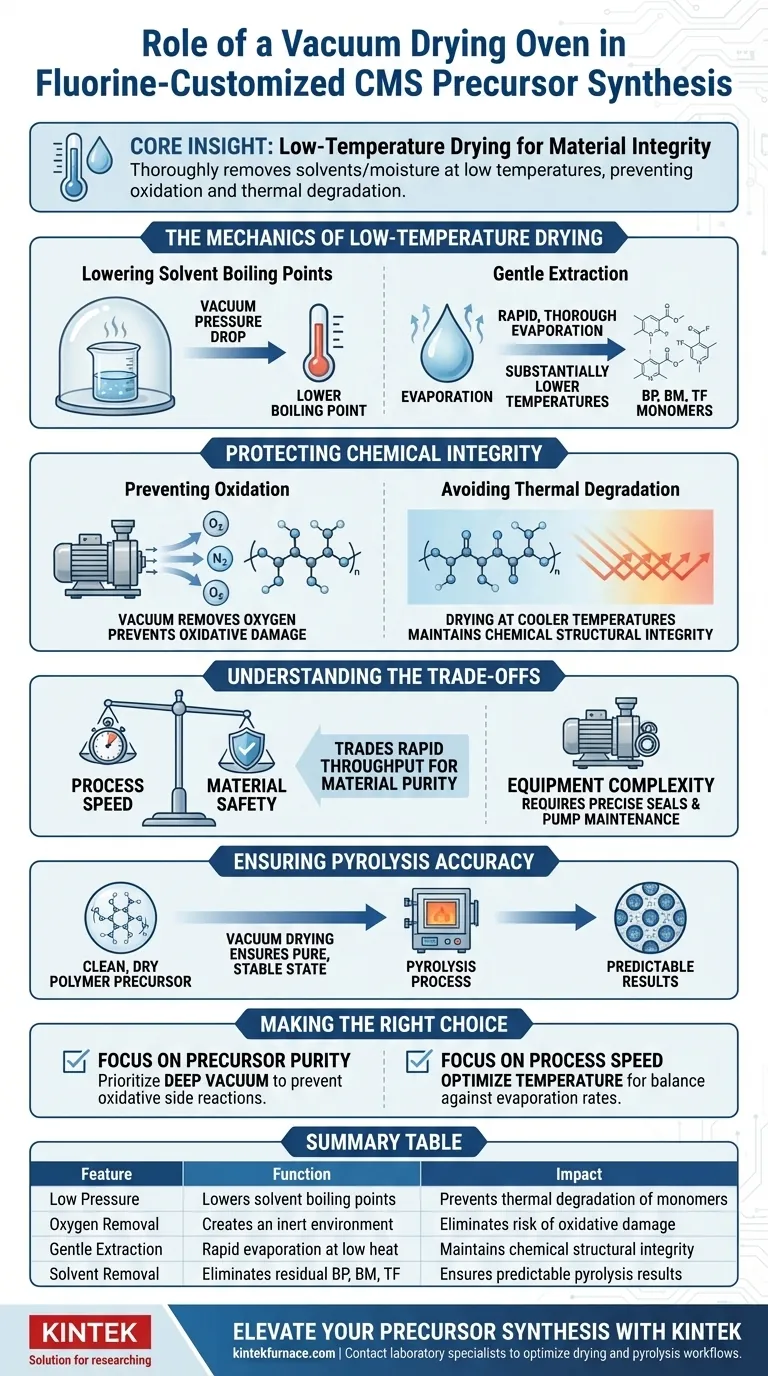
The primary function of a vacuum drying oven in this context is to thoroughly remove solvents and moisture from monomers and polymers without subjecting them to damaging thermal stress. Specifically, this process is applied during the synthesis of monomers (such as BP, BM, and TF) and the final polyimide polymers used as precursors for Carbon Molecular Sieves (CMS).
Core Insight: The value of vacuum drying lies not just in removing moisture, but in doing so at low temperatures. By lowering the boiling point of solvents, the oven prevents oxidation and thermal degradation, preserving the delicate chemical structure required for successful pyrolysis.
The Mechanics of Low-Temperature Drying
Lowering Solvent Boiling Points
In a standard oven, removing stubborn solvents often requires high heat. A vacuum drying oven creates a low-pressure environment that significantly lowers the boiling point of residual solvents and moisture.
Gentle Extraction
This pressure differential allows for rapid, thorough evaporation at substantially lower temperatures. This is critical for processing delicate monomers like BP, BM, and TF, ensuring they reach a dry state without requiring excessive thermal energy.
Protecting Chemical Integrity
Preventing Oxidation
Standard drying processes expose materials to heated air, which increases the risk of oxidation. The vacuum environment removes oxygen from the chamber, effectively preventing oxidative damage to the polymer precursor.
Avoiding Thermal Degradation
High temperatures can cause polymer chains to break down or cross-link prematurely. By facilitating drying at cooler temperatures, the vacuum oven maintains the chemical structural integrity of the polyimide polymers.
Understanding the Trade-offs
Process Speed vs. Material Safety
While vacuum drying is gentler, it can be slower than high-temperature blast drying if the vacuum pressure is not optimized. You trade rapid throughput for material purity and structural assurance.
Equipment Complexity
Maintaining a consistent vacuum requires precise seals and pump maintenance. Any leakage introduces oxygen and moisture, effectively negating the benefits of the process and potentially contaminating the CMS precursor.
Ensuring Pyrolysis Accuracy
The Foundation for Carbonization
The quality of the final Carbon Molecular Sieve is dictated by the quality of the precursor. If the precursor contains residual solvent or has suffered thermal damage, the subsequent pyrolysis process will yield unpredictable results.
Stabilizing the Precursor
Vacuum drying ensures the material enters the pyrolysis stage in a pure, chemically accurate state. This stability is required to achieve the precise pore sizing and separation capabilities expected from fluorine-customized CMS.
Making the Right Choice for Your Goal
To maximize the efficacy of your synthesis process, consider your specific priorities:
- If your primary focus is precursor purity: Prioritize a deep vacuum level to ensure complete solvent removal at the lowest possible temperature to prevent any oxidative side reactions.
- If your primary focus is process speed: Optimize the temperature to the highest safe limit for your specific polyimide variant, balancing thermal stability against evaporation rates.
By controlling the drying environment, you secure the structural fidelity of the precursor before it ever reaches the pyrolysis furnace.
Summary Table:
| Feature | Function in CMS Synthesis | Impact on Precursor Quality |
|---|---|---|
| Low Pressure | Lowers solvent boiling points | Prevents thermal degradation of monomers |
| Oxygen Removal | Creates an inert environment | Eliminates risk of oxidative damage |
| Gentle Extraction | Rapid evaporation at low heat | Maintains chemical structural integrity |
| Solvent Removal | Eliminates residual BP, BM, TF | Ensures predictable pyrolysis results |
Elevate Your Precursor Synthesis with KINTEK
Precision in vacuum drying is the foundation for high-performance Carbon Molecular Sieves. At KINTEK, we understand that maintaining chemical integrity during monomer and polymer processing is non-negotiable.
Backed by expert R&D and industry-leading manufacturing, KINTEK offers advanced Vacuum, Muffle, Tube, and CVD systems designed to provide the stable, oxygen-free environments your research demands. Whether you need customized high-temperature furnaces or precise vacuum control for delicate polyimides, our solutions are tailored to your unique lab requirements.
Ready to optimize your drying and pyrolysis workflows? Contact our laboratory specialists today to discover how KINTEK can enhance your material purity and process reliability.
Visual Guide
References
- Shan Xu, Yunlong Ji. High‐Performance Carbon Capture with Fluorine‐Tailored Carbon Molecular Sieve Membranes. DOI: 10.1002/adma.202420477
This article is also based on technical information from Kintek Furnace Knowledge Base .
Related Products
- Vacuum Heat Treat Sintering and Brazing Furnace
- Vacuum Heat Treat Sintering Furnace Molybdenum Wire Vacuum Sintering Furnace
- Dental Porcelain Zirconia Sintering Ceramic Vacuum Press Furnace
- Molybdenum Vacuum Heat Treat Furnace
- Vacuum Hot Press Furnace Machine Heated Vacuum Press
People Also Ask
- What are the benefits of using vacuum heat treating furnaces for metal alloys? Achieve Superior Metal Properties and Performance
- What is one of the most important uses of vacuum heat treating furnaces in aerospace? Achieve Superior Strength in Aircraft Alloys
- How does vacuum heat treating affect the grain structure of metal alloys? Achieve Precise Microstructure Control
- What is the temperature of a vacuum furnace brazing? Optimize Your Joint Strength and Cleanliness
- What are the steps involved in a typical vacuum brazing treatment? Master the Process for Strong, Clean Joints












