
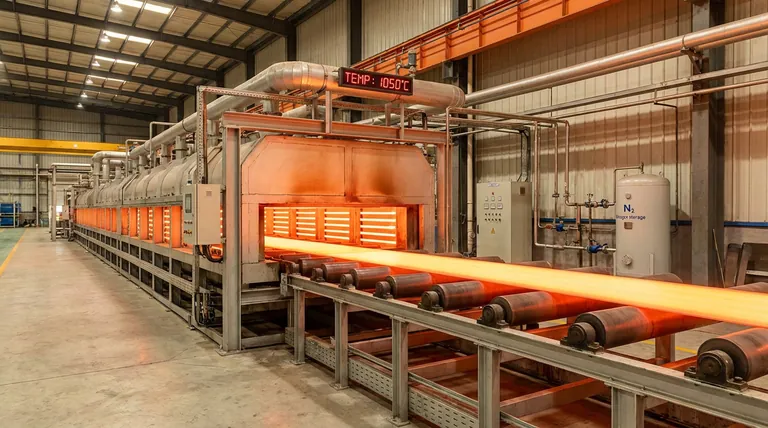
The primary purpose of using a continuous annealing furnace is to expose hot-rolled silicon steel plates to a stable, high-temperature environment, typically between 1000°C and 1050°C. This specific thermal treatment drives full normalization recrystallization, effectively resetting the material's internal structure before further processing.
By eliminating non-uniformities from hot rolling and maintaining a protective atmosphere, this process transforms the steel into a homogeneous material with the precise physical and chemical properties required for optimal cold rolling and final magnetic performance.
Optimizing Internal Microstructure
Eliminating Residual Structures
The hot rolling process inevitably leaves the steel with uneven, stressed internal structures. The continuous annealing furnace provides the necessary thermal energy to eliminate these non-uniform residual structures.
Achieving Full Recrystallization
Through the application of temperatures in the 1000°C to 1050°C range, the steel undergoes full normalization recrystallization. This creates a uniform grain structure throughout the plate, replacing the deformed grains generated during previous mechanical processing.
Promoting Controlled Grain Growth
Beyond simple stress relief, the high-temperature treatment facilitates moderate grain growth. This step is vital for establishing the correct baseline microstructure that will determine the steel's magnetic properties in its final state.
Managing Primary Inclusions
The heat treatment allows for the ripening of primary inclusions. By modifying the size and distribution of these inclusions, the furnace ensures they do not negatively impact the material's integrity during later stages.
Preparing for Cold Rolling
Improving Deformation Behavior
The structural changes achieved during normalization—specifically the grain growth and inclusion ripening—directly optimize the deformation behavior of the steel.
Reducing Processing Risks
A normalized plate behaves more predictably under mechanical stress. This optimization is crucial for preventing defects or breaks during the subsequent cold rolling process.
Critical Operational Safeguards
Maintaining an Inert Environment
To function correctly, the furnace introduces Nitrogen to create an inert protective environment. Without this, the high temperatures required for normalization would damage the material.
Preventing Surface Degradation
This protective atmosphere is essential to prevent the surface of the silicon steel thin plates from undergoing oxidation. Preserving the surface finish at this stage is critical for the quality of the final product.
Stabilizing Chemical Composition
The nitrogen environment specifically prevents decarburization (the loss of carbon). Maintaining the stability of the chemical composition is a non-negotiable requirement for safeguarding the steel's final magnetic performance.
Achieving Your Production Goals
Depending on your specific manufacturing priorities, the role of the continuous annealing furnace shifts slightly in focus.
- If your primary focus is Process Efficiency: Prioritize the temperature range (1000°C–1050°C) to ensure inclusion ripening, which minimizes breakage and optimizes deformation during cold rolling.
- If your primary focus is Final Magnetic Quality: Strictly monitor the nitrogen atmosphere to prevent decarburization and oxidation, ensuring the chemical purity required for superior magnetic performance.
Mastering the normalization process is the bridge between a raw hot-rolled plate and a high-performance electrical steel product.
Summary Table:
| Process Objective | Temperature Range | Primary Benefit |
|---|---|---|
| Recrystallization | 1000°C - 1050°C | Eliminates residual stresses and non-uniform structures |
| Microstructure Control | High-Temp Soak | Facilitates moderate grain growth and inclusion ripening |
| Surface Protection | Nitrogen Atmosphere | Prevents oxidation and decarburization during heating |
| Rolling Preparation | Controlled Cooling | Optimizes deformation behavior for safer cold rolling |
Elevate Your Material Processing with KINTEK
Maximize your production yield and magnetic quality with KINTEK’s advanced thermal solutions. Backed by expert R&D and world-class manufacturing, KINTEK offers a comprehensive range of Muffle, Tube, Rotary, Vacuum, and CVD systems, along with customizable lab high-temperature furnaces designed specifically for silicon steel normalization and precise heat treatments.
Whether you are refining grain structures or protecting surface integrity, our engineering team is ready to build a system tailored to your unique specifications.
Ready to optimize your annealing process? Contact us today for a custom consultation!
References
- The Multiple Effects of RE Element Addition in Non-Oriented Silicon Steel. DOI: 10.3390/ma18020401
This article is also based on technical information from Kintek Furnace Knowledge Base .
Related Products
- Vacuum Sealed Continuous Working Rotary Tube Furnace Rotating Tube Furnace
- 1400℃ Muffle Oven Furnace for Laboratory
- Spark Plasma Sintering SPS Furnace
- Controlled Inert Nitrogen Hydrogen Atmosphere Furnace
- Vacuum Heat Treat Sintering Furnace with Pressure for Vacuum Sintering
People Also Ask
- What is the purpose of rotary tube furnaces? Achieve Uniform Heat Treatment for Powders and Granules
- What are the key advantages of using a rotary tube furnace? Achieve Dynamic, Uniform Heating for Powders
- How does the amount of material processed vary between batch and continuous rotary tube furnaces? Scale Your Production Efficiently
- What are the advantages of rotary tube furnaces in fuel compatibility? Boost Efficiency and Cut Costs
- What is the temperature range of some rotary tube furnaces? Achieve Uniform Heating Up to 1200°C







