
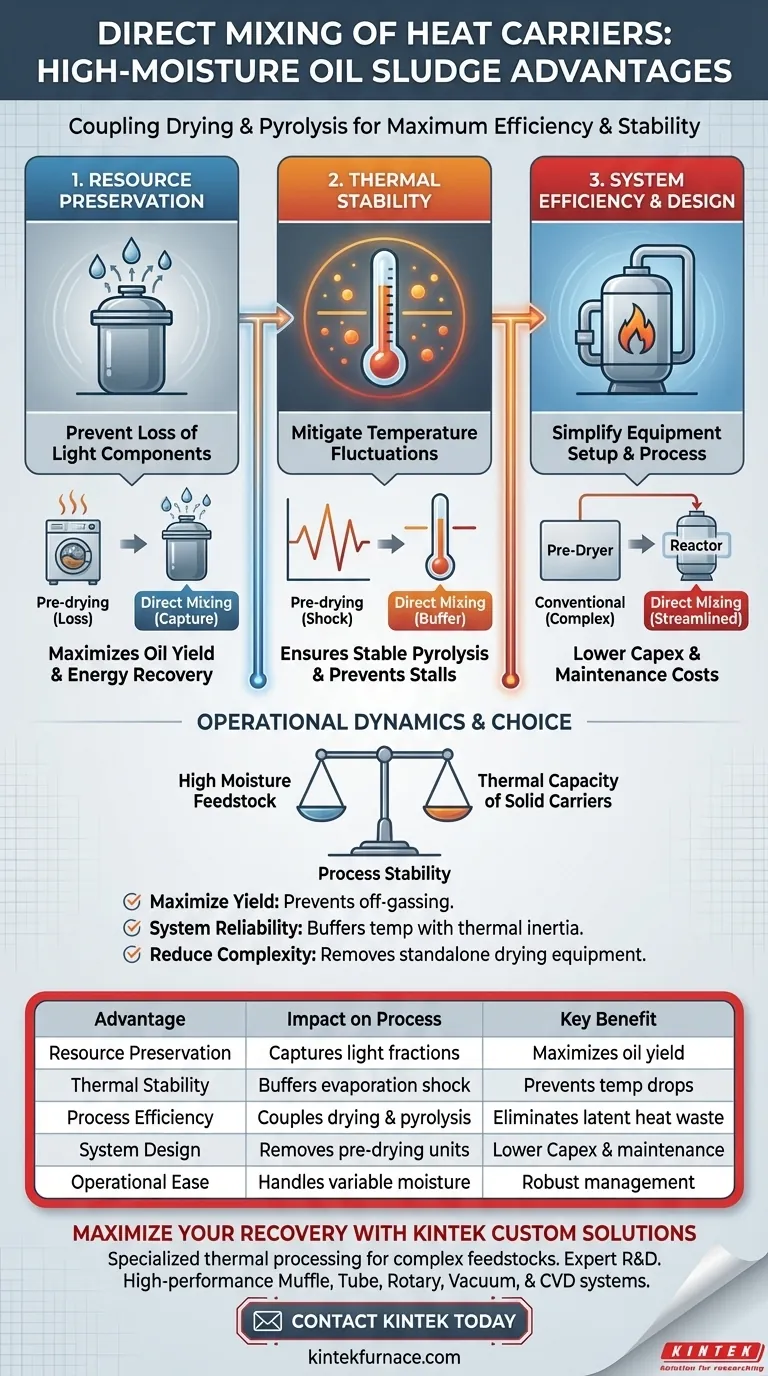
Directly mixing heat carriers with high-moisture sludge offers a significant efficiency advantage by effectively coupling the drying and pyrolysis stages into a single operation. Instead of separating these processes, this method utilizes the sensible heat of high-temperature circulating ash to evaporate water instantaneously, preventing the loss of valuable volatile components while simultaneously stabilizing the reactor's thermal environment.
By eliminating the pre-drying stage, you avoid the inadvertent stripping of light oil fractions that occurs during conventional heating. This approach leverages the substantial thermal mass of solid heat carriers to buffer the system against the rapid energy drain caused by water evaporation.
Preserving Resource Value
Preventing the Loss of Light Components
In conventional pre-drying processes, the heat required to drive off moisture is often sufficient to vaporize light hydrocarbon fractions.
This results in the loss of valuable energy content before the sludge ever reaches the pyrolysis reactor.
Direct mixing avoids this by capturing these light components immediately within the reactor, ensuring they are processed and recovered rather than vented or lost during a preliminary drying phase.
Operational Stability and Thermodynamics
Mitigating Temperature Fluctuations
Processing sludge with high moisture content (e.g., near 72.82%) imposes a massive thermal load on the system due to the latent heat of vaporization required to turn water into steam.
The use of solid heat carriers (such as circulating ash) provides a large thermal capacity.
This thermal mass acts as a buffer, absorbing the "shock" of rapid water evaporation and preventing sharp drops in reactor temperature that could stall the pyrolysis process.
Utilization of Sensible Heat
The process relies on the sensible heat transfer from the high-temperature ash directly to the wet sludge.
This direct contact ensures highly efficient heat transfer, rapidly driving the phase change of water without the need for external heating elements or intermediate heat exchangers.
System Design and Complexity
Simplifying Equipment Setup
Eliminating a dedicated pre-drying unit significantly reduces the mechanical footprint of the processing plant.
This reduction in equipment not only lowers capital expenditure but also minimizes maintenance requirements by removing a complex unit operation from the line.
Understanding the Operational Dynamics
While this method offers clear advantages, it shifts the burden of process stability entirely onto the heat carrier.
The Role of Thermal Capacity
Success depends on the volume and temperature of the circulating ash.
Because the water evaporation is handled inside the reactor, the system must maintain a sufficient ratio of heat carriers to sludge to ensure the temperature remains high enough for pyrolysis after the water has evaporated.
Making the Right Choice for Your Goal
To determine if direct mixing is the correct approach for your specific feedstock, consider your primary operational objectives:
- If your primary focus is maximizing yield: Direct mixing is superior as it prevents the off-gassing and loss of light oil components associated with pre-heating.
- If your primary focus is system reliability: This method utilizes the thermal inertia of solid carriers to stabilize temperatures, making it ideal for sludge with widely varying moisture levels.
- If your primary focus is reducing complexity: Direct mixing removes the need for standalone drying equipment, streamlining the overall facility design.
This approach transforms the high moisture content from a liability into a manageable thermal variable, handled robustly by the system's internal heat capacity.
Summary Table:
| Advantage | Impact on Process | Key Benefit |
|---|---|---|
| Resource Preservation | Captures light hydrocarbon fractions | Maximizes oil yield and energy recovery |
| Thermal Stability | Solid heat carriers buffer evaporation shock | Prevents temperature drops & ensures stable pyrolysis |
| Process Efficiency | Couples drying and pyrolysis stages | Eliminates latent heat energy waste |
| System Design | Removes dedicated pre-drying units | Lower capital expenditure and maintenance costs |
| Operational Ease | Handles variable moisture levels | Robust management of high-moisture feedstocks |
Maximize Your Recovery with KINTEK Custom Solutions
Don't let valuable light oil fractions escape during pre-drying. KINTEK specializes in advanced thermal processing systems designed to handle complex feedstocks with precision and efficiency. Backed by expert R&D and manufacturing, we offer high-performance Muffle, Tube, Rotary, Vacuum, and CVD systems, all customizable to meet your specific lab or industrial high-temperature requirements.
Whether you are refining oil sludge processing or optimizing material synthesis, our technical team is ready to engineer a system tailored to your unique thermal capacity needs. Contact KINTEK today to discuss your project requirements and see how our expertise can streamline your operations.
Visual Guide
References
- Zhengyang Zhang, Changtao Yue. Theoretical Calculation of Heat and Material Balance for Oil Sludge Pyrolysis Process by Solid Heat Carrier Method. DOI: 10.3390/en18020329
This article is also based on technical information from Kintek Furnace Knowledge Base .
Related Products
- Electric Rotary Kiln Pyrolysis Furnace Plant Machine Small Rotary Kiln Calciner
- Electric Rotary Kiln Continuous Working Small Rotary Furnace Kiln for Pyrolysis Plant Heating
People Also Ask
- What are the advantages of electric rotary kilns compared to fuel-fired ones? Boost Precision and Efficiency in Your Process
- What advantages do electric rotary kilns offer over fuel-based kilns? Boost Efficiency and Purity in Your Process
- What materials can be processed in an electric rotary kiln? Versatile Solutions for Advanced Materials
- What are the main applications of a rotary kiln electric furnace? Achieve Uniform Heat Treatment for Powders
- What is the significance of the refractory lining in a rotary kiln electric furnace? Unlock Efficiency and Longevity

