
High-precision high-temperature furnaces are required to validate material safety in extreme environments. These specialized furnaces do more than simply heat a sample; they generate and rigorously regulate a constant thermal field, often exceeding 1000°C. This precise control is the only way to ensure mechanical test results accurately reflect how a material will behave inside critical machinery, such as jet engines or nuclear reactors.
Core Takeaway: Accuracy in mechanical testing relies on stability. A high-precision furnace ensures the material specimen remains in a "preset" thermal environment throughout the loading process, allowing engineers to capture the material's true thermodynamic response under real-world stress.
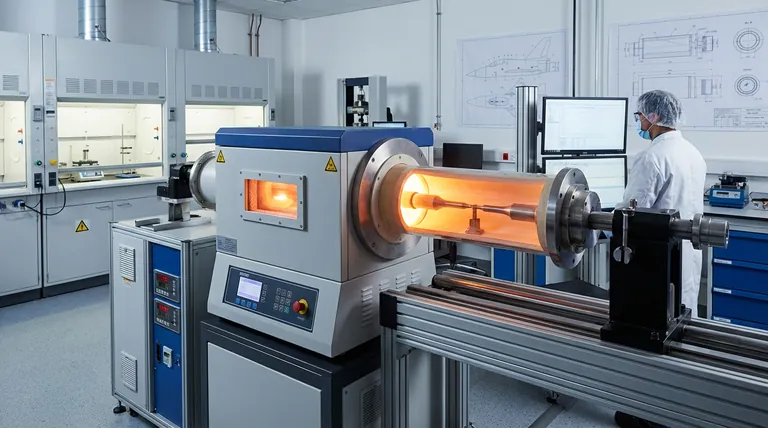
Simulating Extreme Real-World Environments
Replicating Critical Conditions
Advanced materials often serve in unforgiving environments. To validate a material for use in a jet engine or a nuclear reactor, the testing setup must duplicate those exact conditions.
Reaching High Thermal Thresholds
Standard heating elements are insufficient for these applications. The furnace must be capable of providing a high-temperature field that reliably exceeds 1000°C.
The Necessity of Simulation
Without this capability, testing is merely theoretical. The furnace bridges the gap between the lab and the field by strictly enforcing the thermal realities the material will face in service.
Ensuring Data Integrity Through Thermal Stability
Constant Field Regulation
Getting a sample hot is easy; keeping it at a precise temperature is difficult. The core function of these furnaces is to accurately regulate the heat to maintain a constant field.
Consistency During Loading
Mechanical testing involves applying physical stress (load) to a specimen. The furnace ensures that the thermal environment remains preset and unchanging, even as the material deforms under this load.
capturing Thermodynamic Response
Materials behave differently when heat and physical stress interact. High-precision thermal control allows for an accurate reflection of the material's thermodynamic response, ensuring the data collected is valid for engineering decisions.
Understanding the Stakes (Trade-offs)
Precision vs. Approximation
Using a lower-precision heating source may save resources, but it compromises data integrity. If the temperature fluctuates during loading, you cannot distinguish between mechanical failure and thermal failure.
The Cost of Accuracy
Achieving temperatures >1000°C with tight regulation requires sophisticated infrastructure. However, for safety-critical applications, the "cost" of poor data is far higher than the investment in high-precision equipment.
Making the Right Choice for Your Goal
To determine if your testing protocol requires this level of precision, consider the end-use of your material.
- If your primary focus is Safety-Critical Applications (e.g., Aerospace, Nuclear): You must use high-precision furnaces to guarantee the material can survive the specific thermodynamic stresses of the operating environment.
- If your primary focus is Material Characterization: You need the strict regulation capability to isolate variables, ensuring that observed changes are due to the material's properties, not temperature fluctuations.
Precise thermal control is the fundamental requirement for transforming raw data into reliable engineering confidence.
Summary Table:
| Feature | High-Precision Furnace | Standard Laboratory Furnace |
|---|---|---|
| Temperature Range | >1000°C with high stability | Often limited or less stable at peak |
| Field Uniformity | Constant, regulated thermal field | Potential for thermal gradients |
| Dynamic Testing | Maintains temp during mechanical loading | Temp may fluctuate under stress |
| Data Accuracy | High; isolates thermodynamic response | Lower; risks data contamination |
| Primary Use | Safety-critical (Aerospace, Nuclear) | General material characterization |
Elevate Your Testing Precision with KINTEK
Don't compromise your data integrity with inconsistent thermal environments. KINTEK provides industry-leading Muffle, Tube, Rotary, Vacuum, and CVD systems designed for the most demanding mechanical testing requirements. Backed by expert R&D and precision manufacturing, our lab high-temperature furnaces are fully customizable to meet your unique thermodynamic simulation needs.
Ready to ensure your materials survive the world's harshest conditions?
Contact KINTEK Today to Discuss Your Custom Solution
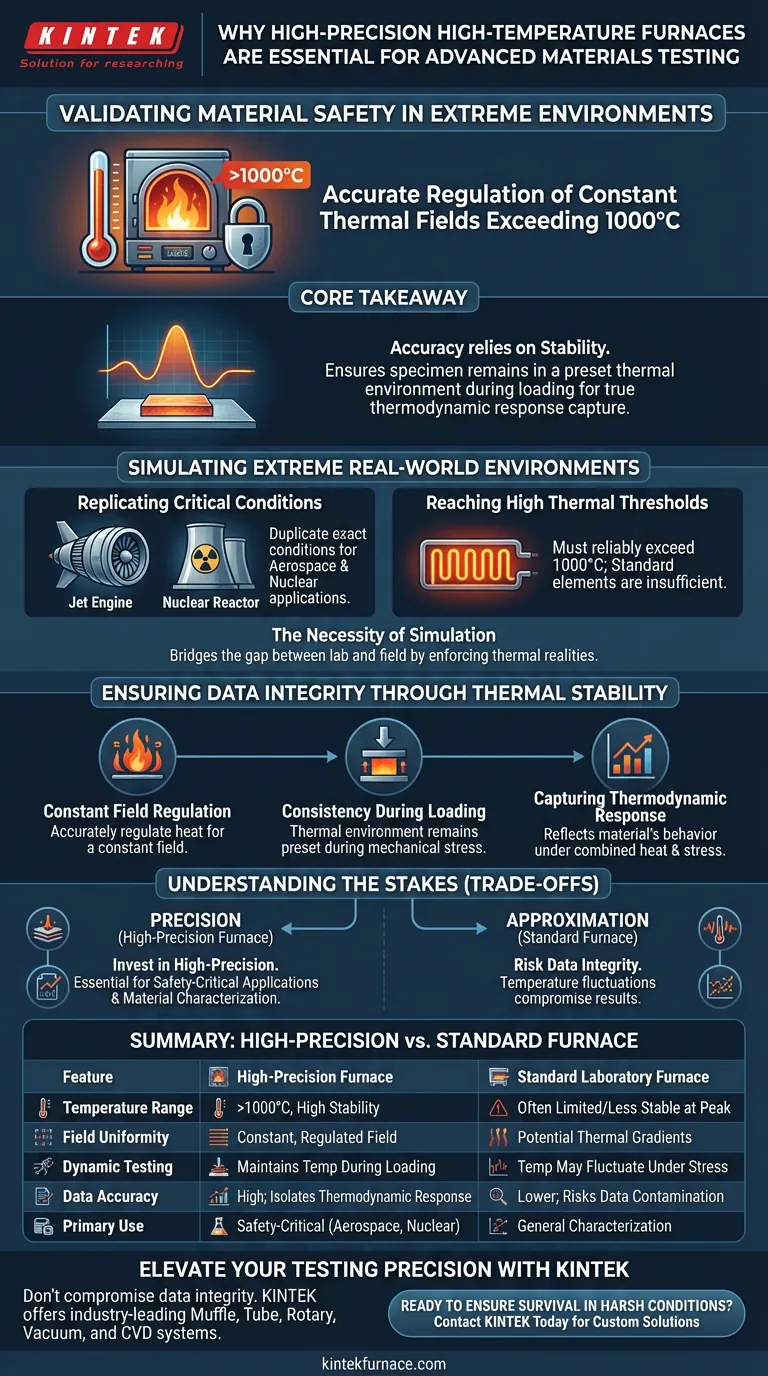
Visual Guide
References
- Priyanka Gupta, Raghad Ahmed Hussien. RETRACTED: High-Temperature Mechanical Characterization of Materials for Extreme Environments. DOI: 10.1051/e3sconf/202450501006
This article is also based on technical information from Kintek Furnace Knowledge Base .
Related Products
- 1400℃ High Temperature Laboratory Tube Furnace with Alumina Tube
- 1700℃ High Temperature Laboratory Tube Furnace with Alumina Tube
- 1700℃ High Temperature Muffle Oven Furnace for Laboratory
- 1800℃ High Temperature Muffle Oven Furnace for Laboratory
- 1200℃ Muffle Oven Furnace for Laboratory
People Also Ask
- How does zone-melting in tube furnaces synthesize bismuth micro-wires? Master Single-Crystal Thermoelectric Growth
- How are high-temperature laboratory tube furnaces applied in long-term vacuum homogenization heat treatments for intermetallic samples?
- How do high-temperature laboratory tube furnaces ensure environmental stability? Precision Thermal Reduction Tips
- How are high-temp tube furnaces used to measure diffusion coefficients per Fick's law? Master Precision Annealing
- How are high-temperature tube furnaces applied in testing ceramic-supported alloy membranes? Insights



















