
Calcination equipment is a prerequisite for ensuring data integrity during Volatile Organic Compounds (VOCs) static adsorption performance tests. Pre-treating ZSM-5 zeolite at 550 °C serves a critical function: it thermally strips away moisture and volatile impurities that the material inevitably absorbs during storage and transfer. This process "resets" the zeolite, ensuring its internal structure is fully accessible for the specific testing of organic solvents.
By eliminating pre-existing contaminants like atmospheric moisture, calcination guarantees that your test data reflects the zeolite's actual capacity to adsorb target VOCs, rather than simply measuring how much space is left after water has clogged the pores.
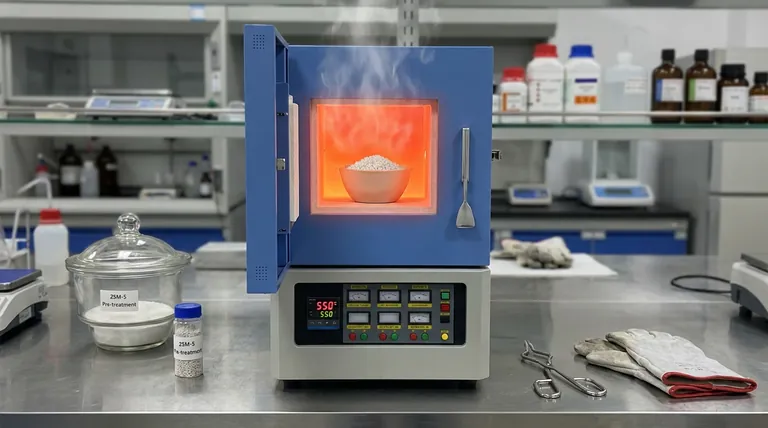
The Mechanics of Zeolite Activation
Eliminating Environmental Interference
Zeolites are highly hygroscopic, meaning they naturally pull moisture from the surrounding air. During the time between manufacturing, storage, and the actual test, ZSM-5 acts like a molecular sponge.
If you skip the calcination step, the water molecules occupying the zeolite's structure will compete with the VOCs you intend to test. This leads to false negative results, creating the illusion that the zeolite has a lower adsorption capacity than it actually possesses.
Restoring Pore Accessibility
The primary goal of the 550 °C treatment is to return the zeolite to a "fully open" state. The internal channels of ZSM-5 are the sites where adsorption occurs.
Calcination ensures these micro-pores are completely cleared of obstructions. This allows the target organic solvents—specifically p-xylene, benzene, and toluene—to access the internal surface area without hindrance.
Activating the Surface
Beyond simple cleaning, thermal treatment brings the material to an active state. While the initial synthesis calcination removes organic templates (like TPAOH) to create the pores, this pre-test calcination reactivates the surface.
It ensures that the material's specific surface area is fully exposed, allowing for the precise interaction required between the VOC molecules and the zeolite’s internal structure.
Understanding the Risks of Improper Treatment
The "Memory Effect" of Storage
It is a common pitfall to assume that because a zeolite was calcined during manufacturing, it remains ready for testing. This is incorrect.
Zeolites retain a "memory" of the environment they were stored in. Without immediate high-temperature pre-treatment, any volatile impurities adsorbed during transport remain in the lattice, skewing your baseline mass and volume calculations.
Temperature Precision
Using a stable heat source, such as a tube or muffle furnace, is vital. The temperature must be high enough (550 °C) to drive off stubborn volatiles but controlled enough to maintain the structural integrity of the zeolite.
Inadequate heating will leave residual moisture, while excessive, uncontrolled heating could potentially alter the crystalline structure, rendering the test invalid.
Making the Right Choice for Your Goal
To ensure your VOC adsorption tests yield reproducible and legally defensible data, apply the following guidelines:
- If your primary focus is Adsorption Capacity: Ensure the calcination fully purges moisture so the mass change recorded during the test is exclusively due to the target VOC (e.g., benzene or toluene).
- If your primary focus is Catalytic Activity: Recognize that this heat treatment also helps expose acid sites (BAS/LAS), which are critical for chemical reactions beyond simple physical adsorption.
- If your primary focus is Comparative Analysis: Standardize the pre-treatment time and temperature across all samples to eliminate "storage history" as a variable.
Ultimately, accurate VOC testing relies less on the adsorption step itself and more on the rigorous thermal preparation that precedes it.
Summary Table:
| Process Objective | Temperature Requirement | Impact on Testing Results |
|---|---|---|
| Moisture Removal | 550 °C | Prevents water from competing with VOCs for pore space |
| Pore Restoration | 550 °C | Clears micro-pores for target solvents (p-xylene, benzene) |
| Surface Activation | 550 °C | Exposes acid sites and full specific surface area |
| Data Standardization | High Precision | Eliminates 'storage history' variables for reproducibility |
Maximize Your Research Precision with KINTEK
Don't let residual moisture compromise your VOC adsorption data. Backed by expert R&D and manufacturing, KINTEK offers high-performance Muffle, Tube, and Vacuum furnace systems specifically designed for the precise thermal activation of ZSM-5 zeolite. Whether you require standard pre-treatment or fully customizable lab high-temp furnaces for unique needs, our equipment ensures the structural integrity and surface activation of your materials.
Ready to upgrade your lab's thermal processing? Contact us today to find your perfect solution.
References
- Zhenhua Sun, Zhaohui Huang. A Hydrothermal Synthesis Process of ZSM-5 Zeolite for VOCs Adsorption Using Desilication Solution. DOI: 10.3390/separations11020039
This article is also based on technical information from Kintek Furnace Knowledge Base .
Related Products
People Also Ask
- What thermal phenomena occur during polymer binder burnout in ceramic green bodies? Lab Furnace Guide
- Why is controlled heat treatment in a muffle furnace necessary for calcined clay? Achieve Optimal Pozzolanic Activity
- What role does a high-temperature muffle furnace play in STFO synthesis? Achieve Pure Perovskite Results
- How does a high-temperature muffle furnace facilitate the formation of LaNbxAl1−xO3+δ perovskite structures? Key Roles
- What role does a high-temperature muffle furnace play in the formation of biochar catalysts? Master Catalyst Synthesis
