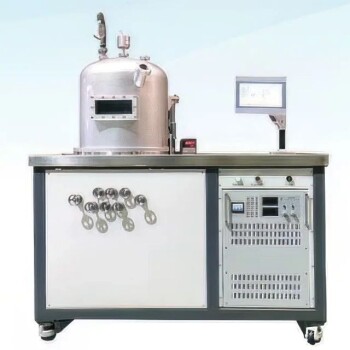
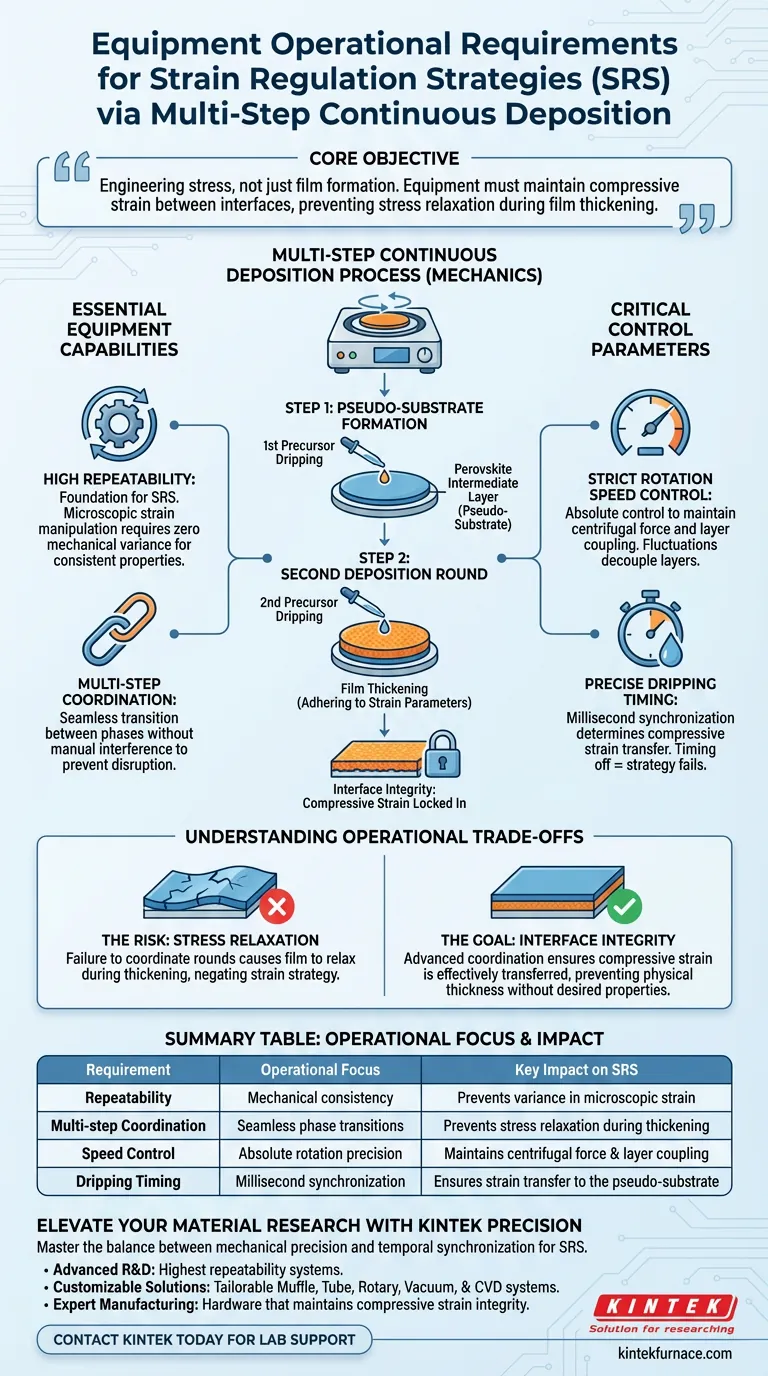
To implement strain regulation strategies (SRS) effectively, you require specialized spin coating equipment designed for high repeatability and precise multi-step coordination. The machinery must be capable of executing a continuous, two-round deposition process where precursor dripping and rotation dynamics are strictly synchronized.
The core objective is not just film formation, but the engineering of stress; the equipment must maintain compressive strain between interfaces by preventing stress relaxation during the film's thickening phase.
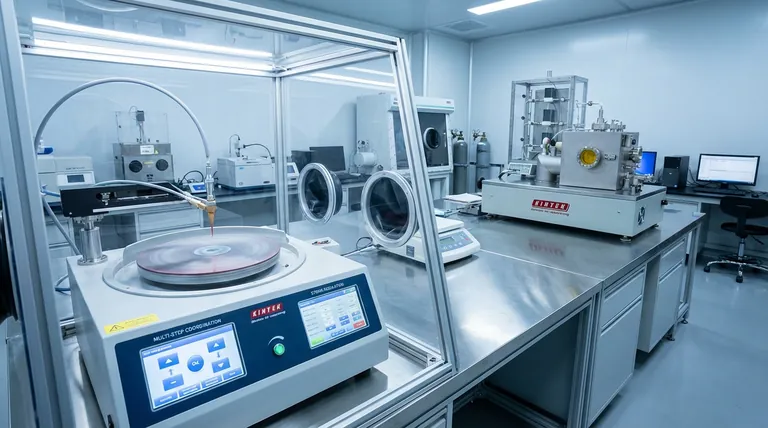
Essential Equipment Capabilities
High Repeatability
The foundational requirement for SRS is the use of spin coating equipment with high repeatability.
Because the process relies on manipulating strain at a microscopic level, any variance in mechanical operation will result in inconsistent film properties.
Multi-Step Coordination
The equipment must support multi-step coordination capabilities.
SRS is not a single-shot process; it requires the machine to seamlessly transition between different operational phases without manual interference that could disrupt the film's state.
The Mechanics of the Deposition Process
Formation of the Pseudo-Substrate
The first operational requirement is the precise execution of a first round of precursor dripping.
This step is critical as it forms the perovskite intermediate layer, which functions as a pseudo-substrate for the subsequent material.
The Second Deposition Round
Following the formation of the intermediate layer, the equipment must immediately facilitate a second round of deposition.
This layering technique is responsible for thickening the film while strictly adhering to the strain parameters established by the pseudo-substrate.
Critical Control Parameters
Strict Rotation Speed Control
The spin coater must offer absolute control over rotation speeds.
Fluctuations in speed can alter the centrifugal forces acting on the precursor, potentially decoupling the layers or inducing unwanted relaxation.
Precise Dripping Timing
Perhaps the most specific operational requirement is the strict control over dripping timing.
The exact moment the precursor hits the substrate determines how the compressive strain is transferred. If the timing is off, the strain engineering strategy fails.
Understanding the Operational Trade-offs
The Risk of Stress Relaxation
The primary pitfall in this process is stress relaxation.
If the equipment cannot maintain the specific coordination between the first and second rounds, the film will relax during thickening. This negates the benefits of the strain regulation strategy entirely.
Interface Integrity
The equipment must ensure that the compressive strain is effectively transferred between interfaces.
Standard spin coaters lacking advanced coordination features often fail to maintain this strain, resulting in a physically thick film that lacks the desired electronic or mechanical properties.
Optimizing Your Setup for SRS
To achieve the best results with Strain Regulation Strategies, evaluate your equipment against these specific goals:
- If your primary focus is Strain Retention: Prioritize equipment with programmable dripping timing to the millisecond to ensure perfect synchronization between the pseudo-substrate and the thickening layer.
- If your primary focus is Process Scalability: Focus on spin coaters with automated multi-step coordination to ensure high repeatability across large batches.
The success of SRS is defined by the hardware's ability to lock in compressive strain before the film has a chance to relax.
Summary Table:
| Requirement | Operational Focus | Key Impact on SRS |
|---|---|---|
| Repeatability | Mechanical consistency | Prevents variance in microscopic strain |
| Multi-step Coordination | Seamless phase transitions | Prevents stress relaxation during thickening |
| Speed Control | Absolute rotation precision | Maintains centrifugal force & layer coupling |
| Dripping Timing | Millisecond synchronization | Ensures strain transfer to the pseudo-substrate |
Elevate Your Material Research with KINTEK Precision
To successfully execute Strain Regulation Strategies (SRS), your lab requires equipment that masters the balance between mechanical precision and temporal synchronization. KINTEK provides industry-leading solutions designed specifically for advanced material deposition.
Our Value to You:
- Advanced R&D: Benefit from systems engineered for the highest repeatability in multi-step processes.
- Customizable Solutions: Our Muffle, Tube, Rotary, Vacuum, and CVD systems are fully tailorable to your unique strain engineering parameters.
- Expert Manufacturing: Maintain compressive strain integrity with hardware that prevents stress relaxation.
Ready to optimize your thin-film deposition and achieve superior interface integrity? Contact us today to discuss how KINTEK can support your lab's high-temperature and coating needs.
Visual Guide
References
- Pengju Shi, Rui Wang. Strain regulates the photovoltaic performance of thick-film perovskites. DOI: 10.1038/s41467-024-47019-8
This article is also based on technical information from Kintek Furnace Knowledge Base .
Related Products
- HFCVD Machine System Equipment for Drawing Die Nano Diamond Coating
- Vacuum Hot Press Furnace Machine for Lamination and Heating
People Also Ask
- What is Hot-filament Chemical Vapor Deposition (HFCVD)? Achieve High-Quality Thin Films with Precision Control
- What are the equipment for chemical vapor deposition? A Guide to the 5 Essential Components
- What is the significance of the vacuum pressure control system in the CVD coating process for powders?
- What is the function of high-purity Argon (Ar) gas during CVD? Optimize Your Thin Film Uniformity and Purity
- What are the advantages of using Chemical Vapor Deposition (CVD) for coating turbine blades? Enhance Life & Performance