
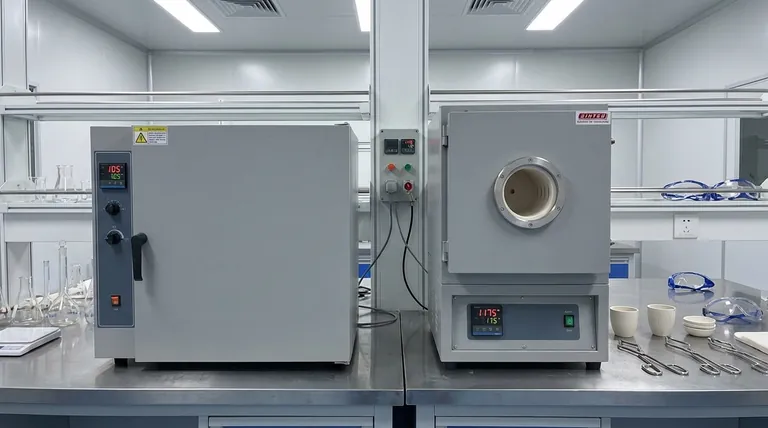
The use of a blast drying oven is strictly necessary to preserve the physical structure of chromite pellets before they are subjected to extreme heat. By pretreating the samples at 105 °C, you eliminate excess moisture that would otherwise vaporize instantly within a high-temperature furnace, causing the pellets to crack or explode.
Core Insight: The blast drying oven acts as a critical safety buffer between the raw sample and the furnace. It ensures that internal moisture is removed gently at low heat, preventing the catastrophic structural failure that occurs when trapped water turns to steam at 1175 °C.
The Physics of Pretreatment
Preventing Rapid Vaporization
When a chromite pellet containing moisture is introduced directly into a high-temperature reduction environment (up to 1175 °C), the water inside does not simply evaporate; it flashes into steam.
This phase change causes a massive volume expansion. If the water is trapped within the pellet's pores, the resulting internal pressure exceeds the material's strength.
Ensuring Structural Integrity
The primary goal of the drying phase is to maintain the structural integrity of the sample.
If the pellets crack or burst due to steam pressure, the geometry of the sample changes. This alters the surface area available for the reduction reaction, potentially skewing experimental results or damaging the furnace environment.
Operational Parameters
The 105 °C Standard
The standard operating procedure involves heating the samples at 105 °C.
This temperature is chosen specifically because it is just above the boiling point of water. It is sufficient to drive off free moisture without inducing premature chemical changes or reduction reactions that are intended for the high-temperature phase.
Duration and Thoroughness
The process requires drying for several hours.
Time is as critical as temperature. A brief exposure might dry the surface, but the core of the pellet could remain damp. "Soaking" the pellet in heat ensures that moisture is removed from the innermost layers, guaranteeing the sample is completely dry throughout.
Common Pitfalls and Trade-offs
The Risk of Incomplete Drying
The most common error is underestimating the drying time. If the sample is removed too early, residual moisture remains deep inside the pellet.
Even a small amount of trapped water can lead to thermal shock and mechanical failure once the pellet enters the high-temperature zone.
Impact on Data Accuracy
While the primary reference focuses on structural integrity, proper drying is also essential for mass balance accuracy.
As noted in broader experimental contexts, if moisture is not completely removed, the initial weight of the sample will be incorrect. This leads to errors in calculating reduction rates and mass loss during the actual high-temperature experiment.
Making the Right Choice for Your Goal
To ensure the success of your high-temperature reduction process, apply the following guidelines:
- If your primary focus is Sample Integrity: Ensure the drying cycle lasts several hours at 105 °C to completely mitigate the risk of pellets bursting or cracking.
- If your primary focus is Experimental Accuracy: Verify constant weight after drying to ensure all moisture is gone, preventing water weight from skewing your mass balance calculations.
Consistently applying this pretreatment step safeguards both your physical samples and the validity of your experimental data.
Summary Table:
| Parameter | Standard Requirement | Purpose of Step |
|---|---|---|
| Drying Temperature | 105 °C | Evaporates free moisture without premature chemical reduction |
| Drying Duration | Several Hours | Ensures core moisture removal and thermal 'soaking' |
| Primary Risk | Thermal Shock | Prevents pellets from exploding/cracking due to rapid steam expansion |
| Data Impact | Mass Balance | Ensures initial weight accuracy for precise reduction rate calculations |
Elevate Your Laboratory Precision with KINTEK
Don't let sample failure compromise your research. KINTEK provides industry-leading thermal solutions, including high-precision Blast Drying Ovens and advanced Muffle, Tube, and Vacuum systems. Backed by expert R&D and manufacturing, our systems are fully customizable to meet the rigorous demands of chromite reduction and material science.
Ready to optimize your pretreatment and high-temp processes?
Contact Our Experts Today to discover how our customizable lab furnaces can bring consistency and durability to your experiments.
Visual Guide

References
- Xiaohong Jiang, Z. H. Lei. Mechanism of Iron Powder to Enhance Solid-State Reduction of Chromite Ore. DOI: 10.3390/min15060652
This article is also based on technical information from Kintek Furnace Knowledge Base .
Related Products
- High Temperature Muffle Oven Furnace for Laboratory Debinding and Pre Sintering
- Laboratory Muffle Oven Furnace with Bottom Lifting
People Also Ask
- What thermal phenomena occur during polymer binder burnout in ceramic green bodies? Lab Furnace Guide
- What role does a high-temperature muffle furnace play in STFO synthesis? Achieve Pure Perovskite Results
- Why is controlled heat treatment in a muffle furnace necessary for calcined clay? Achieve Optimal Pozzolanic Activity
- How does a high-temperature muffle furnace facilitate the formation of LaNbxAl1−xO3+δ perovskite structures? Key Roles
- What role does a high-temperature muffle furnace play in the multi-stage synthesis of Li0.5MnFe1.5O4? Key to Pure Spinel

