
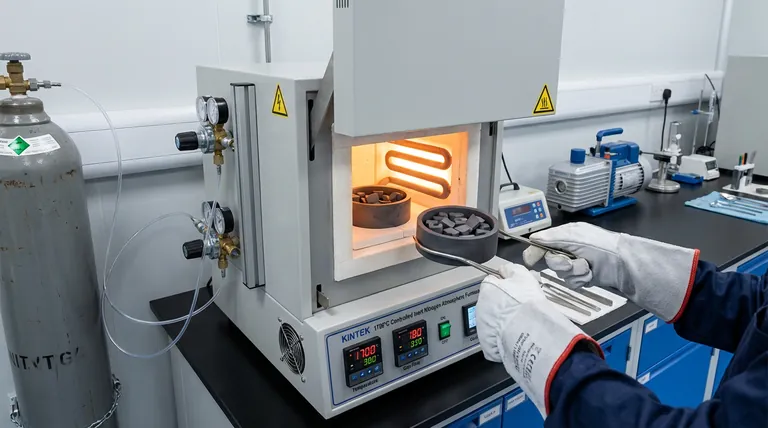
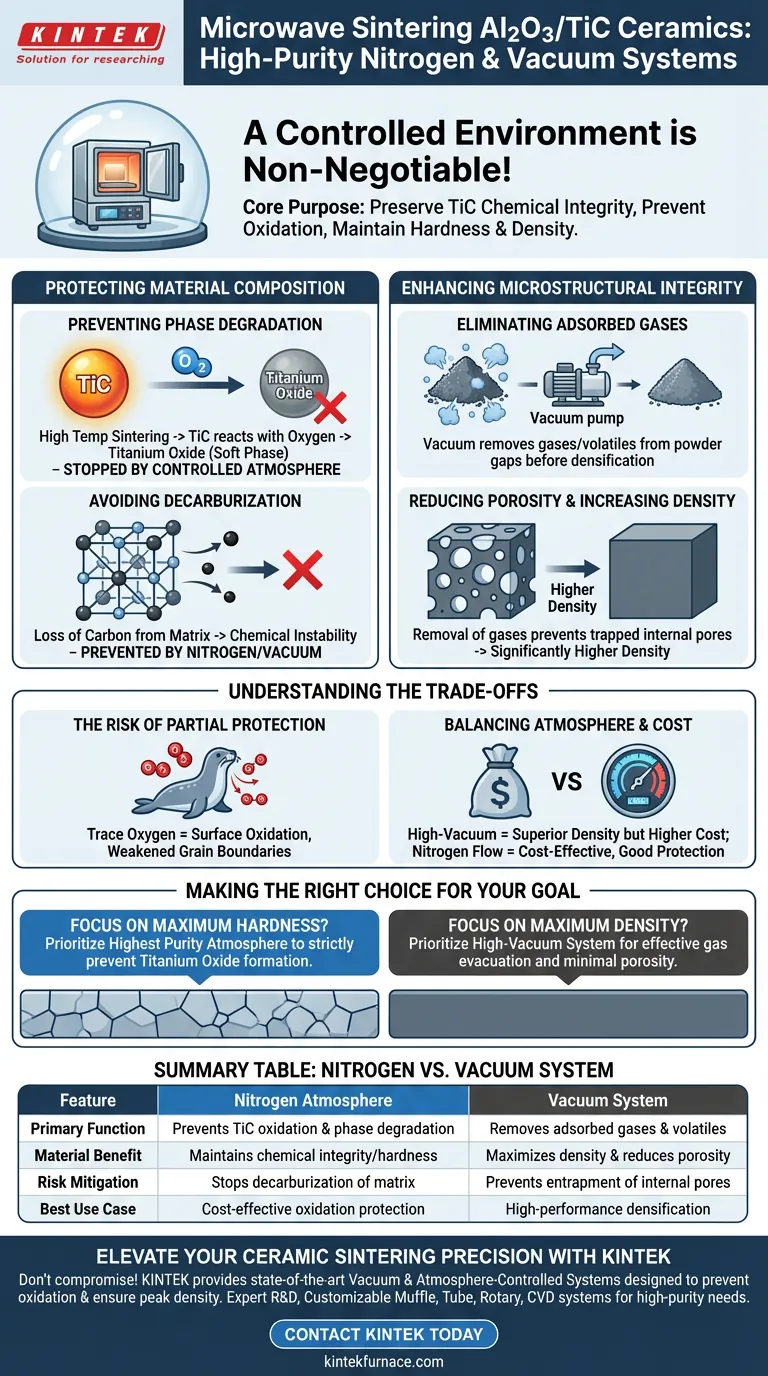
A controlled environment is non-negotiable during the microwave sintering of Al2O3/TiC ceramics because Titanium Carbide (TiC) is extremely susceptible to oxidation at high temperatures. A high-purity nitrogen atmosphere or vacuum system effectively isolates the material from oxygen, preventing the hard TiC phase from degrading into titanium oxide.
The core purpose of these systems is to preserve the chemical integrity of the TiC phase. By preventing oxidation and removing adsorbed gases, the protective atmosphere ensures the ceramic maintains the extreme hardness and high density required for industrial performance.
Protecting Material Composition
Preventing Phase Degradation
The primary danger during sintering is the chemical alteration of Titanium Carbide (TiC).
At the elevated temperatures required for sintering, TiC reacts aggressively with oxygen. Without a protective barrier, TiC oxidizes into titanium oxide.
This phase transformation is catastrophic for the material, as it destroys the specific "hard phase" that gives the ceramic its cutting ability and durability.
Avoiding Decarburization
Beyond simple oxidation, a lack of protection can lead to decarburization.
This process involves the loss of carbon atoms from the material matrix.
A vacuum or nitrogen environment prevents this loss, ensuring the chemical stability of the composite remains intact throughout the heating cycle.
Enhancing Microstructural Integrity
Eliminating Adsorbed Gases
Ceramic powders naturally hold onto gases and volatile impurities on their surfaces.
A vacuum system is particularly effective at extracting these adsorbed gases from the powder gaps before the material densifies.
Reducing Porosity and Increasing Density
If these gases are not removed, they become trapped inside the material as it hardens.
This entrapment creates internal pores, which weaken the structure.
By evacuating these impurities, the system promotes a significantly higher density and reduces the porosity of the final sintered body.
Understanding the Trade-offs
The Risk of Partial Protection
It is a common pitfall to assume that a "mostly" sealed environment is sufficient.
Even trace amounts of residual oxygen or low-purity nitrogen can lead to surface oxidation or weakened grain boundaries.
Balancing Atmosphere and Cost
While high-vacuum systems offer superior gas removal for density, they add complexity and cost compared to nitrogen flow.
However, compromising on the atmosphere quality invariably compromises the mechanical properties—specifically hardness and toughness—of the final tool.
Making the Right Choice for Your Goal
To achieve the optimal performance from your Al2O3/TiC ceramics, consider your specific performance metrics:
- If your primary focus is maximum hardness: Prioritize a system with the highest purity atmosphere to strictly prevent the formation of softer titanium oxide phases.
- If your primary focus is maximum density: Prioritize a high-vacuum system to effectively evacuate adsorbed gases and minimize internal porosity.
By rigorously controlling the sintering atmosphere, you ensure the material transitions from a loose powder to a high-performance composite without sacrificing its essential chemical properties.
Summary Table:
| Feature | Nitrogen Atmosphere | Vacuum System |
|---|---|---|
| Primary Function | Prevents TiC oxidation & phase degradation | Removes adsorbed gases & volatiles |
| Material Benefit | Maintains chemical integrity/hardness | Maximizes density & reduces porosity |
| Risk Mitigation | Stops decarburization of the matrix | Prevents entrapment of internal pores |
| Best Use Case | Cost-effective oxidation protection | High-performance densification |
Elevate Your Ceramic Sintering Precision with KINTEK
Don't compromise the integrity of your Al2O3/TiC composites. KINTEK provides state-of-the-art Vacuum and Atmosphere-Controlled Systems specifically engineered to prevent oxidation and ensure peak material density.
Backed by expert R&D and specialized manufacturing, KINTEK offers a comprehensive range of Muffle, Tube, Rotary, and CVD systems, all fully customizable to meet your unique laboratory or industrial high-temperature needs. Whether you require high-purity nitrogen flow or superior vacuum depth, our equipment guarantees the chemical stability your materials demand.
Contact KINTEK today to discuss your custom furnace solution and achieve the ultimate hardness and toughness for your advanced ceramics.
Visual Guide
References
- Samadar S. Majeed. Formulating Eco-Friendly Foamed Mortar by Incorporating Sawdust Ash as a Partial Cement Replacement. DOI: 10.3390/su16072612
This article is also based on technical information from Kintek Furnace Knowledge Base .
Related Products
- Dental Porcelain Zirconia Sintering Ceramic Vacuum Press Furnace
- Vacuum Dental Porcelain Sintering Furnace for Dental Laboratories
- Vacuum Heat Treat Sintering Furnace with Pressure for Vacuum Sintering
- Vacuum Heat Treat Sintering Furnace Molybdenum Wire Vacuum Sintering Furnace
- Small Vacuum Heat Treat and Tungsten Wire Sintering Furnace
People Also Ask
- What factors determine the quality of sintered zirconia restorations? Master Material, Equipment, and Technique
- How do conventional vs rapid sintering in dental furnaces affect zirconia? Optimize Efficiency Without Sacrificing Strength
- What is the purpose of dental sintering furnaces? Transform Zirconia into Durable, High-Quality Dental Restorations
- What precautions should be taken when sintering zirconia in the Fast Slow Dental Sintering Furnace? Master Key Steps for Perfect Results
- What temperature range is used for sintering zirconia ceramics? Achieve Optimal Strength and Translucency
















