High-purity hexagonal Boron Nitride (h-BN) targets are essential for maximizing the switching ratio by ensuring the material functions as a near-perfect electrical insulator in its initial state. By minimizing unintentional doping, these high-purity precursors drastically reduce background carrier concentration, preventing leakage current from degrading the device's performance.
The switching ratio of a memristor is defined by the contrast between its On and Off states. High-purity h-BN ensures the "Off" state (High Resistance State) remains pristine with extremely low leakage, creating a massive differential when the conductive filament forms.
The Physics of Resistivity and Switching
To understand why purity is non-negotiable, one must look at the electrical requirements of the memristor's dielectric layer.
The Role of the Dielectric Layer
In a memristor structure, h-BN acts as the insulating dielectric layer.
Its primary function is to impede electron flow completely until a specific switching event occurs.
Establishing the High Resistance State (HRS)
A high switching ratio depends entirely on the "Off" state being as electrically quiet as possible.
h-BN possesses an inherent high resistivity of approximately $10^{14}$ $\Omega \cdot cm$, making it an ideal candidate for achieving a robust High Resistance State (HRS).
Why Purity Dictates Performance
The theoretical resistivity of h-BN is only achievable if the source material—the target or precursor—is free of contaminants.
Eliminating Unintentional Doping
Low-quality targets often contain impurities that act as unintentional dopants within the crystal lattice.
Using high-purity h-BN targets eliminates these foreign elements, ensuring the deposited layer remains intrinsic.
Minimizing Initial Carrier Concentration
Impurity-driven doping increases the initial carrier concentration, allowing current to leak through the device even when it should be off.
High-purity precursors prevent this, maintaining the material's insulating integrity.
Widening the Logic Window
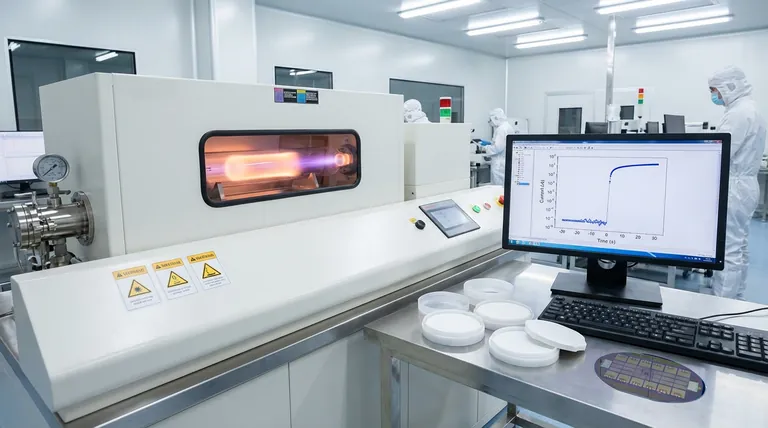
When the HRS maintains extremely low leakage current, the baseline for the device is set near zero.
Once the conductive filament forms, the resulting current step is massive, creating a wider logic window that is easy to detect.
Understanding the Sensitivity of the Process
While high purity offers significant performance benefits, it also introduces strict requirements for material selection.
The Risk of Leakage Current
Any compromise in precursor quality directly translates to increased leakage current in the High Resistance State.
This leakage reduces the "distance" between the On and Off states, effectively collapsing the switching ratio.
Signal reliability
If the switching ratio is too low due to impurities, the device may suffer from read errors.
The distinction between a logical "0" and "1" becomes blurred, compromising the reliability of the memory storage.
Making the Right Choice for Your Goal
Selecting the correct grade of h-BN is a strategic decision that impacts the fundamental operation of your memristive device.
- If your primary focus is maximizing the On/Off ratio: Prioritize precursor purity to ensure the High Resistance State reaches the theoretical resistivity limit of $10^{14}$ $\Omega \cdot cm$.
- If your primary focus is signal clarity: Use high-purity targets to minimize initial carrier concentration, ensuring a distinct and noise-free current step during switching.
Ultimately, the purity of the h-BN source material is the determining factor in achieving the distinct current steps necessary for reliable, high-performance memory devices.
Summary Table:
| Feature | High-Purity h-BN Impact | Benefit to Memristor Performance |
|---|---|---|
| Resistivity | Maintains theoretical $10^{14}$ $\Omega \cdot cm$ | Ensures a pristine High Resistance State (HRS/Off) |
| Doping Profile | Eliminates unintentional carrier doping | Prevents background leakage and power loss |
| Carrier Conc. | Minimizes initial carrier density | Widens the gap between On and Off logical states |
| Signal Clarity | Reduces electrical noise/interference | Enhances read reliability and distinct state detection |
Elevate Your Thin Film Research with KINTEK
Precision in memristor performance starts with the purity of your source materials. KINTEK provides industry-leading high-purity hexagonal Boron Nitride (h-BN) targets and precursors specifically designed for advanced semiconductor applications.
Backed by expert R&D and world-class manufacturing, we offer a full suite of deposition materials and laboratory equipment—including Muffle, Tube, Rotary, Vacuum, and CVD systems—all customizable to meet your unique experimental needs.
Ensure your devices achieve the highest switching ratios possible. Contact KINTEK today to discuss your material requirements and discover how our expertise can accelerate your innovation.
References
- Shaojie Zhang, Hao Wang. Memristors based on two-dimensional h-BN materials: synthesis, mechanism, optimization and application. DOI: 10.1038/s41699-024-00519-z
This article is also based on technical information from Kintek Furnace Knowledge Base .
Related Products
- Controlled Inert Nitrogen Hydrogen Atmosphere Furnace
- Multi Zone Laboratory Quartz Tube Furnace Tubular Furnace
- 1200℃ Controlled Inert Nitrogen Atmosphere Furnace
- Vertical Laboratory Quartz Tube Furnace Tubular Furnace
- High Pressure Laboratory Vacuum Tube Furnace
People Also Ask
- How does hydrogen furnace annealing assist in preparing mechanically alloyed powders for compaction?
- How does atmospheric annealing in a controlled hydrogen furnace affect the cold compaction behavior of metal powders?
- What are the characteristics and uses of hydrogen atmosphere in furnaces? Achieve Superior Surface Purity and Bonding
- What are the characteristics and uses of hydrogen atmospheres in furnaces? Unlock Clean Metal Processing
- What controlled-atmosphere furnace conditions are required for sintering powder metallurgy copper alloy compacts? Ideal Setup