
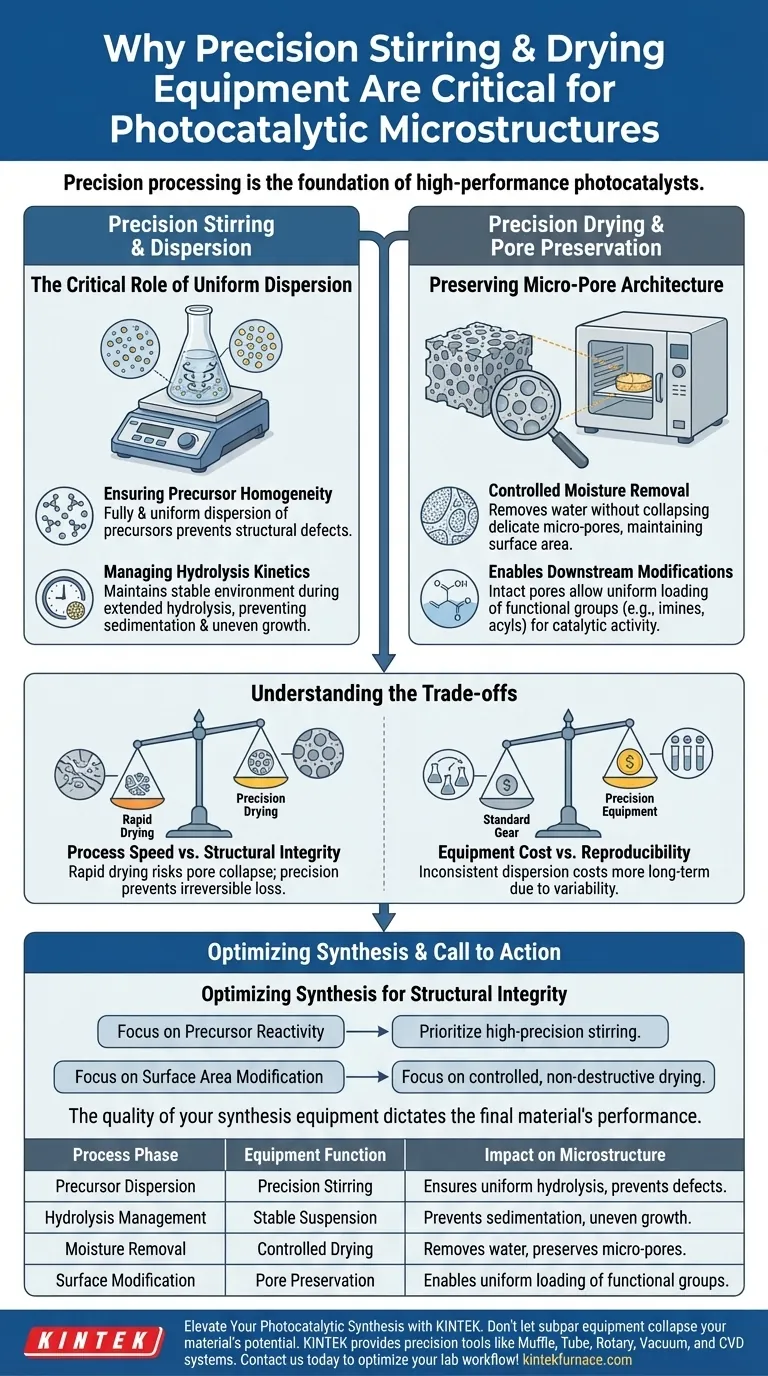
Precision processing is the foundation of high-performance photocatalysts. Precision stirring and drying equipment are not merely operational conveniences; they are critical for maintaining the material's structural integrity during synthesis. Stirring guarantees the uniform dispersion of precursors required for consistent hydrolysis, while specialized drying removes moisture without collapsing the delicate micro-pores necessary for future chemical modifications.
To regulate microstructure effectively, you must strictly control the physical environment of synthesis. Precision equipment ensures that the material's porous architecture remains intact, enabling the uniform loading of functional groups required for catalytic activity.
The Critical Role of Uniform Dispersion
Ensuring Precursor Homogeneity
The primary function of precision stirring is to ensure that precursors are fully and uniformly dispersed within the solvent system. In processes involving pure water, this dispersion is the baseline requirement for a consistent reaction. Without this uniformity, the material develops structural defects at the molecular level.
Managing Hydrolysis Kinetics
Synthesis often requires extended hydrolysis periods, where reactants must remain suspended over long durations. Precision stirring maintains a stable environment throughout this timeframe. This prevents sedimentation or concentration gradients that would otherwise lead to uneven particle growth.
Preserving Micro-Pore Architecture
Controlled Moisture Removal
Once the initial structure is formed, drying processes are employed to remove surface moisture. The challenge here is delicate: the equipment must extract water without damaging the newly formed micro-pores. Aggressive or uneven drying can cause these delicate structures to collapse, destroying the material's potential surface area.
Enabling Downstream Modifications
The preservation of micro-pores is vital for subsequent synthesis steps, such as imine condensation or acylation in ethanol systems. If the pores are intact, functional groups can be uniformly loaded onto the catalyst. If the drying process fails to preserve the pores, these functional groups cannot attach evenly, severely limiting the material's final utility.
Understanding the Trade-offs
Process Speed vs. Structural Integrity
A common pitfall is prioritizing speed over precision during the drying phase. Rapid drying often exerts capillary forces strong enough to crush the micro-pore structure. While precision drying may take longer or require more complex equipment, it prevents the irreversible loss of active surface area.
Equipment Cost vs. Reproducibility
Precision equipment represents a higher initial investment compared to standard laboratory gear. However, the cost of inconsistent dispersion is far higher in the long run. Using standard stirring methods often results in batch-to-batch variability that makes it impossible to scientifically regulate the microstructure.
Optimizing Synthesis for Structural Integrity
Achieving the correct microstructure requires balancing mechanical consistency with thermal delicacy throughout the synthesis workflow.
- If your primary focus is Precursor Reactivity: Prioritize high-precision stirring to ensure total dispersion during the hydrolysis phase.
- If your primary focus is Surface Area Modification: Focus on controlled, non-destructive drying parameters to protect micro-pores for later functional group loading.
Ultimately, the quality of your synthesis equipment dictates the accessible surface area and reactivity of your final photocatalytic material.
Summary Table:
| Process Phase | Equipment Function | Impact on Microstructure |
|---|---|---|
| Precursor Dispersion | Precision Stirring | Ensures uniform hydrolysis and prevents molecular defects. |
| Hydrolysis Management | Stable Suspension | Prevents sedimentation and uneven particle growth during long reactions. |
| Moisture Removal | Controlled Drying | Removes water without collapsing delicate micro-pore structures. |
| Surface Modification | Pore Preservation | Enables uniform loading of functional groups like imines or acyls. |
Elevate Your Photocatalytic Synthesis with KINTEK
Don't let subpar equipment collapse your material's potential. KINTEK provides the precision tools required to maintain structural integrity at the molecular level. Backed by expert R&D and manufacturing, we offer a comprehensive range of customizable solutions including Muffle, Tube, Rotary, Vacuum, and CVD systems, specifically engineered for lab high-temperature processing and delicate drying needs.
Whether you are focusing on uniform precursor dispersion or protecting fragile micro-pore architectures for downstream modification, KINTEK has the expertise to support your unique research requirements. Contact us today to optimize your lab workflow!
Visual Guide
References
- Hong Tu, Jian Wu. Unveiling the Impact of Microstructure Alterations on Photocatalytic Hydrogen Peroxide Preparation via <scp>DFT</scp> Prediction and Analysis. DOI: 10.1002/eem2.70016
This article is also based on technical information from Kintek Furnace Knowledge Base .
Related Products
- Dental Porcelain Zirconia Sintering Ceramic Vacuum Press Furnace
- High Temperature Muffle Oven Furnace for Laboratory Debinding and Pre Sintering
- Vacuum Heat Treat Sintering and Brazing Furnace
- Vacuum Dental Porcelain Sintering Furnace for Dental Laboratories
- Vacuum Hot Press Furnace Machine for Lamination and Heating
People Also Ask
- What factors determine the quality of sintered zirconia restorations? Master Material, Equipment, and Technique
- How do conventional vs rapid sintering in dental furnaces affect zirconia? Optimize Efficiency Without Sacrificing Strength
- What is the purpose of dental sintering furnaces? Transform Zirconia into Durable, High-Quality Dental Restorations
- What precautions should be taken when sintering zirconia in the Fast Slow Dental Sintering Furnace? Master Key Steps for Perfect Results
- What temperature range is used for sintering zirconia ceramics? Achieve Optimal Strength and Translucency




