
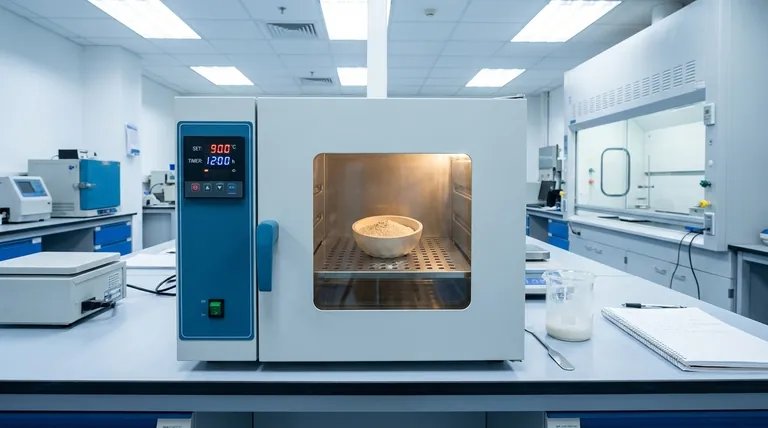
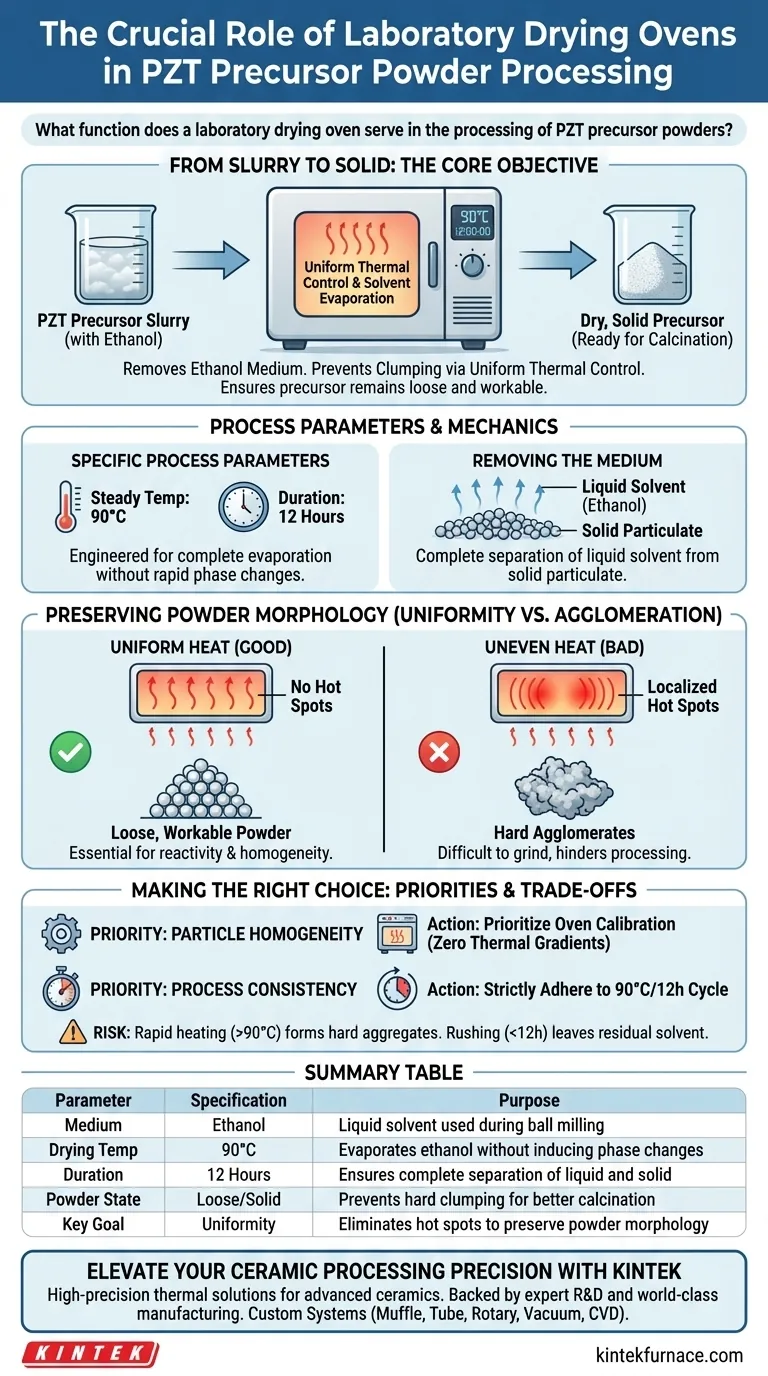
In the processing of PZT precursor powders, the laboratory drying oven serves as a critical solvent evaporation unit immediately following the ball milling stage. Its primary function is to remove the ethanol medium from the milled slurry, converting the wet mixture into a dry, solid precursor ready for calcination.
The Core Objective: The drying oven does more than simply remove moisture; it employs uniform thermal control to prevent the powder from clumping. By avoiding localized overheating, the oven ensures the precursor remains loose and workable, rather than forming hard agglomerates that would hinder subsequent processing.
The Mechanics of Solvent Evaporation
Transitioning from Slurry to Solid
After ball milling, PZT precursors exist as a wet slurry containing an ethanol medium. The drying oven is the bridge between this liquid phase and the solid phase required for calcination.
Specific Process Parameters
For PZT precursors, the standard protocol involves maintaining a steady temperature of 90 degrees Celsius. This temperature is held consistently for a duration of 12 hours.
Removing the Medium
This specific thermal profile is designed to fully evaporate the ethanol without inducing rapid phase changes in the ceramic materials. The result is a complete separation of the liquid solvent from the solid particulate.
Preserving Powder Morphology
The Role of Uniformity
The distinct advantage of a high-quality laboratory oven is its ability to maintain a uniform temperature throughout the chamber.
Preventing Agglomeration
If heat is applied unevenly, "hot spots" can cause localized overheating within the powder bed. This localized heat often causes particles to bind together, forming hard clumps or agglomerates.
Maintaining Looseness
By ensuring the heat is steady and evenly distributed, the oven maintains the necessary "looseness" of the precursor powder. A loose powder structure is essential for ensuring reactivity and homogeneity in the later high-temperature firing stages.
Understanding the Trade-offs
The Risk of Rapid Heating
While it might be tempting to increase temperatures to speed up evaporation, deviating from the 90°C standard carries significant risks. Excessive heat can lead to the formation of hard aggregates that are difficult to grind down later.
Efficiency vs. Quality
The 12-hour duration is a trade-off between throughput and quality. Rushing this process results in residual solvent or uneven drying, which can compromise the chemical composition of the final PZT ceramic.
Making the Right Choice for Your Goal
To ensure the highest quality PZT precursor, consider the following processing priorities:
- If your primary focus is Particle Homogeneity: Prioritize oven calibration to ensure there are no thermal gradients inside the chamber that could cause localized clumping.
- If your primary focus is Process Consistency: Adhere strictly to the 90°C/12-hour cycle to guarantee that every batch has the same baseline moisture content before calcination.
The drying phase is not merely about dehydration; it is a structural preservation step that defines the workability of your final ceramic powder.
Summary Table:
| Parameter | Specification | Purpose in PZT Processing |
|---|---|---|
| Medium | Ethanol | Liquid solvent used during ball milling stage |
| Drying Temp | 90°C | Evaporates ethanol without inducing phase changes |
| Duration | 12 Hours | Ensures complete separation of liquid and solid |
| Powder State | Loose/Solid | Prevents hard clumping for better calcination |
| Key Goal | Uniformity | Eliminates hot spots to preserve powder morphology |
Elevate Your Ceramic Processing Precision with KINTEK
Maintaining strict thermal uniformity is the difference between a loose, reactive precursor and unusable hard agglomerates. Backed by expert R&D and world-class manufacturing, KINTEK provides high-precision laboratory ovens and high-temperature systems—including Muffle, Tube, Rotary, Vacuum, and CVD systems—specifically designed to meet the rigorous demands of PZT and advanced ceramic production.
Our equipment is fully customizable to your unique research or industrial needs, ensuring consistent results batch after batch. Contact KINTEK today to discuss your specialized thermal processing requirements.
Visual Guide
References
- Amna Idrees, Mohsin Saleem. Transforming Waste to Innovation: Sustainable Piezoelectric Properties of Pb(Ti<sub><b>0.52</b></sub>Zr<sub><b>0.48</b></sub>)O<sub><b>3</b></sub> with Recycled β-PbO Massicot. DOI: 10.1021/acsomega.5c00071
This article is also based on technical information from Kintek Furnace Knowledge Base .
Related Products
- 1200℃ Muffle Oven Furnace for Laboratory
- 1800℃ High Temperature Muffle Oven Furnace for Laboratory
- High Temperature Muffle Oven Furnace for Laboratory Debinding and Pre Sintering
- 1400℃ Muffle Oven Furnace for Laboratory
- Laboratory Muffle Oven Furnace with Bottom Lifting
People Also Ask
- What is the primary function of a high-temperature laboratory muffle furnace in chemical synthesis? Achieve Precision.
- How does a high-temperature laboratory muffle furnace affect material properties? Transform Anodic Oxide Films Fast
- How is a laboratory muffle furnace used in 3D-printed PP-CF cross-linking? Achieve Thermal Stability at 150 °C
- What role does a muffle furnace play in plant bark mineral analysis? Essential for Precise Dry Ashing & Trace Extraction
- How is a laboratory high-temperature muffle furnace used to evaluate porous Co-Al materials? Precision Thermal Analysis












