
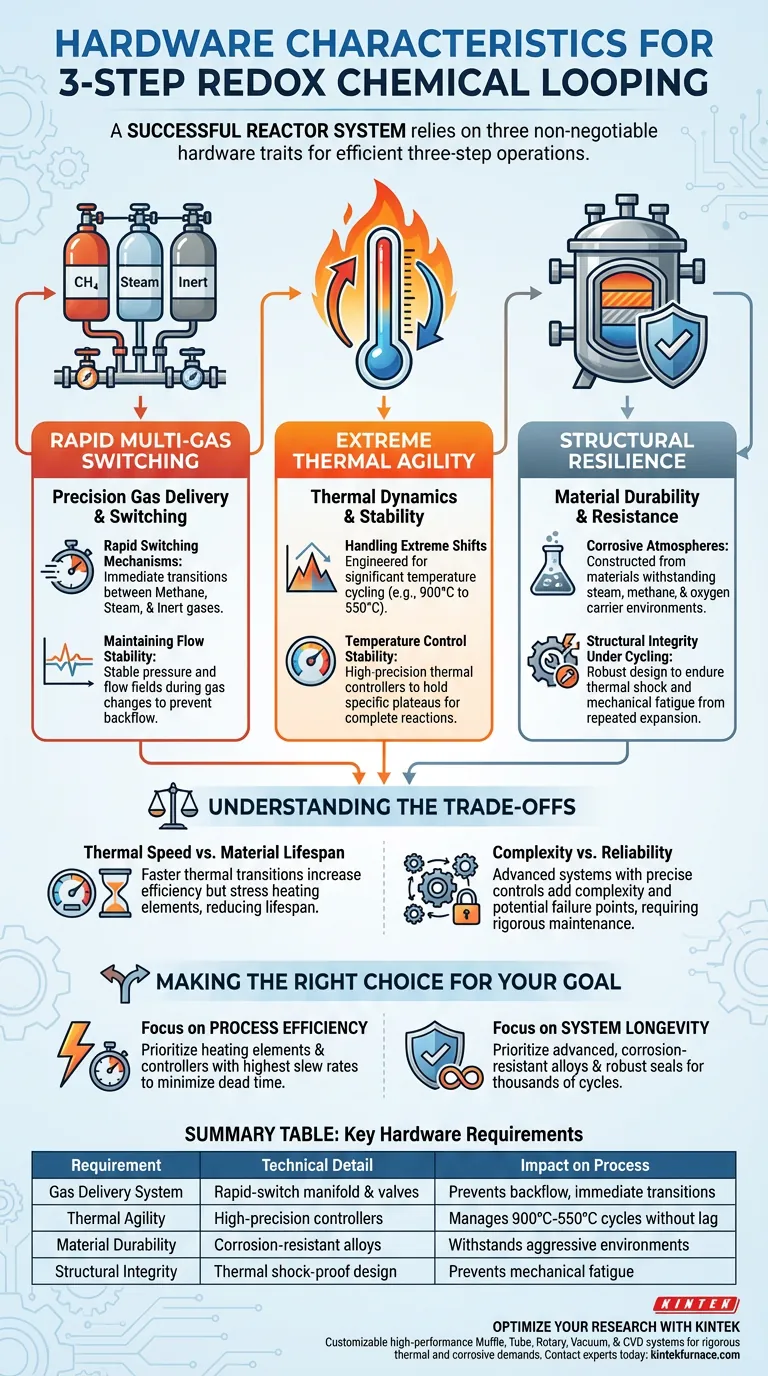
A successful reactor system for three-step redox operations relies on three non-negotiable hardware traits: rapid multi-gas switching, extreme thermal agility, and structural resilience against corrosion. The system must seamlessly transition between methane, steam, and inert gases while managing aggressive temperature shifts, such as dropping from 900 °C to 550 °C, without losing pressure stability.
The core challenge in three-step chemical looping is not just the chemistry, but the physical stress of the cycle. Success depends on hardware that can endure rapid thermal gradients and corrosive environments while maintaining strict separation of process gases through precise flow control.
Precision Gas Delivery and Switching
Rapid Switching Mechanisms
The hardware must incorporate a gas manifold and valve system capable of rapid switching between multiple distinct process gases.
Because the process involves three distinct steps—often utilizing methane, steam, and inert carrier gases—the transition between these inputs must be immediate to maintain process efficiency.
Maintaining Flow Stability
Despite the rapid changes in input gases, the reactor design must ensure stable pressure and flow fields.
Fluctuations in pressure during gas transitions can disrupt the reaction kinetics or cause backflow, making the maintenance of a steady-state flow environment critical during the switching phase.
Thermal Dynamics and Stability
Handling Extreme Temperature Shifts
The reactor hardware must be engineered to accommodate significant and frequent temperature cycling.
A typical cycle may require a shift from methane reduction at a high of 900 °C down to steam oxidation at 550 °C. The heating and cooling elements must be responsive enough to achieve these shifts efficiently without lag.
Temperature Control Stability
Beyond just reaching temperatures, the system requires excellent control stability to hold these specific thermal plateaus.
Drifting temperatures during the reduction or oxidation phases can lead to incomplete reactions or unwanted byproducts, necessitating high-precision thermal controllers and sensors.
Material Durability and Resistance
Resistance to Corrosive Atmospheres
The internal components of the reactor must be constructed from materials capable of withstanding corrosive atmospheres.
The interaction of steam, methane, and oxygen carriers at high temperatures creates an aggressive environment that can rapidly degrade standard reactor materials.
Structural Integrity Under Cycling
The hardware design must account for the physical stress of thermal shock.
Repeatedly cycling between 900 °C and 550 °C causes expansion and contraction that can lead to mechanical fatigue. The reactor vessel and seals must be robust enough to maintain integrity under this constant physical stress.
Understanding the Trade-offs
Thermal Speed vs. Material Lifespan
While rapid temperature changes are necessary for process efficiency, they place maximum stress on the hardware. Pushing for faster thermal transitions often reduces the operational lifespan of heating elements and reactor walls due to thermal fatigue.
Complexity vs. Reliability
Implementing systems for rapid gas switching and precise temperature modulation increases the mechanical complexity of the reactor. This introduces more potential points of failure, requiring a rigorous maintenance schedule to prevent leaks or sensor drift.
Making the Right Choice for Your Goal
To select or design the correct reactor system, align the hardware capabilities with your specific research or production priorities.
- If your primary focus is Process Efficiency: Prioritize heating elements and controllers with the highest slew rates to minimize dead time between the 900 °C and 550 °C setpoints.
- If your primary focus is System Longevity: Prioritize the selection of advanced, corrosion-resistant alloys and robust seals that can endure thousands of thermal cycles without degradation.
Select hardware that turns the volatility of redox cycling into a controlled, repeatable advantage.
Summary Table:
| Key Hardware Requirement | Technical Detail | Impact on Process |
|---|---|---|
| Gas Delivery System | Rapid-switch manifold & valves | Prevents backflow; ensures immediate gas transition |
| Thermal Agility | High-precision thermal controllers | Manages 900°C to 550°C cycles without stability lag |
| Material Durability | Corrosion-resistant alloys & seals | Withstands aggressive steam/methane/oxygen environments |
| Structural Integrity | Thermal shock-proof vessel design | Prevents mechanical fatigue during repeated expansion cycles |
Optimize Your Chemical Looping Research with KINTEK
Transitioning between complex redox steps requires hardware that never compromises on precision or durability. Backed by expert R&D and manufacturing, KINTEK offers high-performance Muffle, Tube, Rotary, Vacuum, and CVD systems—all fully customizable to meet the rigorous thermal and corrosive demands of your specific chemical looping applications.
Ready to build a more resilient lab? Contact our experts today to discuss your custom furnace needs.
Visual Guide
References
- Stefano Scognamiglio, Gianluca Landi. Tunable H <sub>2</sub> /Syngas Production by Chemical Looping Reforming of Methane over La <sub>0.6</sub> Sr <sub>0.4</sub> <i>M</i> <sub>x</sub> <i>M’</i> <sub>1‐x</sub> ( <i>M</i> , <i>M’</i> = Fe, Mn, Co)O <sub>3</sub> Perovskites. DOI: 10.1002/cctc.202500554
This article is also based on technical information from Kintek Furnace Knowledge Base .
Related Products
- Custom Made Versatile CVD Tube Furnace Chemical Vapor Deposition CVD Equipment Machine
- MPCVD Machine System Reactor Bell-jar Resonator for Lab and Diamond Growth
- 915MHz MPCVD Diamond Machine Microwave Plasma Chemical Vapor Deposition System Reactor
- Electric Rotary Kiln Small Rotary Furnace Biomass Pyrolysis Plant Rotating Furnace
- Slide PECVD Tube Furnace with Liquid Gasifier PECVD Machine
People Also Ask
- Why are CVD tube furnace sintering systems indispensable for 2D material research and production? Unlock Atomic-Scale Precision
- What is a CVD tube furnace and what is its primary function? Discover Precision Thin-Film Deposition
- How does CVD tube furnace sintering enhance graphene growth? Achieve Superior Crystallinity and High Electron Mobility
- Which industries and research fields benefit from CVD tube furnace sintering systems for 2D materials? Unlock Next-Gen Tech Innovations
- What temperature range do standard CVD tube furnaces operate at? Unlock Precision for Your Material Deposition











