
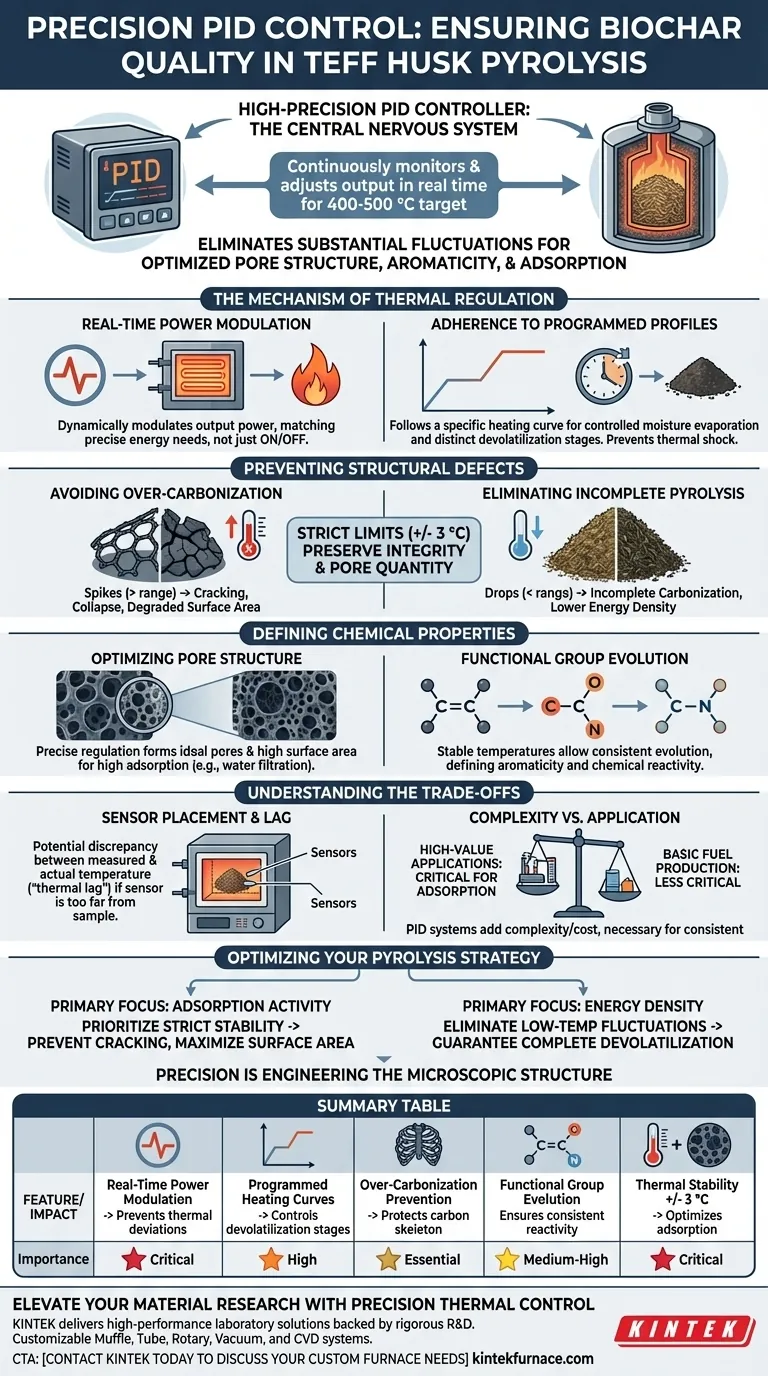
A high-precision PID temperature controller acts as the central nervous system of the pyrolysis reactor, utilizing proportional-integral-derivative algorithms to continuously monitor and adjust the heating element's output power in real time. For the pyrolysis of teff husk, this technology ensures the internal reactor temperature strictly aligns with programmed targets—typically between 400 and 500 °C—thereby preventing thermal deviations that lead to inconsistent material quality.
By eliminating substantial temperature fluctuations, high-precision control stabilizes the physical and chemical transformation of the biomass. This thermal stability is the defining factor in optimizing the biochar’s pore structure, aromaticity, and overall adsorption capacity.
The Mechanism of Thermal Regulation
Real-Time Power Modulation
The core function of the PID controller is to bridge the gap between the current reactor temperature and the desired setpoint.
It does not simply turn the heat on or off; instead, it dynamically modulates the output power of the electric heating furnace.
This ensures that the heat input matches the precise energy required to maintain the specific pyrolysis temperature of teff husk.
Adherence to Programmed Profiles
Biochar quality depends on following a specific temperature ramp, not just hitting a final number.
The controller ensures the system follows a programmed heating curve, allowing for controlled moisture evaporation and distinct stages of devolatilization.
This adherence prevents thermal shock, which can alter the mass loss characteristics of the teff husk.
Preventing Structural Defects
Avoiding Over-Carbonization
If temperatures spike beyond the programmed range, the carbon skeleton of the biomass can crack or collapse.
The primary reference notes that precision control prevents these fluctuations, protecting the structural integrity of the material.
Supplementary data indicates that maintaining temperatures within strict limits (e.g., +/- 3 °C) is vital to preventing the degradation of surface area and pore quantity.
Eliminating Incomplete Pyrolysis
Conversely, drops in temperature result in incomplete carbonization.
Without sufficient consistent heat, the volatile matter in the teff husk does not fully decompose.
This results in a product with lower energy density and unstable physical properties, rendering it less effective for industrial or agricultural use.
Defining Chemical Properties
Optimizing Pore Structure
The stability provided by the PID controller directly influences the development of the biochar's internal architecture.
Precise thermal regulation ensures the formation of an ideal pore structure and high surface area.
This is critical for applications requiring high adsorption activity, such as water filtration or soil amendment.
Functional Group Evolution
The chemical makeup of biochar changes rapidly during the devolatilization phase.
Stable temperatures allow for the consistent evolution of chemical functional groups, including C=C, C-O, and C-N bonds.
Preserving these groups determines the aromaticity and chemical reactivity of the final teff husk biochar.
Understanding the Trade-offs
Sensor Placement and Lag
While PID algorithms are highly accurate, they rely entirely on the data provided by thermal sensors.
If the sensor is placed too far from the teff husk sample (e.g., near the heating element rather than the sample core), there may be a discrepancy between the measured and actual temperature.
This "thermal lag" can lead to a false sense of precision, where the controller stabilizes the furnace air rather than the biomass itself.
Complexity vs. Application
High-precision PID systems add complexity and cost to the reactor setup.
For basic fuel production where specific pore structure is less critical, this level of precision might yield diminishing returns.
However, for high-value applications requiring specific adsorption capabilities, the trade-off in cost is necessary to ensure consistent quality.
Optimizing Your Pyrolysis Strategy
To extract the maximum value from teff husk pyrolysis, align your thermal control strategy with your end goal:
- If your primary focus is Adsorption Activity: Prioritize strict temperature stability to prevent carbon skeleton cracking and maximize surface area.
- If your primary focus is Energy Density: Ensure the controller eliminates low-temperature fluctuations to guarantee complete devolatilization of the biomass.
Precision in temperature control is not just about heating; it is about engineering the microscopic structure of the final product.
Summary Table:
| Feature | Impact on Biochar Quality | Importance Level |
|---|---|---|
| Real-Time Power Modulation | Prevents thermal deviations and ensures consistent carbonization. | Critical |
| Programmed Heating Curves | Controls devolatilization stages and prevents structural thermal shock. | High |
| Over-Carbonization Prevention | Protects the carbon skeleton and preserves surface area/pore quantity. | Essential |
| Functional Group Evolution | Ensures consistent aromaticity and chemical reactivity (C=C, C-O bonds). | Medium-High |
| Thermal Stability (+/- 3 °C) | Optimizes adsorption capacity for high-value industrial applications. | Critical |
Elevate Your Material Research with Precision Thermal Control
Achieving the perfect biochar structure requires more than just heat—it requires the absolute thermal precision that only expert engineering can provide. KINTEK delivers high-performance laboratory solutions backed by rigorous R&D and world-class manufacturing.
Whether you are processing teff husk or advanced composites, our Muffle, Tube, Rotary, Vacuum, and CVD systems are fully customizable to meet your specific temperature ramp and stability requirements. Don't let thermal fluctuations compromise your results.
Contact KINTEK today to discuss your custom furnace needs and discover how our precision technology can optimize your production quality.
Visual Guide
References
- Marcin Landrat, Semira Seyid. Assessing the Potential of Teff Husk for Biochar Production through Slow Pyrolysis: Effect of Pyrolysis Temperature on Biochar Yield. DOI: 10.3390/en17091988
This article is also based on technical information from Kintek Furnace Knowledge Base .
Related Products
- 1400℃ Muffle Oven Furnace for Laboratory
- 1700℃ Controlled Inert Nitrogen Atmosphere Furnace
- 1200℃ Controlled Inert Nitrogen Atmosphere Furnace
People Also Ask
- How does a high-temperature laboratory muffle furnace affect material properties? Transform Anodic Oxide Films Fast
- What is the primary function of a high-temperature laboratory muffle furnace in chemical synthesis? Achieve Precision.
- What is the function of a muffle furnace in MOF-derived zirconia conversion? Optimize Phase & Pore Engineering
- What role does a muffle furnace play in refractory bricks? Enhance Performance and Durability Testing
- How is a laboratory high-temperature muffle furnace used in agloporite preparation? Optimize Material Synthesis


