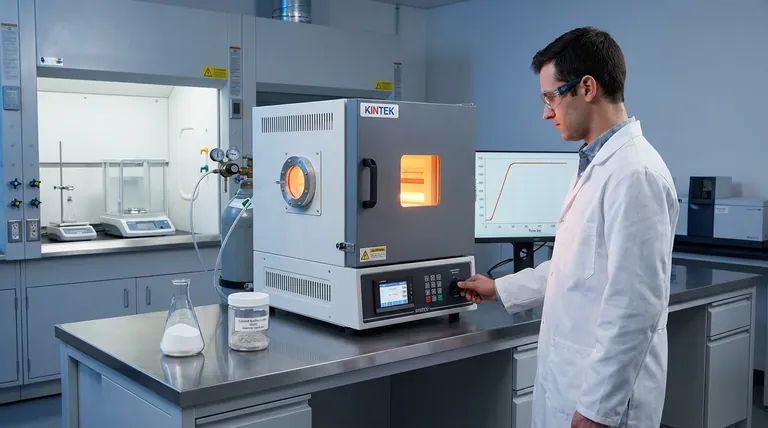
The ramp rate controlled by high-precision temperature control systems is the critical lever for optimizing Layered Double Oxide (LDO) performance. By enabling rapid heating, these systems induce intense thermal decomposition while significantly limiting the time available for grain growth. This process directly results in materials with higher specific surface areas and increased surface hydroxyl concentrations.
Rapid ramp rates prevent excessive grain growth during synthesis, leading to structural enhancements that can improve CO2 capture efficiency by approximately 69%.
The Mechanism of Rapid Heating
Limiting Grain Growth
The primary benefit of a high ramp rate is the restriction of time.
When heating is slow, crystalline grains have ample time to coalesce and grow larger.
Rapid heating effectively shortcuts this window, freezing the material in a state with smaller grain sizes.
Intense Thermal Decomposition
High-precision systems deliver a thermal shock that forces immediate decomposition.
This intensity prevents the gradual structural re-ordering that typically occurs during slower heating profiles.
The result is a more active, less settled material structure.
Impact on Material Properties
Increased Specific Surface Area
Because the grain growth is stunted, the resulting LDOs maintain a much finer microstructure.
This directly translates to a significantly higher specific surface area.
More surface area means more contact points for chemical reactions or adsorption processes.
Higher Surface Hydroxyl Concentrations
The chemical composition of the surface is also altered favorably.
The rapid decomposition process leads to a greater retention or formation of surface hydroxyl groups.
These groups are often the active sites required for catalytic or capture applications.
Performance Implications
Enhanced CO2 Capture
The combination of high surface area and hydroxyl density creates a potent material for environmental applications.
The specific interaction of these properties allows for a dramatic improvement in performance.
Data indicates that this method can boost CO2 capture efficiency by approximately 69%.
Understanding the Trade-offs
The Need for Precision Control
While rapid heating is beneficial, it requires strictly controlled equipment.
Standard heating elements often struggle to ramp quickly without "overshooting" the target temperature.
High-precision systems are non-negotiable here to ensure the rate is fast but the final temperature remains stable.
Thermal Homogeneity Risks
Rapid heating can sometimes create temperature gradients within a large sample.
If the ramp is too fast for the sample size, the outer layers may decompose before the core.
Process engineers must ensure the sample mass is appropriate for the heating rate to maintain uniformity.
Making the Right Choice for Your Goal
To leverage these insights for your material synthesis, consider your specific performance metrics:
- If your primary focus is maximizing CO2 capture efficiency: Configure your system for the fastest stable ramp rate possible to target the potential 69% performance increase.
- If your primary focus is maximizing active sites: Prioritize rapid thermal decomposition to ensure the highest density of surface hydroxyls and specific surface area.
High-precision thermal control is not just about stability; it is a tool for fundamentally altering material microstructure to unlock superior efficiency.
Summary Table:
| Property Affected | Impact of Rapid Ramp Rate | Performance Benefit |
|---|---|---|
| Grain Growth | Significantly Restricted | Smaller grain size and finer microstructure |
| Specific Surface Area | Increased | More active sites for chemical reactions |
| Hydroxyl Concentration | Higher Surface Density | Enhanced catalytic and adsorption activity |
| CO2 Capture | Optimized Decomposition | Up to 69% improvement in capture efficiency |
Unlock Superior Material Performance with KINTEK
Don't let imprecise heating limit your material's potential. KINTEK provides the high-precision thermal solutions required to master rapid ramp rates and prevent grain growth. Backed by expert R&D and world-class manufacturing, we offer Muffle, Tube, Rotary, Vacuum, and CVD systems—all fully customizable to meet the rigorous demands of LDO synthesis and CO2 capture research.
Ready to achieve a 69% boost in efficiency? Contact our technical team today to design the perfect high-temperature furnace for your unique lab needs.
References
- Daisy W. Leung, Dermot O’Hare. Optimising the acid–base ratio of Mg–Al layered double oxides to enhance CO<sub>2</sub> capture performance: the critical role of calcination conditions. DOI: 10.1039/d4dt00270a
This article is also based on technical information from Kintek Furnace Knowledge Base .
Related Products
People Also Ask
- What are the typical application temperatures for molybdenum disilicide (MoSi2) heating elements? Master High-Temp Performance
- What is the primary use of molybdenum disilicide? Ideal for High-Temp Heating Elements
- What are the characteristics of molybdenum disilicide heating elements? Unlock High-Temp Performance
- What are the properties of molybdenum disilicide (MoSi2) that make it suitable for high-temperature applications? Discover Its High-Temp Resilience
- What are the applications of molybdenum disilicide heating elements? Achieve Extreme Heat Stability for Industrial Processes