
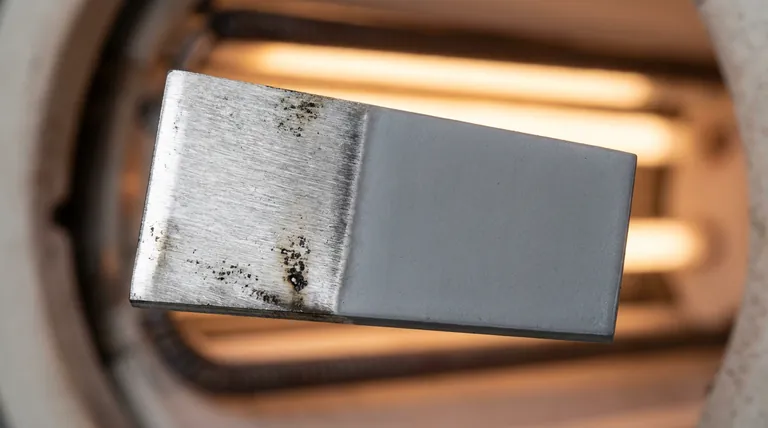
The pre-oxidation process acts as a critical surface engineering step. During the pre-treatment phase of steam cracking, this process subjects high-temperature alloys to controlled conditions to intentionally cultivate a dense, protective oxide film. This engineered layer serves as a physical shield, fundamentally altering how the alloy interacts with the reactive environment.
The primary function of pre-oxidation is to isolate catalytic metals like nickel and iron from the cracking gas. By establishing a robust oxide barrier, the process inhibits the onset of catalytic carbon deposition and prevents the material degradation known as metal dusting.
The Mechanics of Surface Protection
Generating the Oxide Shield
The core objective of pre-oxidation is not merely cleaning the surface, but chemically transforming it. Under specific, controlled conditions, the process promotes the growth of stable oxide layers.
Commonly, these layers consist of alumina or manganese-chromium spinels. These specific oxides are chosen for their stability and ability to adhere tightly to the alloy substrate.
Creating a Physical Blockade
The effectiveness of this process relies on the density of the film formed. The oxide layer functions as a hermetic seal over the base metal.
It physically blocks active radicals present in the cracking gas from penetrating the surface. This separation is the first line of defense in maintaining the integrity of the reactor coil.
Neutralizing Catalytic Activity
Identifying the Reactive Elements
High-temperature alloys typically contain metals such as nickel (Ni) and iron (Fe) to maintain structural strength at high heat. However, these specific metals are chemically active in a steam cracking environment.
If exposed, Nickel and Iron act as catalysts. They accelerate the chemical reactions that lead to coke formation (carbon deposition).
Breaking the Reaction Cycle
The pre-oxidation film effectively "hides" these catalytic metals from the process gas. By covering the nickel and iron, the oxide film removes the catalyst from the equation.
Without contact between the gas and the catalytic metals, the initial mechanism for catalytic carbon deposition is inhibited. This significantly delays the fouling of the equipment.
Critical Success Factors and Potential Pitfalls
The Importance of Film Density
For pre-oxidation to be successful, the resulting oxide film must be uniform and dense. A porous or discontinuous film will fail to provide adequate isolation.
If the barrier is permeable, active radicals will bypass the oxide layer. They will reach the substrate, rendering the pre-treatment ineffective.
Preventing Metal Dusting
Beyond simple coke formation, the most severe risk is metal dusting. This is a catastrophic form of corrosion where the metal disintegrates into dust.
By preventing carbon from diffusing into the metal matrix, the pre-oxidation layer serves as the primary defense against this destructive phenomenon.
Optimizing Alloy Performance
To maximize the longevity and efficiency of your steam cracking operations, consider the following strategic goals regarding pre-oxidation:
- If your primary focus is minimizing fouling: Prioritize conditions that ensure complete coverage of surface Nickel and Iron to halt catalytic coke formation immediately.
- If your primary focus is equipment longevity: Verify that the pre-oxidation protocol generates a sufficiently dense alumina or spinel layer to robustly prevent metal dusting.
A well-executed pre-oxidation phase is the most effective passive strategy for decoupling the alloy's structural needs from its surface chemical reactivity.
Summary Table:
| Feature | Effect of Pre-oxidation |
|---|---|
| Surface Layer | Forms a dense, protective alumina or spinel oxide film |
| Mechanism | Acts as a physical blockade against reactive cracking gases |
| Catalyst Inhibition | Isolates Nickel (Ni) and Iron (Fe) to stop carbon deposition |
| Material Integrity | Prevents catastrophic corrosion known as metal dusting |
| Strategic Benefit | Extends equipment lifespan and reduces maintenance fouling |
Maximize Your Reactor Efficiency with KINTEK Advanced Thermal Solutions
Don't let catalytic carbon deposition and metal dusting compromise your steam cracking experiments. KINTEK provides the precision thermal equipment needed to execute perfect pre-oxidation protocols.
Backed by expert R&D and world-class manufacturing, we offer a comprehensive range of Muffle, Tube, Rotary, Vacuum, and CVD systems. Whether you need standard lab high-temp furnaces or fully customizable solutions tailored to your unique material research, KINTEK ensures your alloys receive the exact surface treatment required for peak performance.
Ready to upgrade your laboratory’s high-temperature capabilities?
References
- Hamed Mohamadzadeh Shirazi, Kevin M. Van Geem. Effect of Reactor Alloy Composition on Coke Formation during Butane and Ethane Steam Cracking. DOI: 10.1021/acs.iecr.3c03180
This article is also based on technical information from Kintek Furnace Knowledge Base .
Related Products
- High Temperature Muffle Oven Furnace for Laboratory Debinding and Pre Sintering
- 1700℃ High Temperature Laboratory Tube Furnace with Alumina Tube
- 1400℃ High Temperature Laboratory Tube Furnace with Alumina Tube
- 1700℃ High Temperature Muffle Oven Furnace for Laboratory
- 2200 ℃ Tungsten Vacuum Heat Treat and Sintering Furnace
People Also Ask
- What thermal phenomena occur during polymer binder burnout in ceramic green bodies? Lab Furnace Guide
- What role does a high-temperature muffle furnace play in STFO synthesis? Achieve Pure Perovskite Results
- Why is controlled heat treatment in a muffle furnace necessary for calcined clay? Achieve Optimal Pozzolanic Activity
- How does a high-temperature muffle furnace facilitate the formation of LaNbxAl1−xO3+δ perovskite structures? Key Roles
- What role does a high-temperature muffle furnace play in the formation of biochar catalysts? Master Catalyst Synthesis



















